
Permian Entry Without Production: Circle Energy’s Path from Lease Acquisition to Well Drilling
Circle Energy holds strategic lease interests in the Permian Basin but faces capital and operational hurdles ahead of its drilling commitment.
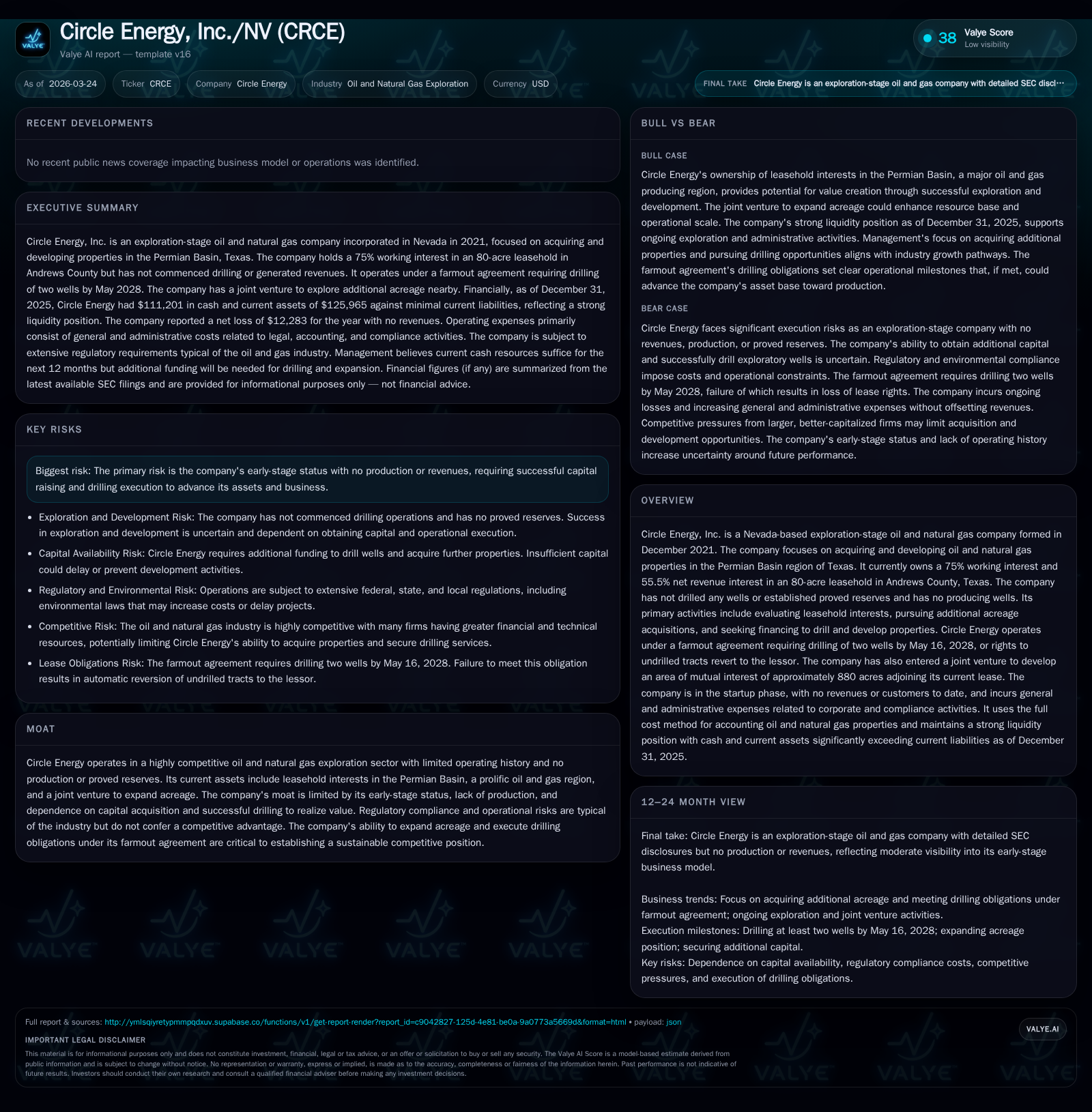
Circle Energy, an exploration-stage oil and natural gas company incorporated in 2021, currently holds a significant working interest in an 80-acre Andrews County lease in Texas but has yet to drill or produce. The company's financial results reflect a typical early-stage startup with increasing administrative costs and no revenue generation. Critical near-term milestones include meeting farmout agreement drilling obligations by mid-2028 to retain lease rights, while expanding acreage through a joint venture offers potential for scale economies. Capital acquisition remains a pivotal challenge as it prepares for well drilling amidst competitive and regulatory pressures inherent in the Permian Basin.
From Inception to Present: Circle Energy’s Early Operating History
Circle Energy, Inc., formed in December 2021 as a Nevada corporation, operates as an independent exploration-stage oil and natural gas company targeting properties primarily in the Permian Basin region of Texas [S1]. Since inception, the company has not drilled any wells nor established proved reserves and currently lacks production or revenues [F1][S1]. Over four fiscal years ending December 31, 2025, operating income and net income have remained negative albeit with modest fluctuations: operating losses slightly improved from approximately -$16,345 in FY2023 to -$12,283 in FY2025 [F1]. General and administrative expenses rose from $63,936 in FY2024 to $73,663 in FY2025 due mainly to increased legal costs associated with evaluating acquisition targets [S1][S16]. Despite growing expenditures typical of a pre-revenue public company poised for exploration expansion, net loss growth has been contained.
Leasehold Acquisition Strategy Centered on Andrews County, Texas
Circle Energy holds a commanding 75% working interest with corresponding net revenue interest of about 55.5% on its initial lease covering approximately 80 acres in Andrews County, Texas—a prolific segment of the Permian Basin known for stacked pay zones amenable to both vertical and horizontal drilling [S1][S26]. This core lease was acquired via farmout agreements initially with Aspen Energy Partners but later assigned to Boa Vista LLC [S1][S26]. The company also entered into a joint venture arrangement covering an area of mutual interest totaling roughly 880 acres contiguous or adjoining the original leasehold [S1][S26]. This strategic focus allows Circle Energy to pursue acreage scalability critical for optimizing drilling architecture decisions and improving development economics. However, under current terms, failure to drill two wells on designated tracts by May 16, 2028 triggers automatic reversion of those undrilled tracts back to the lessor—imposing an inflexible timeline constraint on asset tenure [S1][S4].
Financial Snapshot: Stability Amid Pre-Revenue Exploration Stage
As Circle Energy remains pre-production without revenue inflows, its financial posture is characterized by controlled burn against limited cash resources. At year-end FY2025, cash and cash equivalents stood at approximately $111,201 down from about $192,024 at end-FY2024; correspondingly, working capital remained robust at approximately $125,263 versus current liabilities near $702—yielding an exceptionally high current ratio (approx. 179) that signifies strong short-term liquidity albeit at a modest overall scale [F1][S3]. Operating cash flow outflows around $75,823 in FY2025 slightly increased versus prior periods reflecting incremental spending on G&A and lease acquisitions; capital expenditures remain minimal ($5,000) focused mainly on leasehold costs rather than drilling activity which has yet to commence [F1][S3][S16]. This financial discipline underscores the cautious progression typical among junior E&P firms awaiting capital infusion for more material investment phases.
Fulfilling Farmout Drilling Obligations Ahead of May 2028 Deadline
The farmout agreement mandates drilling two wells—one on each forty-acre tract composing the total eighty-acre lease—before May 16, 2028 [S1][S4]. This contractual requirement effectively defines Circle Energy's principal operational milestone needed to retain control over its acreage position. Management indicates that drilling plans will be influenced significantly by successful expansion efforts: increased contiguous acreage could enable adoption of more cost-efficient horizontal well designs exploiting Permian horizontal plays; absent such expansions, mandated development would proceed with vertical wells estimated at approximately $750,000 each inclusive of drilling and completion costs [S4][S7][S14]. Securing third-party funding commitments appears central since management continues conversations with prospective industry partners willing to participate financially for shared working interests although no binding agreements are yet executed [S4][S7]. Delays or failure to initiate these wells carries substantial risk as failing contract terms would result in partial loss of mineral rights.
Growth Prospects Through Acreage Expansion and Joint Venture Development
Circle Energy’s growth strategy hinges primarily on enlarging its footprint beyond the initial eighty acres by leveraging the joint venture covering approximately 880 adjoining acres [S1][S26]. Success here could improve production scale economics through contiguous land blocks, thereby enhancing project's attractiveness for horizontal multi-lateral drilling often employed across productive Permian strata such as Wolfcamp or Spraberry formations (industry insight). The company actively evaluates additional prospective acquisitions consistent with its focus on Permian assets indicating a tactical approach aimed at portfolio buildout before committing heavily to costly capital-intensive well development [S1][S2]. Strategic alliances via joint ventures also mitigate risk exposure by sharing technical expertise and funding burdens.
Capital Structure, Funding Challenges, and Liquidity Analysis
Circle Energy’s operating funds have been derived largely from founder equity injections ($240,000 by Mr. Rochford) alongside subsequent private placements raising gross proceeds near $264,000 early post-incorporation [S4][S7]. Cash reserves have been strategically deployed towards OTC market listing maintenance costs, legal support for acquisition endeavors, and initial leasehold payments while deferring large-scale capex pending further financing availability [F1][S3]. Management openly acknowledges that despite sufficient near-term liquidity for ongoing corporate needs within twelve months from FYQ3-2025 period end ($144k cash), extensive drilling operations require additional capital raises or joint venture funding arrangements—hallmarks of typical junior explorer finance risk profiles [S4][S7]. Reliance on external funding amidst volatile oil prices and competitive capital markets adds layers of execution uncertainty.
Risks From Regulatory, Market, and Operational Perspectives
Operating within the heavily regulated oil & gas extraction sector involves multifaceted risk vectors for Circle Energy. Federal laws such as CERCLA, RCRA, Clean Air Act among others impose compliance costs that rise with planned operational expansion including emissions controls and waste disposal practices commonly faced during well site development [S5][S8][S24]. As a nascent entity without production revenues, management bears disproportionate exposure to these regulatory burdens which lack offsetting cash flows at this stage [F1]. Commodity price volatility impacts project economics directly while inflationary pressures increase input costs especially labor and equipment hire crucial during rig mobilization phases [S1][S24]. Competitive disadvantages stem from limited scale compared with industry incumbents possessing superior technical capabilities and capital reserves hampering rapid property acquisition or securing favorable service contracts needed before positive reserve establishment [S26]. The looming farmout-related reversion clauses amplify operational pressure requiring timely execution despite these constraints.
Key Metrics and Historical Financial Performance Overview
Historical performance (annual)
| FY | Rev | Net ($) | CFO ($) | OpInc ($) | Net YoY |
|---|---|---|---|---|---|
| 2025 | 0 | -12283 | -75823 | -12283 | +2.2% |
| 2024 | 0 | -12565 | -69314 | -12565 | +23.1% |
| 2023 | 0 | -16345 | -74903 | -16345 | -10.5% |
| 2022 | 0 | -14788 | -73672 | -14788 |
Source: SEC companyfacts cache [F1].
Capital returns and efficiency (annual)
| FY | ROE% |
|---|---|
| 2025 | -7.5 |
| 2024 | -5.3 |
| 2023 | -5.4 |
| 2022 | -3.9 |
Source: SEC companyfacts cache [F1].
The table illustrates zero revenues throughout reflecting pre-production status paired with consistent net losses driven mostly by administrative overheads associated with corporate formation activity plus incremental land evaluations [F1][S16]. An approximate return on equity stands near negative 7.5% in FY25 highlighting absence of earnings power presently but consistent loss mitigation since peak losses recorded in FY23 [F1]. Investment outlays are minor so far concentrated on acquisition-related intangible property assets rather than physical drilling equipment or well completions.
Milestones to Watch: Drilling Execution and Resource Confirmation
The overriding milestone guiding Circle Energy’s trajectory will be fulfillment of its farmout agreement’s dual-well drilling commitment ahead of the May 16, 2028 deadline ensuring retention of all existing leased tracts; missing this deadline means forfeiting rights over undrilled land parcels which would significantly impair business continuity prospects [S1][S4]. Parallelly important will be progress made within its joint venture acreage targeting efforts aimed at augmenting holdings near Andrews County facilitating potentially horizontal well deployment—an industry best practice enhancing per-well hydrocarbon recovery efficiency and improving capex returns.
Capital formation remains critical as initiation of drilling campaigns requires substantial upfront funds estimated near $750k per well plus ancillary development costs potentially shared among partner operators or via equity offerings contingent upon market conditions and investor appetite [S4][S7]. Monitoring regulatory filings related to operator designation by Texas Railroad Commission will also provide transparency into operational readiness [S15]. Lastly trough commodity price trends informing project viability amid escalating labor/drilling service rates must be observed closely given their influence on potential reserve booking thresholds post-drill.
This analysis summarizes Circle Energy’s position as an emerging player striving to translate promising Permian Basin acreage rights into producing assets under contractual time constraints while navigating startup financial realities common within exploration-focused junior companies. No assurances can be made regarding future outcomes given prevailing uncertainties around financing availability and operational execution risks inherent at this phase.
This report is intended solely for informational purposes based on available regulatory filings as of March 24th, 2026. It does not constitute investment advice or recommendations.
Disclaimer: This is research-only, informational analysis and not investment advice. It may include AI-generated interpretation and general industry context. Always verify important details using primary sources.

Comments