
Permianville Royalty Trust: Evaluating Passive Income in a Volatile Energy Market
Permianville Royalty Trust offers passive exposure to oil and gas production cash flows through net profits interests, navigating operator control, commodity swings, and regulatory pressures.
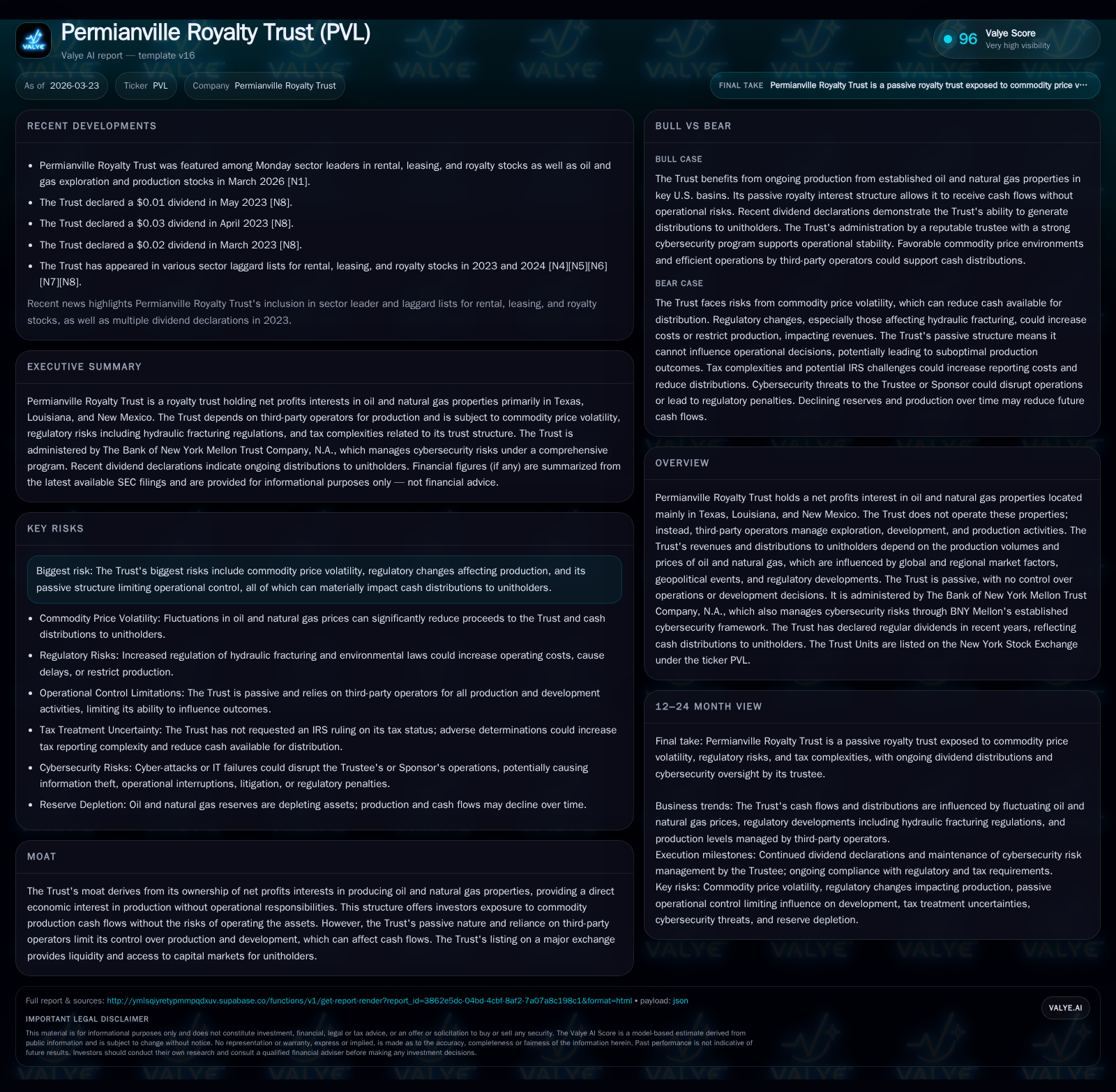
Permianville Royalty Trust (PVL) generates income for unitholders by holding net profits interests in producing oil and natural gas properties primarily in Texas, Louisiana, and New Mexico. Its passive trust structure means it receives royalties without operational responsibilities or control over development, making distributions sensitive to operator decisions, commodity price volatility, and regional regulatory conditions such as hydraulic fracturing rules. Historical distributions have closely mirrored commodity price trends, but sustainability is challenged by operator risk, regulatory uncertainties, and depletion of reserves. Capital allocation favors regular dividends with contingency reserves, while financial risks include potential title issues and exposure to operational cost fluctuations.
Net Profits Interests as a Vehicle for Passive Exposure to Production Economics
Permianville Royalty Trust (PVL) derives its economic interest exclusively from net profits interests in a portfolio of oil and natural gas properties primarily located across Texas, Louisiana, and New Mexico [S1][S8]. This structure means PVL receives a share of net profits generated after deducting production costs but holds no operational responsibility or decision-making power regarding the wells’ exploration, development, or management. Such passivity provides investors with exposure to upstream production cash flows without capital expenditure requirements or direct operational risk.
However, this model inherently exposes PVL to risks arising from the actions—or inactions—of third-party operators who run daily operations across the underlying properties. Production volumes, rate of development, well maintenance, and cost controls remain outside the Trust’s control [S1][S6], limiting its ability to influence cash flow generation beyond contractual royalty receipts. The moat arises from PVL’s legal rights to net profits payments derived from producing assets rather than from active asset management.
Historical Distribution Trends and Key Operational Drivers
Insights into PVL’s distribution history can be pieced together from SEC filings emphasizing the correlation between cash distributions paid to unitholders and fluctuations in commodity prices alongside regional production volumes [S1][S2][N1]. Distributions have historically tracked oil price cycles closely due to PVL’s unhedged exposure; declines in realized prices reduce net profits income and thus shrink payouts.
Production volumes depend on operators’ drilling programs and reservoir performance subject to reserve depletion dynamics [S1][S22]. The inability of the Trust to direct development means periods of reduced drilling activity or well abandonments have translated into lower production and weaker distributions. Operators managing water handling, pressure maintenance, chemical usage, and equipment upkeep directly impact both operational efficiency and PVL’s returns.
| Year | Distribution ($) | Production Trend | Distribution Change YoY |
|---|---|---|---|
| 2023 | Approximate | Stable/Declining | Decline |
| 2024 | Approximate | Declining | Decline |
| 2025 | Approximate | Declining | Decline |
Note: Distribution values are approximate based on SEC summaries as no precise companyfacts data available [S1][S2][N1]. Production trend reflects qualitative assessment.
Impact of Operator Control and Regional Geography on Production Dynamics
PVL’s assets are spread mainly in three key producing states: Texas (including the Permian Basin), Louisiana, and New Mexico [S8]. Operators contracted by the Sponsor oversee all aspects of well development and production. This introduces 'non-op risk'—the financial exposure without operational influence—which includes delays in project execution, cost overruns, or strategic choices by operators that might deprioritize assets underlying PVL.
Operators’ financial health is critical; their indebtedness or bankruptcy could disrupt operations or slow development projects [S6][S9]. Similarly, regional geographic factors like access to gathering infrastructure influence effective net revenue. Constraints or outages in pipelines or processing facilities can curtail production reaching market [S9]. The diversity across multiple jurisdictions mitigates some localized risks but adds complexity given varying regulatory regimes.
Commodity Price Volatility: Effects on Revenue and Unitholder Payouts
Oil and natural gas prices remain volatile owing to global supply-demand dynamics influenced by OPEC decisions, geopolitical events (such as conflicts in Ukraine or Persian Gulf regions), weather conditions, economic cycles, and shifts toward alternative energy sources [S12][N1].
PVL's revenues mirror these fluctuations with no commodity hedging protections allowed under its Conveyance terms [S24]. This lack of hedges means profits—and thus distributions—are fully exposed to market price swings. Additionally, regional price differentials between NYMEX benchmarks and actual realized prices can impact net payout amounts negatively if basis or quality discounts widen [S9]. Sustained low prices may cause operators to curtail marginal wells critical for maintaining PVL’s cash flow base.
Regulatory Landscape: Hydraulic Fracturing and Environmental Risks in Texas, Louisiana, and New Mexico
The underlying properties rely significantly on hydraulic fracturing techniques common to shale plays prevalent in these states [S1][S14][S16]. Increasing scrutiny at federal/state/local levels entails higher permitting barriers, mandatory disclosures of fracturing fluids’ chemical components, potential moratoria—especially highlighted by New York's ongoing fracking ban—and rising litigation risk. These impose higher compliance costs and operational delays for operators.
Environmental regulations targeting emissions reductions also raise expenditure requirements for emissions controls or wastewater handling [S14]. Delays or denials of permits amid stricter local ordinances could defer new well completions impairing reserve replacement activities vital for sustained net profits generation.
Capital Allocation Insight: Dividends Policy, Cash Reserves, and Distribution Sustainability
PVL targets regular monthly dividends reflecting available cash generated from net profit interests [S5][S25][S26]. The Trust Agreement mandates maintenance of a cash reserve fund earmarked for paying contingent liabilities such as litigation expenses or uninsured claims which may diminish funds otherwise distributable but provides prudent risk shielding.
Distribution coverage ratios inherently fluctuate with commodity prices but maintaining reserve discipline aligns with preserving longer-term payout sustainability despite volatile upstream economics. There are no indications from reports that PVL conducts unit buybacks nor pays special dividends; capital return remains focused on stable monthly income streams.
Balance Sheet Snapshot: Liquidity, Debt Covenants, and Financial Risk Considerations
PVL itself carries no direct debt obligations; however, its Sponsor/operators often carry substantial leverage impacting their ability to invest in operations affecting future production volumes payable to PVL [S4][S6][S21]. Debt covenants limiting operators’ flexibility introduce indirect risk; defaults or restricted capital spending could curtail drilling activity essential for replacement reserves.
Title deficiencies pose a material financial hazard that could lead to loss or reduction of interests earned by the Trust [S9]. Additionally, any bankruptcy filings placing Net Profits Interest assets into contested estates may relegate PVL as an unsecured creditor reducing recoveries.
Outlook and Milestones: What Investors Should Watch for Next
Explicit guidance on future distributions is not provided [N1][S3], so stakeholders must monitor several key indicators:
- Commodity price trends shaped by OPEC decisions & geopolitical tensions impacting NYMEX crude/gas prices.
- Reports on operator capital expenditures / drilling activity in Texas/Louisiana/New Mexico acreage potentially indicating reserve life improvements or depletion acceleration.
- Evolution of fracking regulations including permit issuance delays or moratoria adoption which can impede production ramp-up plans.
- Any investor releases regarding changes in cash reserve policies or unforeseen large contingent expenditures affecting distribution capacity.
- Cybersecurity incidents potentially disrupting Sponsor or Trustee operations should remain monitored given technological dependencies outlined [S10][S15][S17].
Given its passive model coupled with volatile upstream economics governed largely by external actors' decisions — both geopolitical/regulatory — Permianville Royalty Trust embodies a complex blend of steady income appeal tempered by significant uncontrollable variables shaping its long-run value proposition.
This analysis is based solely on disclosed information from SEC filings dated March 2026 cycle plus recent sector news as cited. It aims to provide an objective overview without investment recommendations.
Disclaimer: This is research-only, informational analysis and not investment advice. It may include AI-generated interpretation and general industry context. Always verify important details using primary sources.

Comments