
Planet Labs PBC’s Strategic Expansion and Persistent Losses Amid Competitive Satellite Imagery Market
Strong revenue growth and improved operating cash flow contrast with ongoing net losses and operational challenges.
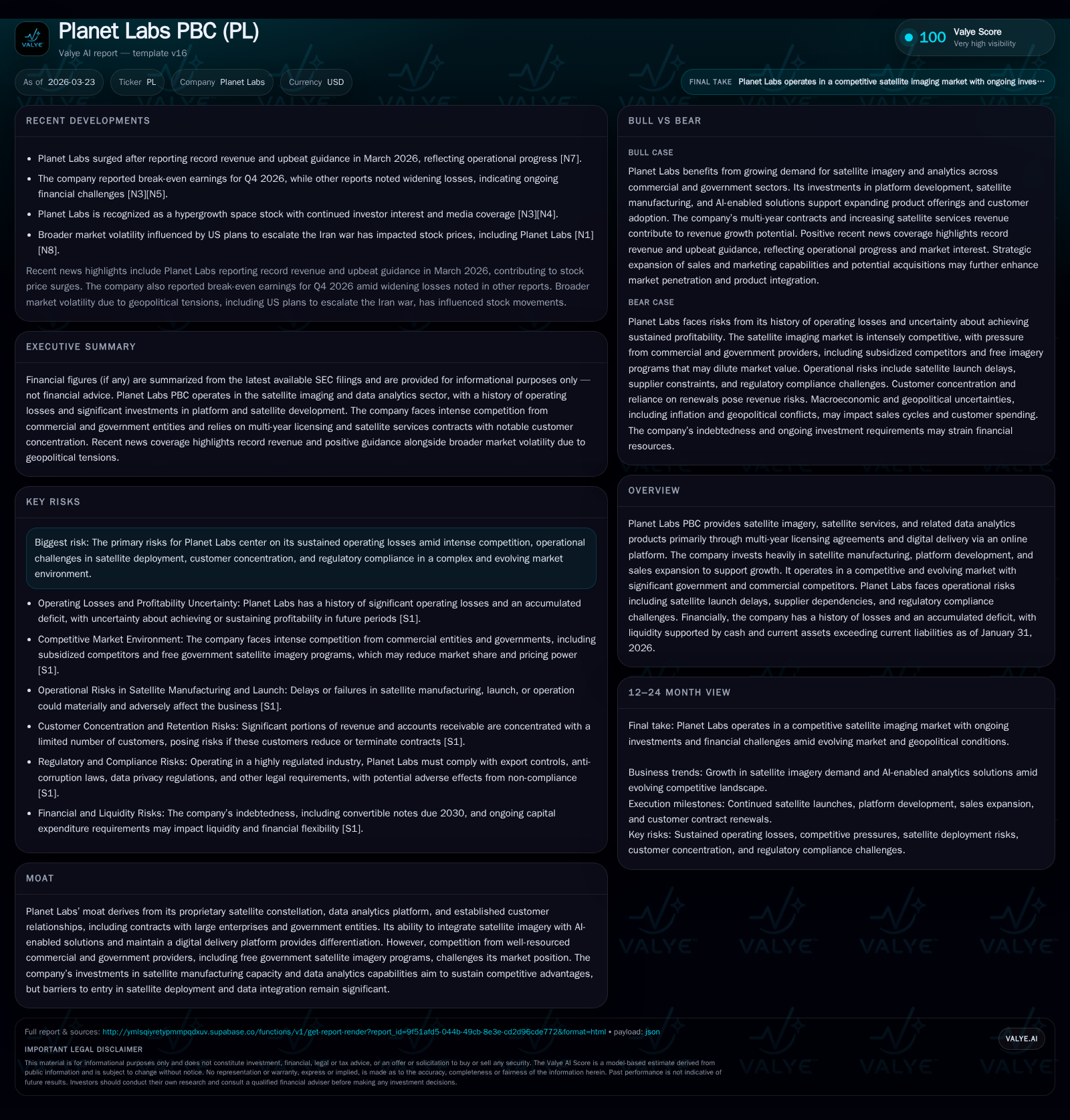
Planet Labs PBC operates a proprietary satellite constellation delivering imagery and data analytics primarily via multi-year licenses. The company has demonstrated top-line growth accompanied by a marked improvement in operating cash flow in fiscal 2026, supported by expanded contracts with large commercial and government customers. However, it continues to report significant net losses driven by high operating expenses and investments in manufacturing and platform development. Risks include customer concentration, intense competition from both well-funded commercial players and free government programs, as well as satellite deployment and regulatory complexities. Capital allocation reflects investment-heavy strategies balanced by positive free cash flow generation for the first time in recent years.
Historical Performance
Planet Labs PBC has exhibited a pattern of accelerating top-line growth alongside sustained operating losses reflective of its capital-intensive business model centered on satellite manufacturing, launch operations, and platform development. According to the latest SEC filings covering fiscal year ended January 31, 2026, the company improved its operating income loss to -$95.1 million from -$116.1 million the previous year, marking an 18.1% improvement while still remaining unprofitable at the operating level [F1]. Despite these improved operating results, net income declined substantially to -$246.9 million from -$123.2 million a year earlier — a decrease of over 100%, indicating significant non-operating expenses or one-time charges impacting the bottom line [F1].
The company notably turned around its operating cash flows sharply from negative $14.4 million to a positive $134.4 million in FY2026, underscoring operational efficiency gains or working capital improvements that partially offset reported accounting losses [F1]. This change is especially meaningful given Planet Labs’ prior consistent negative cash flows reflecting heavy upfront capital investments.
Capital expenditures more than doubled year-over-year to $76.7 million as Planet Labs aggressively ramped its satellite manufacturing capacity and ground infrastructure investments necessary for fleet expansion and service enhancement [F1]. Equity declined significantly during this period—from $441.3 million to $188.4 million—likely reflecting accumulated losses and possibly share buybacks or other equity transactions [F1].
Historical performance (annual)
| FY | Net ($mm) | CFO ($mm) | OpInc ($mm) | Capex ($mm) | Net YoY |
|---|---|---|---|---|---|
| 2026 | -247 | 134 | -95 | 77 | -100.4% |
| 2025 | -123 | -14 | -116 | 44 | +12.3% |
| 2024 | -141 | -51 | -170 | 38 | +13.2% |
| 2023 | -162 | -74 | -176 | 10 |
Source: SEC companyfacts cache [F1].
Capital returns and efficiency (annual)
| FY | FCF ($mm) | ROE% |
|---|---|---|
| 2026 | 58 | -131.0 |
| 2025 | -59 | -27.9 |
| 2024 | -89 | -27.1 |
| 2023 | -84 | -28.1 |
Source: SEC companyfacts cache [F1].
Figures presented are rounded to nearest hundred thousand USD per SEC filings [F1].
Business Overview & Competitive Moat
Planet Labs provides high-resolution Earth observation through a proprietary constellation of small satellites with data products delivered digitally via its cloud-based platform under mostly multi-year licensing agreements with major enterprises and governments globally [S1,N2]. Its moat is established through control of its satellite fleet coupled with advanced AI-integrated analytics capabilities that set it apart from commoditized imagery providers.
Despite these strengths, industry headwinds arise from formidable government players offering free or heavily subsidized data such as the U.S.-based Landsat/MODIS systems and Europe’s Copernicus program with Sentinel satellites—placing pricing pressure on Planet's offerings [S19]. Commercial competition is intensifying with large-scale entrants like SpaceX leveraging vertically integrated launch capacity that could enable more affordable satellite deployments threatening Planet’s market share and pricing structure [S21]. Moreover, supplier limitations for critical satellite components constrain manufacturing scale-up pacing [S11,S12]. These factors collectively dampen pricing power and impose ongoing pressure on gross margins.
Planet’s customer base remains concentrated: two customers accounted for approximately 25% of revenue in FY2026 while one represented a third of accounts receivable —a concentration risk exposing revenues to potential volatility from contract renewals or expansions with these few key clients [S5,F1]. Seasonality tied to agricultural cycles, natural disaster monitoring demand spikes, and commodity price fluctuations also impacts usage variability across periods [S4,S5].
Future Growth Prospects
Growth drivers center on expanding sales penetration among large enterprises and governmental agencies worldwide through upselling enhanced analytical features like Planet Monitoring, Planet Tasking services, archived data access via APIs, and emerging AI-powered feeds designed to unlock novel use cases beyond simple image delivery [S15,S17]. Cross-selling these bundled offerings remains pivotal although success depends on perceived value additions convincing customers to commit incremental spend beyond baseline image subscriptions.
International market expansion carries execution risks including navigating geopolitically sensitive export controls, regulatory compliance regimes across multiple jurisdictions, especially Europe where increased operation costs from sanctions regimes or tariffs have been flagged by management as concerns impacting margins or sales cycles [S6,S9,S17]. Moreover, political instability or macroeconomic slowdowns could delay decision-making among prospective clients or compression of discretionary spending budgets could temper contract sizes or deferments.
Operationally, Planet must continue overcoming inherent technological risks—successful satellite launches on schedule requiring reliable supplier chains are mission critical as delays erode customer trust and increase costs significantly [S1,S7,S12]. Ongoing R&D investment aims at providing constant platform innovation but entails risk that product enhancements fail market acceptance or introduce unforeseen defects leading to potential customer attrition [S10,S17].
Competitive landscape intensifies with new entrants lowering barriers enabled by reusable launch technologies reducing cost-to-orbit potentially commoditizing Earth Observation data further—a structural challenge necessitating continual differentiation either through AI-enabled analytics superiority or breadth/depth of niche vertical applications coverage [S19,S21].
Forecasts & Milestones to Monitor
Planet Labs’ most recent earnings highlighted record annual revenue growth accompanied by break-even operating earnings on a quarterly basis indicating trajectory improvement but no explicit forward financial guidance was publicly provided beyond commentary on pipeline strength suggesting cautious optimism contingent on contract renewals/expansions and new product adoption rates [N2,N3,N9]. Investors should monitor:
- Renewal rates within top-tier multi-year contracts as these underpin recurring revenue stability.
- Adoption metrics for newly launched advanced AI-integrated data services signaling diversification beyond raw imagery licensing.
- Satellite launch cadence adherence balancing replacement needs against scaling plans impacting data timeliness/reliability.
- International regulatory developments particularly export control adjustments affecting cross-border sales feasibility.
- Pricing trends amidst competitor discounting or governmental open-data expansions influencing average selling price sustainability.
Financial Returns & Capital Allocation
Despite sustained net losses pushing accumulated deficit further negative ($247 million net loss vs $188 million equity implies an approximate negative return on equity exceeding -130%), the company achieved positive operating cash flow after years of burn—a key inflection affirming underlying operational improvements not visible at the GAAP income level alone [F1]. Free cash flow estimated around $57.6 million after capex demonstrates capacity to internally fund some portion of growth initiatives although external financing may be necessary given planned capital intensity required for satellite construction launches plus technological upgrades [F1,S26].
There is no evidence of dividend distribution or meaningful share repurchase programs consistent with the company's reinvestment phase stance amid ongoing losses and growth objectives [F1,S26]. The liquidity position appears stable with approximately $229 million of cash plus current assets exceeding current liabilities at a ratio of about 1.65x supporting near-term working capital needs comfortably but likely necessitating future financings depending on execution success or adverse operational scenarios [F1,S26].
Risks Summary
The primary headwinds emerge from varied sources:
- Continued operating losses driven by high R&D, SG&A expenses tied to international expansion efforts, supply chain constraints delaying satellite deployment timelines thereby impacting service fulfillment commitments causing reputational risk [S1,S7,S16].
- Customer concentration risk exposing revenue streams to disproportionate impact if sizable clients reduce engagement or negotiate less favorable terms amid broader macroeconomic uncertainty affecting budget availability notably within public sector accounts sensitive to funding shifts or U.S government shutdowns/modifications in spending priorities [S4,S5,S13,S20].
- Intense competition landscape fueled by government-subsidized imagery programs diluting commercial pricing rationales while privately funded large-cap players leverage cost synergies via vertical integration creating oligopoly dynamics raising barriers for standalone providers like Planet Labs without similar infrastructure advantages[S19,S21].
- Regulatory complexity spanning export controls restricting technology transfer cross-border markets creating administrative expense burdens plus potential compliance risks triggering fines or contract disruptions jeopardizing steady contract pipelines globally including EU-specific laws impacting operational frameworks[S12,S18,S22]
- Technological execution risk where any failure in satellite launches or system malfunctions could lead to contractual penalties or loss of customer confidence negatively affecting future bookings[S1,S7]
- Data security/privacy risks inherent in cloud-based delivery involving third-party hosting dependencies which if breached could diminish reputation and unleash financial liabilities[S22,S23]
Conclusion
Planet Labs PBC embodies a quintessential high-growth tech hardware-software hybrid navigating significant operational complexity in a rapidly evolving competitive environment shaped by governmental free alternatives alongside deep-pocked private sector disruptors deploying scale advantages via integrated launch solutions ahead of peers.
Financially, the firm’s dramatic turnaround from negative cash flows to a positive $134 million operating cash flow represents tangible progress toward sustaining internal funding capabilities despite worsening GAAP profitability pressures reflecting heavy investments into next-gen satellites and platform enhancements.
Success rests heavily upon sustaining expansive long-term contracts amid increasing customer diversification efforts while managing supply chain bottlenecks critical for satellite manufacture/deployment cadence aligned tightly with client usage seasonality patterns requiring elastic capacity planning flexibilities.
Investors closely following Planet Labs will benefit from tracking qualitative indicators around competitive positioning shifts driven by policy evolutions affecting government-owned free datasets competing directly with commercially priced products plus achieved milestones related to AI-enabled analytic rollouts adding defensible differentiation layers beyond commoditized Earth imaging cause shifting usage patterns incentivizing stickier platform adoption.
As with many space-adjacent ventures transitioning their business model toward profitable scale economies post-heavy upfront capital outlays, Planet Labs signals compelling operational momentum counterbalanced by intrinsic risks stemming principally from industry competitiveness intensity compounded by geopolitical/regulatory compliance costs challenges inherent in global aerospace marketplace participation.
Disclaimer: This analysis is based solely on publicly available information as of March 23, 2026, including SEC filings and recent news reports; it does not constitute investment advice or recommendations.
Disclaimer: This is research-only, informational analysis and not investment advice. It may include AI-generated interpretation and general industry context. Always verify important details using primary sources.

Comments