
AutoZone’s Growth Moderates as Margin Pressures and Capital Allocation Priorities Evolve
AutoZone posted steady revenue gains in fiscal 2025 but faced margin contraction amid competitive and cost challenges, while maintaining aggressive share repurchases and investing in supply chain expansion.
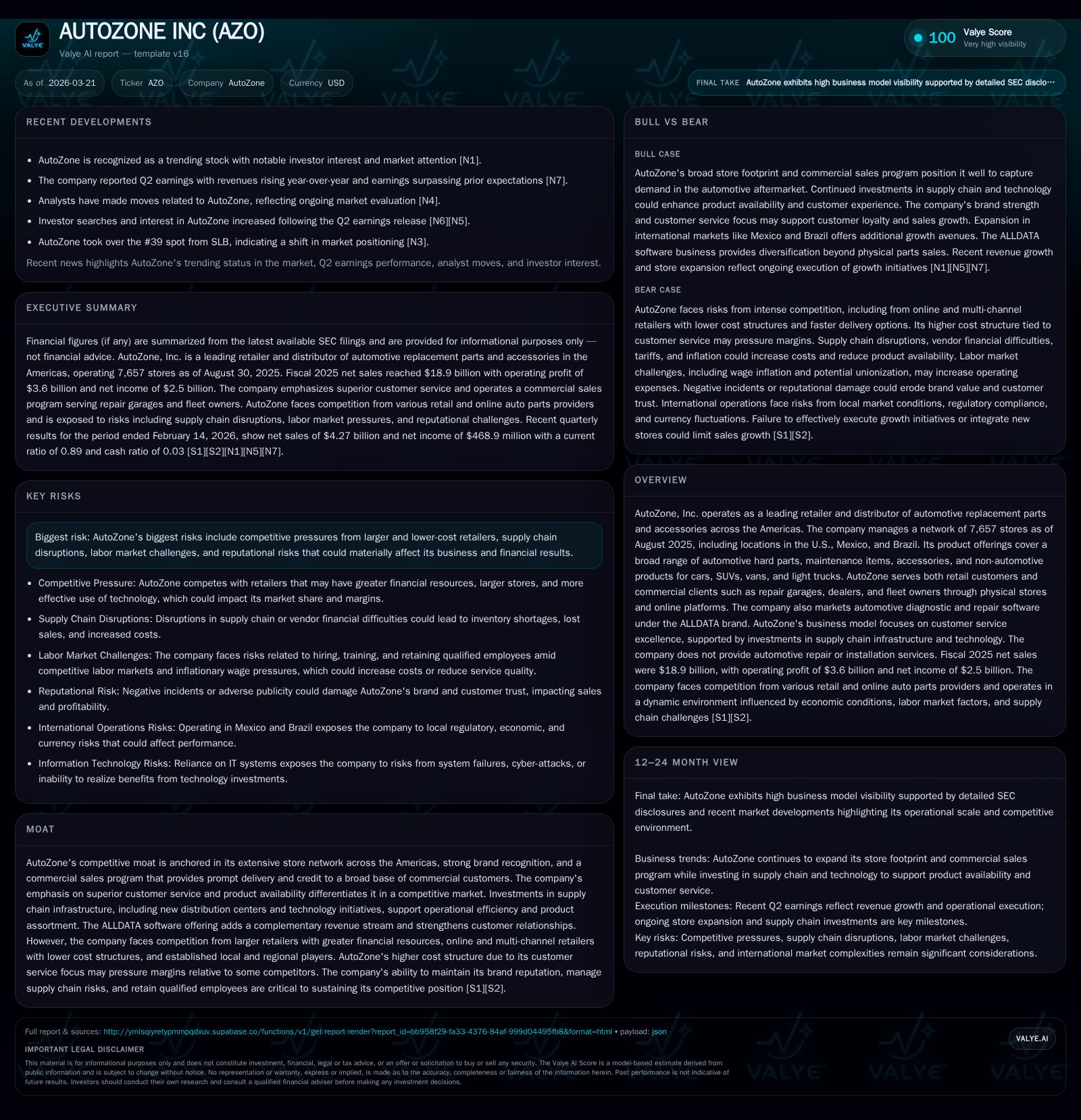
AutoZone has delivered consistent top-line growth driven by store expansion, same-store sales increases, and commercial programs, growing revenues at approximately 8% CAGR over five years. Fiscal 2025 saw a 2.4% revenue increase to $18.9 billion, though operating income declined 4.7% as margin pressures mounted from higher costs and investment in customer service. Future growth hinges on continued store rollouts, supply chain investments, and commercial market penetration, balanced against intensifying competition and digital disruption risks. The company sustains shareholder returns through sizable share repurchases funded by robust operating cash flow but reports negative equity due to historical buybacks.
Historical Performance: Sustained Revenue Growth with Margin Challenges
AutoZone has demonstrated solid historical performance characterized by consistent revenue expansion over the past five years. Its total annual revenues grew from $12.6 billion in fiscal 2020 to approximately $18.9 billion in fiscal 2025, equating to a compound annual growth rate near eight percent [F1]. This growth was primarily fueled by new store openings—rising from about 6,549 stores to 7,657 stores between fiscal years 2020 and 2025—and positive same-store sales driven both by volume increases and pricing strategies [S1]. In addition to retail customer traction, enhanced commercial programs serving professional garages and fleet owners have contributed meaningfully.
Despite rising top-line figures, operating income retreated nearly five percent to around $3.61 billion in fiscal 2025 compared with the prior year [F1]. This contraction reflected increased expense loads tied to AutoZone's focus on elevated customer service levels—such as staffing across its large store network—and investments in supply chain infrastructure that add fixed costs [S1], [S17]. Net income followed suit with a decline of approximately six percent year-over-year to about $2.5 billion.
Operating cash flow showed resilience, expanding modestly by roughly four percent year-over-year to nearly $3.12 billion in fiscal 2025 [F1]. Meanwhile capital expenditures escalated sharply by about 24 percent reaching almost $1.33 billion as the company accelerated investments mainly linked to opening new stores and upgrading distribution capabilities including mega hubs [F1].
Historical performance (annual)
| FY | Rev ($bn) | Net ($bn) | CFO ($bn) | OpInc ($bn) | Rev YoY | Net YoY |
|---|---|---|---|---|---|---|
| 2025 | 18.9 | 2.5 | 3.1 | 3.6 | +2.4% | -6.2% |
| 2024 | 18.5 | 2.7 | 3.0 | 3.8 | +5.9% | +5.3% |
| 2023 | 17.5 | 2.5 | 2.9 | 3.5 | +7.4% | +4.1% |
| 2022 | 16.3 | 2.4 | 3.2 | 3.3 |
Source: SEC companyfacts cache [F1].
Capital returns and efficiency (annual)
| FY | Buybacks ($bn) | FCF ($bn) | ROE% |
|---|---|---|---|
| 2025 | 1.6 | 1.8 | -73.2 |
| 2024 | 3.1 | 1.9 | -56.1 |
| 2023 | 3.7 | 2.1 | -58.1 |
| 2022 | 4.4 | 2.5 | -68.7 |
Source: SEC companyfacts cache [F1].
Table reflects key financial metrics for AutoZone over four fiscal years ending FY2025 (Aug). Buybacks data refer to gross share repurchase spend during each year.
Future Growth Prospects: Expansion under Competitive Pressure
AutoZone’s future growth prospects are anchored on sustained store rollouts domestically and internationally (notably Mexico and Brazil), alongside further penetration into commercial automotive aftermarket segments through expanded credit programs and delivery logistics [S1], [S15]. The company’s omni-channel approach combining physical stores with online ordering capabilities—including integration of its branded ALLDATA automotive diagnostic software—offers incremental revenue diversification.
However, revenue growth could moderate if the firm struggles to maintain its historically strong same-store sales performance amid economic headwinds that dampen automotive maintenance spending or if pricing flexibility erodes due to competition [S1]. Additionally, consumer shopping increasingly begins online where competitors possibly offer more attractive prices or faster delivery; AutoZone must evolve its digital user experience accordingly or risk losing market share [S1]. Supply chain disruptions could also impair product availability—a crucial component given AutoZone’s reputation for inventory readiness—which might impact customer loyalty adversely [S26]. Labor market tightness is another potential constraint affecting store staffing levels necessary for its premium service model.
Forecasts and Milestones: Key Indicators To Monitor
Explicit near-term forecasts were not publicly provided as of the latest filings; however, operational commentary outlines expectations for moderately increased capital spending relative to fiscal year prior levels primarily focused on tactical store expansion and enhancements of hub distribution centers for better assortment offerings [S14]. Observers should monitor quarterly disclosures for updates on sequential same-store sales trends, gross margin recovery initiatives amid cost pressures, and progress on digital platform deployments impacting e-commerce penetration.
The progression of ALLDATA software monetization represents a milestone metric reflecting success in expanding non-traditional aftermarket services revenue streams [N3], enhancing customer retention beyond parts sales.
Returns and Capital Allocation: Shareholder Returns Amid Negative Equity
AutoZone maintains an active capital allocation policy emphasizing significant share repurchases funded through strong operating cash flows [S4], [F1]. Fiscal year ending August 30, 2025 included approximately $1.58 billion spent on repurchasing shares—a deceleration compared with prior years yet still substantial—with remaining board authorization near $632 million for continued buybacks [S4]. The longevity of this share repurchase program since the late ’90s speaks to a persistent strategy prioritizing returning capital efficiently.
The company reported negative shareholders’ equity near -$3.41 billion at August 30, 2025 primarily due to accumulated treasury stock retirements offsetting retained earnings balances [F1]. Consequently, typical return-on-equity metrics are distorted—in FY25 the computed ROE is roughly -73%—and less meaningful without adjustments.
Free cash flow after capital expenditures remains healthy near $1.79 billion illustrating ample liquidity generation for reinvestment or shareholder returns [F1]. Debt levels are managed within investment-grade parameters; as of the latest quarter end there were no borrowings against a $2.25 billion revolver facility with total long-term debt near $8.9 billion composed predominantly of fixed rate senior notes maturing between now and mid-2030s [S19], [S21], [S22]. Interest coverage ratios well above covenant minima provide flexibility.
Competitive Positioning: Moat Supported by Service But Facing Digital Disruption
AutoZone’s moat derives mainly from its dense network of brick-and-mortar stores across North America (U.S., Mexico, Brazil), brand identity recognized by DIY customers and commercial clients alike, along with tailored credit-based commercial sales programs ensuring prompt delivery schedules that many competitors find tough to replicate , [S15], [S26]. Investments in supply chain technology—such as mega distribution hubs—enhance product availability crucial for customer satisfaction.
However, the company's higher cost structure stemming from superior service orientation implies thinner margins versus low-cost omnichannel competitors who leverage scale or purely digital distribution models without brick-and-mortar overhead [S1]. Larger retailers may access better vendor pricing due to scale while online entrants offer convenience gains which appeal especially to younger demographics accustomed to fast delivery or click-to-ship experiences.
Additional vulnerabilities include risks around adapting quickly enough to ongoing digital innovation cycles—online price transparency encourages shopper comparison pushing AutoZone towards continuous improvement of its website/mobile platforms plus loyalty initiatives [S1]. Maintaining operational excellence through these transitions will be essential for preserving market share.
Risks Overview: Supply Chain, Competition & Labor Market Dynamics
Supply chain risks remain notable given ongoing global logistics uncertainties including port congestion or transportation labor shortages that could delay inventory replenishment impacting store sell-through rates adversely [S26], compounded somewhat by inflationary freight costs impacting margins.
Competitive pressures from both established big-box chains such as O'Reilly Automotive (ORLY), Advance Auto Parts (AAP), regional players plus expanding multi-channel online retailers pose constant threats potentially eroding pricing power or foot traffic volumes over time [S15], [N9]. As e-commerce penetration intensifies industry-wide parts providers will need scalable omnichannel capabilities aligned with consumer preferences.
Labor markets tightness raises concerns about recruiting sufficient skilled store associates maintaining high customer service standards which underpin AutoZone’s differentiation strategy; failure here may degrade experience quality impacting repeat business metrics.
Reputational risk factors include product quality issues or data breaches which can materially affect brand equity given dependency on consumer trust.
This analysis synthesizes reported financial performance data from AutoZone's SEC filings complemented by recent news coverage insights up through early calendar year 2026 without speculation beyond documented information sources cited herein.
Disclaimer: This document is prepared solely for informational purposes summarizing publicly available disclosures about AutoZone Inc.; it does not constitute investment advice nor an offer or solicitation regarding securities.
Disclaimer: This is research-only, informational analysis and not investment advice. It may include AI-generated interpretation and general industry context. Always verify important details using primary sources.

Comments