
PPLUS Trust Series GSC-2: Assessing Yield Stability and Structural Risks in Trust Certificates
An analytical review of PPLUS Trust Series GSC-2's income dynamics, structural features, and embedded credit risks shaping investor outcomes.
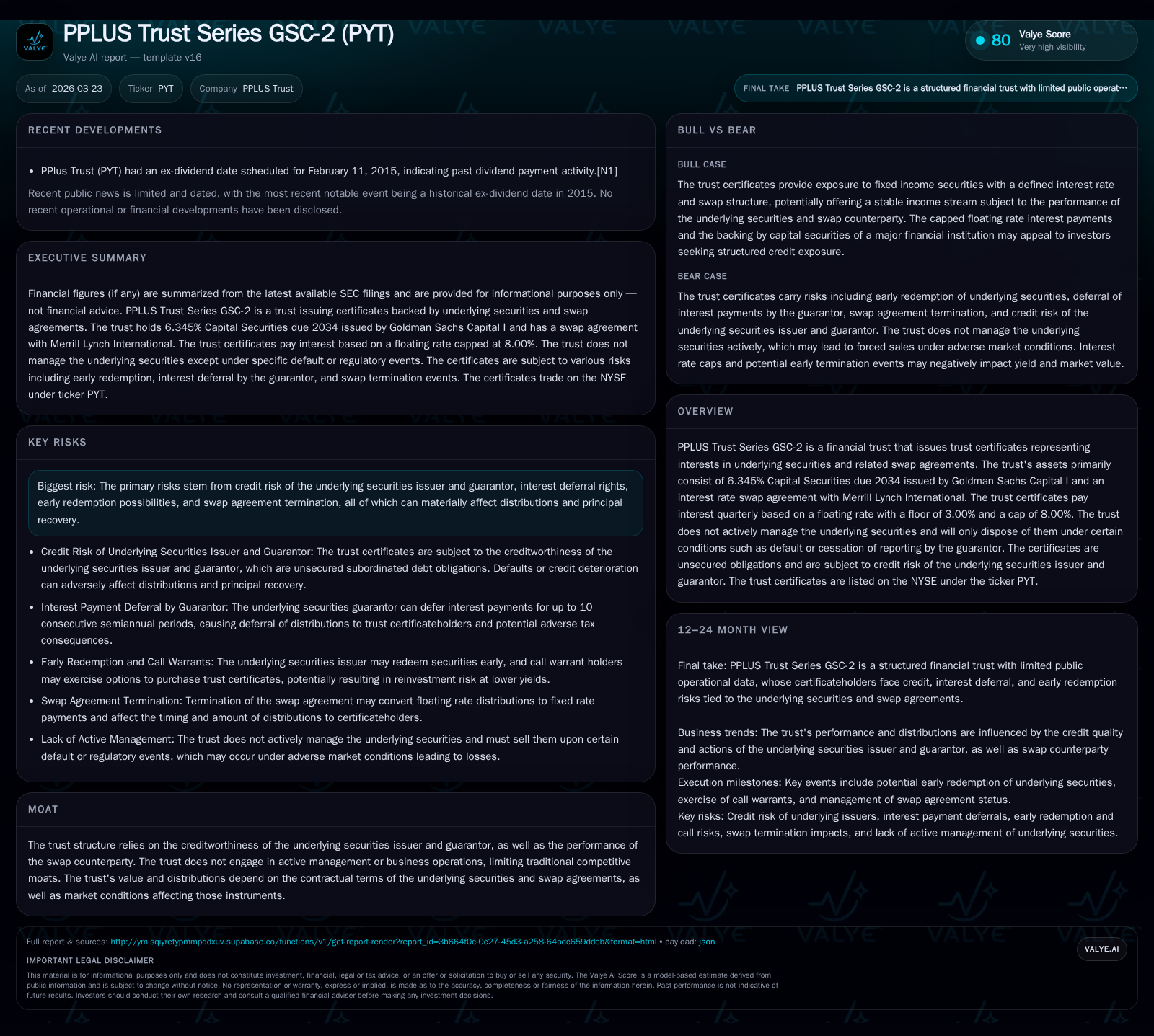
PPLUS Trust Series GSC-2 (PYT) represents an interest in a passive financial trust focused on Goldman Sachs Capital I’s 6.345% Capital Securities due 2034 combined with an interest rate swap agreement. The trust certificates deliver quarterly floating interest within a floor of 3.00% and cap of 8.00%, though distributions are subject to notable credit, deferral, and structural risks. Key considerations include the impact of interest deferrals by the guarantor, early redemption rights, call warrant exercises, and swap termination scenarios. While the trust does not actively manage assets or deploy capital beyond servicing coupon payments, its income stream stability is tethered to the financial health of the underlying securities issuer and swap counterparty performance.
Historical Yield Performance and Distribution Drivers
PPLUS Trust Series GSC-2 (PYT) issues trust certificates representing beneficial interests in Goldman Sachs Capital I’s 6.345% Capital Securities due 2034 combined with a floating-to-fixed interest rate swap with Merrill Lynch International [S1]. Quarterly interest distributions paid to certificateholders are based on a floating rate subject to a floor of 3.00% and cap of 8.00%, ensuring minimum cash flow albeit capped upside potential [S1],[S15]. Distribution reports indicate consistent quarterly interest payments aligned with these parameters, with no reported principal amortization to date given the securities’ maturity profile [S8],[S11],[S28]. Unlike corporate bonds, PYT certificates are unsecured obligations whose payment streams depend on both the underlying securities’ coupons and received swap payments netted quarterly.
Interest distribution amounts have followed expected floating rates constrained within established floor/cap boundaries without aberrant volatility in recent filings [S3],[S8]. No evidence indicates that call warrants held by third parties have been exercised historically; however, these instruments retain the option to accelerate redemptions or purchases impacting certificateholder yields [S1],[S13]. Early redemption activity could cause reinvestment risk if market rates are unfavorable relative to initial yields.
Structural Features of PYT: Credit, Swaps, and Interest Mechanisms
PYT’s structure is passively backed by tangible financial instruments rather than direct operating assets or active trading portfolios [S1]. The trust holds directly Goldman Sachs Capital I’s subordinated capital securities carrying a fixed coupon of 6.345% due in 2034 [S16],[S28], combined with an interest rate swap that converts the trust’s receipt from fixed into quarterly floating payments bounded between 3% floor and 8% ceiling [S15],[S25]. This arrangement enables investors exposure to a floating rate yield profile derived from static underlying fixed coupon securities.
The trust certificates themselves constitute unsecured obligations underpinned solely by these assets without collateral or recourse beyond them. This positioning exposes certificateholders structurally subordinate risk compared to secured creditors of Goldman Sachs Capital I or its subsidiaries [S6],[S9]. The term "trust certificates" here is precise—these represent undivided beneficial interests issued via a Delaware statutory trust governed by defined agreements rather than traditional bond instruments.
Yield Volatility Factors: Interest Deferral Rights and Call Options
Principal sources of yield volatility include explicit deferral rights reserved by the underlying securities guarantor permitting deferment of interest for up to ten consecutive semiannual periods without additional accrued interest owed during deferral [S1],[S23]. Such deferrals disrupt cash flow timing as the trust correspondingly defers distributions on certificates during those periods without compensatory increases later—yielding effective original issue discount (OID) tax implications for investors who must accrue income despite absence of cash distributions [S5].
Additionally, call warrants held by unspecified parties grant optionality to repurchase outstanding trust certificates possibly before scheduled maturity [S1],[S13]. The underlying securities issuer also retains early redemption rights either at its discretion or when obligated to pay additional amounts impacting certificate tenure [S12]. These embedded options inject reinvestment risk as prevailing market rates could be lower than current yields when calls/redemptions occur.
Credit Risk Profile: Underlying Securities and Guarantor Dependencies
Credit exposure derives fundamentally from both the underlying securities issuer (Goldman Sachs Capital I) and its guarantor entities responsible for guaranteeing principal and interest payments under the capital securities structure [S1],[S13]. Being unsecured subordinated obligations places PYT certificates behind secured debt claims upon liquidation or bankruptcy scenarios [S6],[S9].
Goldman Sachs operates through multiple subsidiaries incurring various debt layers; earnings flows from these subsidiaries support upstream obligations but may be constrained by claims senior creditors hold over subsidiary assets or dividends [S6],[S9]. The unlimited indebtedness capability highlighted in disclosures further underscores absence of structural caps protecting these subordinated liabilities’ creditworthiness.
Thus any deterioration in creditworthiness or liquidity stress for Goldman Sachs subsidiaries could impair their ability to service upstream debt including guaranteed capital securities ultimately jeopardizing PYT's distributions.
Analyzing Potential Disruptions: Swap Termination and Default Scenarios
The trust is party to an interest rate swap converting fixed coupons on underlying securities into floating rate payments [S1],[S25]. If this swap terminates due to events affecting solely it (swap termination event) but not causing overall trust termination, distribution mechanics shift substantially—the floating rate distributions convert into fixed semiannual payments at original fixed coupon levels (6.345%) [S25].
Such conversion changes quarterly income timing and negates any benefit above that fixed coupon offered by favorable swaps spread movement.
In default scenarios where Goldman Sachs Capital I fails on obligations or ceases Exchange Act filings triggering liquidation events for underlying securities, any proceeds first satisfy early termination payment obligations owed to Merrill Lynch as swap counterparty before certificateholders receive funds [S1],[S6],[S12]. This priority exposes investors to potentially material losses relative to face value particularly if liquidation values are depressed.
Capital Flows, Payments, and Return Metrics Overview
Distributions occur quarterly as net positive receipts from Goldman Sachs capital security coupons combined with inflows under the swap arrangement less any trustee fees which have historically been zero or nominal per reports [S11],[S27],[S28]. No principal repayments or buybacks have been reported as the notes mature in 2034.
Return on equity metrics do not apply meaningfully given that PYT functions strictly as a pass-through vehicle lacking operational income generation or capital deployment beyond servicing coupon flows [S1],[S15]. It's more akin to an income vehicle aligned with fixed income mutual funds focused on distributing contractual coupon streams rather than generating equity-style returns.
Forecasting Insights: What Investors Should Monitor Going Forward
Key factors requiring continual observation include credit quality signals from Goldman Sachs Capital I issuer/guarantor such as ratings adjustments, changes in subsidiary leverage profiles, announcement of early redemption intentions by issuer or call warrant holders exercising their purchase rights potentially truncating certificate durations [S1].[N/A]
Interest rate environment impacts distribution floors/caps relevance: rising rates approaching cap constrain float gains while dips near floor safeguard minimal income but limit upside.
Swap counterparty credit condition also matters given payment dependency; any downgrade or default could precipitate early termination events negatively affecting yields or payment timing given floating-to-fixed conversion mechanics outlined prior [S25].[N/A]
Investor Takeaways on Risk vs. Return for PYT Certificates
PPLUS Trust Series GSC-2 offers exposure primarily via passively held subordinated capital securities plus a structured swap yielding quarterly income within established floors/caps but without active asset management moat shielding risks.
Investment returns depend materially on counterparties—credit reliability of Goldman Sachs Capital I issuer/guarantor plus Merrill Lynch as swap party—as well as embedded contract terms allowing deferred interests and early redemption options introducing distribution variability.
Tax implications linked with deferred interest accruals further complicate investor after-tax outcomes requiring informed planning.
Overall, PYT represents a specialized fixed income-like instrument prioritizing steady if capped cash flow supported structurally by defined contractual arrangements rather than operational earnings growth or asset appreciation dynamics. Investor focus should center on assessing counterparty credit trends alongside monitoring option exercise likelihoods influencing duration uncertainties.
This analysis synthesizes disclosures filed through March 2026 reflecting PPLUS Trust Series GSC-2's structural framework without extrapolating future events beyond stated facts. It is intended purely for informational purposes without providing investment recommendations or price forecasts.
Disclaimer: This is research-only, informational analysis and not investment advice. It may include AI-generated interpretation and general industry context. Always verify important details using primary sources.

Comments