
Duluth Holdings' Turnaround: From Shrinking Revenues to Operating Improvement
Duluth Holdings balances declining topline with operational gains amid supply chain and capital structure challenges.
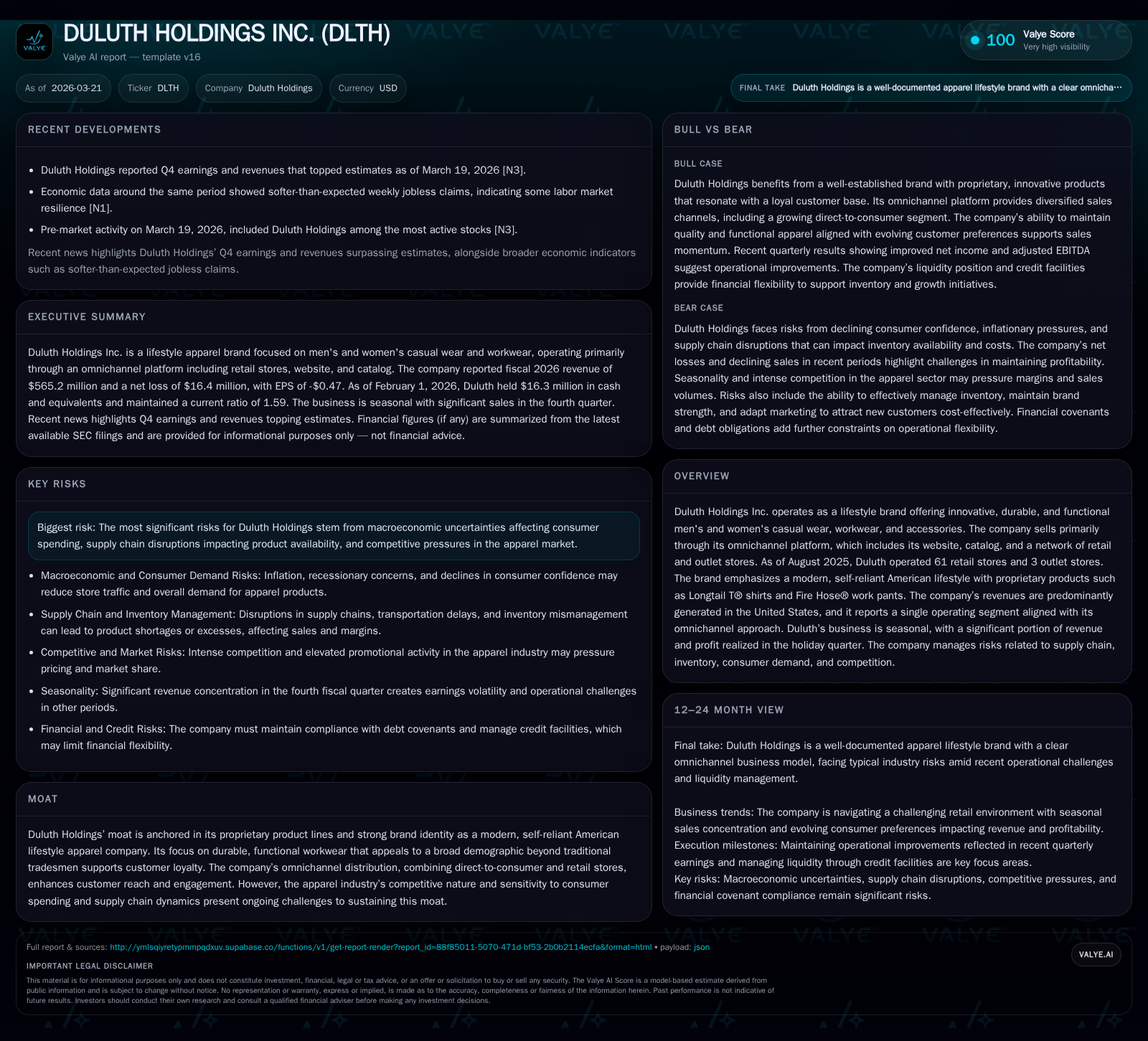
Duluth Holdings Inc. operates a rugged workwear brand that has faced shrinking revenues since FY2023 but demonstrated notable operating income improvement in FY2026. Despite a nearly 10% decline in revenue from FY2024 to FY2026, operating losses narrowed significantly. This operating progress coincides with a strategic shift in capital structure, including refinancing its credit facility, while managing macro-driven supply chain risks and maintaining customer loyalty through proprietary product innovation and an omnichannel platform. The company’s cash flow turnaround positions it for operational resilience, though sustained growth will require navigating margin pressures and consumer demand headwinds.
Evolution of Growth: Revenue Trends and Historical Profit Drivers
Duluth Holdings’ financial trajectory since FY2022 reveals a clear tension between top-line contraction and improving operating efficiency. Revenue slid approximately 9.8% from $626.6 million in FY2024 to $565.2 million in FY2026 [F1]. Despite this revenue shrinkage—driven by macroeconomic factors suppressing consumer discretionary spending—the company achieved a notable turnaround in operating results. Operating losses narrowed dramatically from -$36.9 million in FY2024 to -$10.2 million in FY2026, a roughly 72% reduction [F1]. This suggests successful cost containment initiatives or favorable product mix shifts.
Seasonality further influences Duluth’s performance: the fourth fiscal quarter concentrates a significant portion of revenue and profitability due to holiday shopping patterns [S20]. Past growth benefited from proprietary SKUs such as the Longtail T® shirt line credited with brand distinction [S18], highlighting SKU innovation as a historical driver of customer loyalty within the durable workwear niche.
Historical performance (annual)
| FY | Rev ($mm) | Net ($mm) | CFO ($mm) | OpInc ($mm) | Rev YoY | Net YoY |
|---|---|---|---|---|---|---|
| 2026 | 565 | -16 | 24 | -10 | ||
| 2024 | 627 | -44 | -17 | -37 | -3.1% | -366.8% |
| 2023 | 647 | -9 | 39 | -9 | -1.0% | -506.1% |
| 2022 | 653 | 2 | -6 | 6 |
Source: SEC companyfacts cache [F1].
Capital returns and efficiency (annual)
| FY | FCF ($mm) | ROE% |
|---|---|---|
| 2026 | 17 | -9.7 |
| 2024 | -25 | -23.9 |
| 2023 | -10 | -4.2 |
| 2022 | -28 | 1.0 |
Source: SEC companyfacts cache [F1].
Note: Data for FY2025 revenue not explicitly provided; omitted accordingly [F1].
Strategic Brand Positioning and Its Role in Customer Loyalty
Duluth Holdings fortifies its market moat through targeted brand positioning that appeals broadly beyond traditional tradesmen toward a lifestyle archetype of rugged individuality and functionality [S18]. Proprietary product lines — notably Longtail T® shirts and Fire Hose® work pants — act as anchor SKUs fostering repeat purchases by balancing durability with everyday wearability.
In an apparel market often commoditized by price competition, Duluth’s emphasis on 'workwear lifestyles' connects emotionally with consumers who value utility blended with heritage American ruggedness [S18]. This strategic positioning supports deeper consumer engagement compared to undifferentiated apparel brands, helping mitigate competitive encroachment.
Sector-native observations note that proprietary SKUs reduce direct price elasticity by establishing unique value propositions; combined with loyal omnichannel customers, this underpins recurring demand even amid economic softness.
Supply Chain and Inventory Management Amid Macroeconomic Volatility
Risks articulated by the company consistently highlight inflationary pressures on raw material costs and tariffs impacting product availability [S12][S13][N1]. These headwinds complicate inventory management dynamics, increasing the risk of excess or obsolete stock which can erode gross margins through shrinkage or markdowns [S7].
Transportation delays and port congestions exacerbate timing uncertainties for inbound shipments [S12][S27], heightening working capital requirements amid unpredictable customer demand fluctuations noted in recent disclosures.
Effective supply chain agility remains critical for Duluth’s ability to deliver products aligned with seasonal peaks; inventory turns optimization is thus a key metric investors should monitor as indicative of operational responsiveness.
Omnichannel Platform: Synergies Between Retail, Catalog, and Digital Sales
Duluth operates an integrated omnichannel selling model combining brick-and-mortar stores, catalogs, and e-commerce website sales [S18]. As of August 2025, the footprint included 61 retail stores plus three outlets [S18].
This diversified channel structure enhances reach but introduces complexity managing stock allocation across physical vs digital points of sale [S10]. Direct-to-consumer sales accounted for approximately $141.7 million over six months ended mid-2025 versus store sales near $92.7 million, underscoring the prominence of digital/catalog segments even as physical retail remains vital [S26].
Such multichannel integration offers cross-selling advantages but also requires sophisticated fulfillment capabilities to maintain consistent customer experience across platforms.
Financial Performance Recap: Margins, Earnings, and Cash Flow Trajectory
Despite sustained net losses (-$16.4 million in FY2026), operating cash flow swung positively to $24.2 million compared to negative cash flow years prior—one of the clearest signs of improved underlying operational health [F1].
This improvement may stem from tightened working capital management or adjusted expense structures aligned with shrinking revenues yet favorable margin management [N1][S3]. Adjusted EBITDA metrics previously reported indicate management’s focus on de-emphasizing volatility from depreciation or restructurings to reflect core earnings power better [S7][S10].
SG&A expenses show normal seasonal variability tied to holiday period marketing outlays but remain tightly controlled relative to net sales [S19]. Capital expenditures declined slightly year-over-year reflecting disciplined capacity investment consonant with moderated growth expectations [F1].
Capital Structure Resets and Debt Refinancing Dynamics
A pivotal development was the April 28, 2025 entry into a new $100 million asset-based revolving senior credit facility replacing a larger prior revolver at lower interest rates (SOFR plus approximately 150 basis points) extending maturity to April 2030 [S4][S5][S8][S14], signaling prudence in liquidity management.
This facility carries customary financial covenants emphasizing maintaining rent-adjusted leverage ratios below specified thresholds alongside minimum fixed charge coverage ratios, necessitating careful leverage discipline [S5][S14].
Long-term debt obligations linked to TRI Holdings LLC remain consolidated but distinct notes mature beyond the horizon date without imminent principal amortizations that stress liquidity [S6][S9][S14]. To date, no default or covenant breaches have been reported.
Dividend Policies, Share Repurchases, and Capital Allocation Philosophy
Given persistent net losses and cash conservation priorities evident from balance sheet figures ($16.3 million cash/equivalents at fiscal year-end FY2026), Duluth currently does not pursue dividend distributions nor engage materially in share repurchases [F1][S2].
Capital allocation appears focused on sustaining operational flexibility against economic uncertainties rather than shareholder returns enhancement at this stage.
Recent filings lack mention of formal buyback authorization or dividend declarations consistent with this cautious approach.
Future Growth Catalysts and Operational Risks to Watch
Looking ahead, reopening avenues for revenue stabilization or growth hinge largely on enhanced inventory turnover rates, expansion of omnichannel consumer engagement especially online, and leveraging proprietary product lines for differentiated market positioning.
Conversely, risks persist from inflation-related input cost hikes, tariff volatility affecting sourcing costs/non-availability,[N1][S12] inconsistent consumer confidence impacting discretionary spend patterns,[S12] and intensifying apparel sector competition.[S12]
Monitoring same-store-sales trends alongside e-commerce penetration metrics will provide early signals on recovery prospects while analyzing supply chain resilience measures could indicate margin sustainability potential.
Ultimately Duluth’s ability to translate brand loyalty into widened profitable scale amid these variables warrants close observation.
This analysis is compiled solely for informational purposes drawing exclusively on publicly available data including SEC filings and news sources without delivering investment advice or recommendations.
Disclaimer: This is research-only, informational analysis and not investment advice. It may include AI-generated interpretation and general industry context. Always verify important details using primary sources.

Comments