
Lowe’s Companies Inc: Transforming Home Improvement with Subscription Services and AI Tools
Lowe’s is shifting from traditional retail toward digital and subscription innovations to drive growth in a competitive home improvement market.
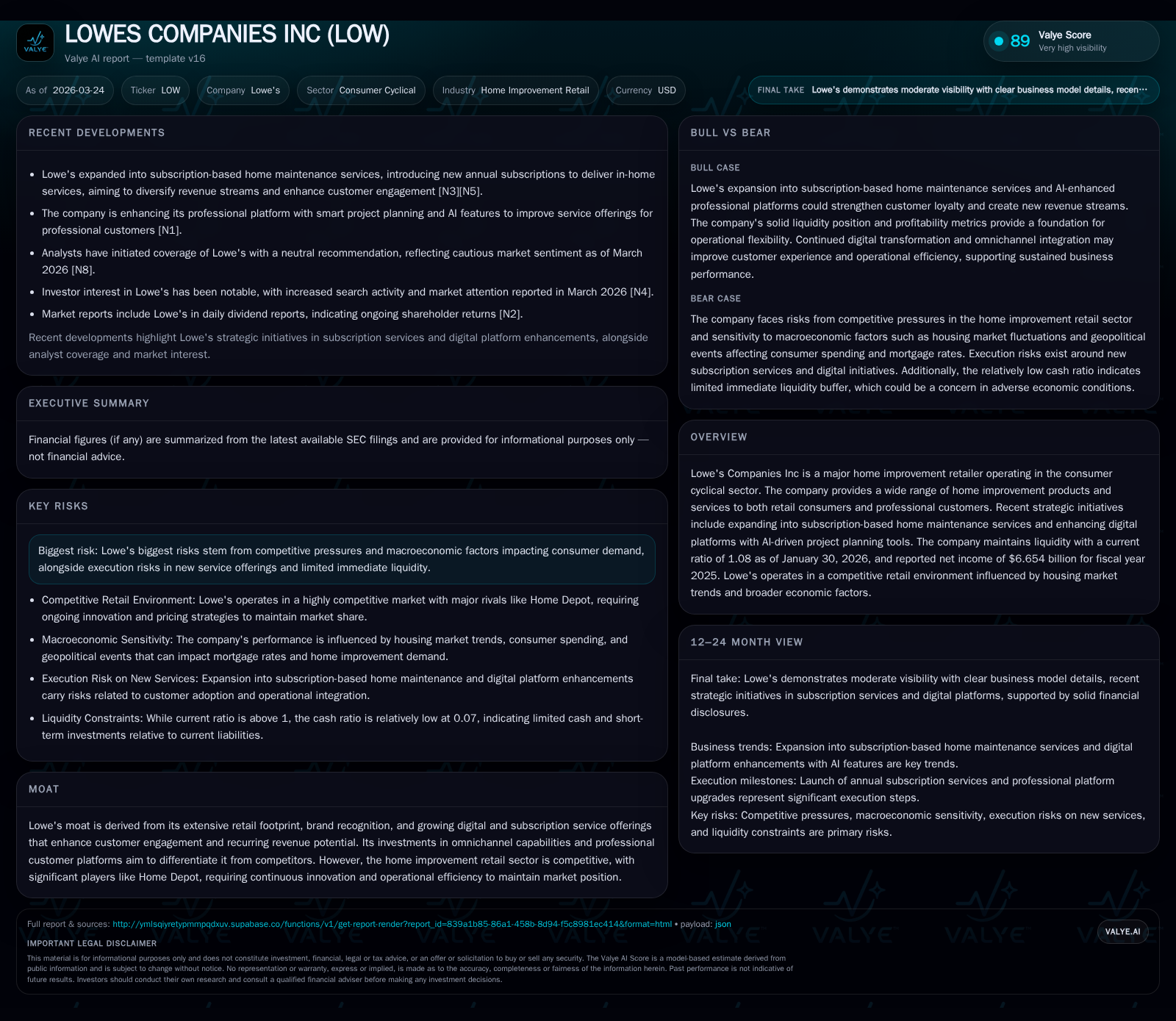
Lowe’s Companies Inc has demonstrated steady revenue growth over recent years despite margin pressures and a slight dip in net income. The company is actively expanding into subscription-based home maintenance services while enhancing its digital platforms through AI-driven project planning tools aimed at both retail and professional customers. Capital allocation prioritizes stable dividends with markedly reduced share repurchases, reflecting cash flow strength but also caution. Market challenges including housing trends and macroeconomic uncertainties remain key risks that will test Lowe’s ability to sustain competitive advantage and operational momentum.
Historical Financial Performance: Steady Growth Amid Margin Pressure
Lowe’s Companies Inc has delivered consistent top-line expansion over the past several fiscal years culminating in fiscal 2025 with revenues reaching $68.62 billion, representing a healthy approximately +5.5% year-over-year increase versus FY2024 [F1]. However, this growth trajectory contrasts with slightly declining operating income which fell by about -3% to $10.15 billion in FY25 from $10.47 billion the prior year; similarly, net income declined -4.4% to $6.65 billion from $6.96 billion a year earlier [F1]. These figures collectively portray margin contraction amid rising costs or competitive pricing pressures.
Operating cash flow remained robust at nearly $9.86 billion (+2.5% YoY), supporting increased investment activity as capital expenditures rose sharply +14.8% to $2.21 billion in FY25 from roughly $1.93 billion previously [F1]. This capex ramp aligns with Lowe’s strategic shift toward technology-enabled infrastructure and service capabilities necessary to bolster its omnichannel experience.
Historical performance (annual)
| FY | Net ($bn) | CFO ($bn) | OpInc ($bn) | Capex ($bn) | Net YoY |
|---|---|---|---|---|---|
| 2025 | 6.7 | 9.9 | 10.2 | 2.2 | -4.4% |
| 2024 | 7.0 | 9.6 | 10.5 | 1.9 | -10.0% |
| 2023 | 7.7 | 8.1 | 11.6 | 2.0 | +20.0% |
| 2022 | 6.4 | 8.6 | 10.2 | 1.8 |
Source: SEC companyfacts cache [F1].
Capital returns and efficiency (annual)
| FY | Div ($bn) | Buybacks ($bn) | FCF ($bn) |
|---|---|---|---|
| 2025 | 2.6 | 0.2 | 7.7 |
| 2024 | 2.6 | 4.1 | 7.7 |
| 2023 | 2.5 | 6.1 | 6.2 |
| 2022 | 2.4 | 14.1 | 6.8 |
Source: SEC companyfacts cache [F1].
Revenue growth shows steady gains but operating income and net income have faced pressure likely due to cost inflation and competitive dynamics.
Subscription Services: A New Revenue Frontier
In response to intensified competition and evolving customer expectations within the home improvement sector, Lowe’s has ventured into subscription-based home maintenance solutions—a clear pivot towards generating recurring revenue streams beyond big-ticket product sales [N4][N6]. The recently introduced annual subscription offering delivers regular in-home services such as preventative maintenance tasks which amplify lifetime customer value while fostering brand loyalty.
This strategic move not only diversifies Lowe’s revenue base but also strengthens its moat by embedding the company deeper into customers’ ongoing home care routines rather than one-off transactions typically characteristic of retail hardware sales.
Advancing Digital Innovation to Engage Professionals and Consumers
Lowe’s is aggressively leveraging artificial intelligence-driven project planning tools integrated into its digital platforms—tools designed to simplify complex renovations through virtual assistance, materials selection guidance, and real-time inventory visibility across stores [N1][N8]. Such omnichannel fulfillment capabilities are critical for capturing both DIY enthusiasts and professional contractors who demand efficiency and accuracy.
This digital uplift aligns Lowe’s competitively with key rival Home Depot which recently enhanced its pro platform using smart tracking technologies facilitating delivery transparency and seamless order management [N1][N8]. By embracing these emerging tech trends, Lowe’s aims not only to retain traditional walk-in shoppers but also expand its professional customer segment—recognized as a lucrative growth vector given their larger average basket sizes.
Competitive Environment and Market Pressures
Despite these advancements, Lowe’s operates within a highly competitive landscape where macroeconomic factors materially influence consumer spending patterns on discretionary home projects [S4][N7]. The housing market remains sensitive to mortgage rate fluctuations impacted by geopolitical tensions such as conflicts in the Middle East which can tighten credit affordability or delay real estate turnover [N7]. Such dynamics inject volatility into demand forecasts complicating scaling of new service models like subscriptions.
Additionally, competitors like Home Depot aggressively pursue similar pro segment expansions alongside large-scale investments in technological infrastructure creating persistent execution risks for Lowe’s because differentiation becomes increasingly reliant on flawless operational delivery.
Capital Allocation Focus: Dividends, Buybacks, and Cash Flow Management
Cash flow management remains a cornerstone of Lowe’s financial discipline as evidenced by free cash flow generation approximating $7.65 billion for FY25 calculated by subtracting capex ($2.21B) from CFO ($9.86B) [F1]. This robust free cash flow underpins continued shareholder returns.
Dividends have been steadily raised reaching $2.64 billion paid out in FY25 up modestly from prior years demonstrating management's commitment to returning capital even as buybacks plunged dramatically—from over $6 billion repurchased three years ago down to only around $211 million most recently [F1][S8][S9]. This shift points toward cautious capital deployment possibly reflecting uncertainty from rising competition and investments needed for service innovation.
Another notable balance sheet feature is the materially negative shareholder equity (-$9.92 billion in FY25), likely a product of accounting treatments related to debt issuance or treasury stock balances rather than solvency concerns; however this distorts traditional profitability ratios such as ROE which appears significantly negative (-67%) if calculated naively [F1]. Liquidity is sound with a current ratio of approximately 1.08 indicating adequate short-term asset coverage of liabilities.
Outlook: Growth Drivers, Risks, and What Investors Should Monitor
Looking ahead, critical indicators for assessing Lowe’s trajectory include successful scale-up metrics for its subscription offerings along quantitative adoption rates of AI-enhanced digital platforms among pros versus casual consumers [N9][N5][S1]. Margin performance will be telling as the company seeks stabilization after recent declines amidst increased operational costs.
Analyst commentary remains cautiously optimistic about growth potential balanced against execution uncertainty inherent in expanding relatively nascent service lines in an environment shaped by external economic headwinds such as inflationary pressures and mortgage market instability [N9]. Monitoring competitor moves—particularly Home Depot’s Big Ticket sales momentum—and macro developments impacting consumer discretionary budgets will provide essential context for gauging Lowe’s endurance.
This analysis is based solely on documented financial data from SEC filings, company disclosures, and publicly reported news without inferring undisclosed information or providing investment recommendations.
Disclaimer: This is research-only, informational analysis and not investment advice. It may include AI-generated interpretation and general industry context. Always verify important details using primary sources.

Comments