
Chicago Rivet & Machine Co.: Balancing Operational Hurdles and Growth Initiatives
Chicago Rivet & Machine Co. faces persistent liquidity and profitability challenges while pursuing operational streamlining and non-automotive market expansion.
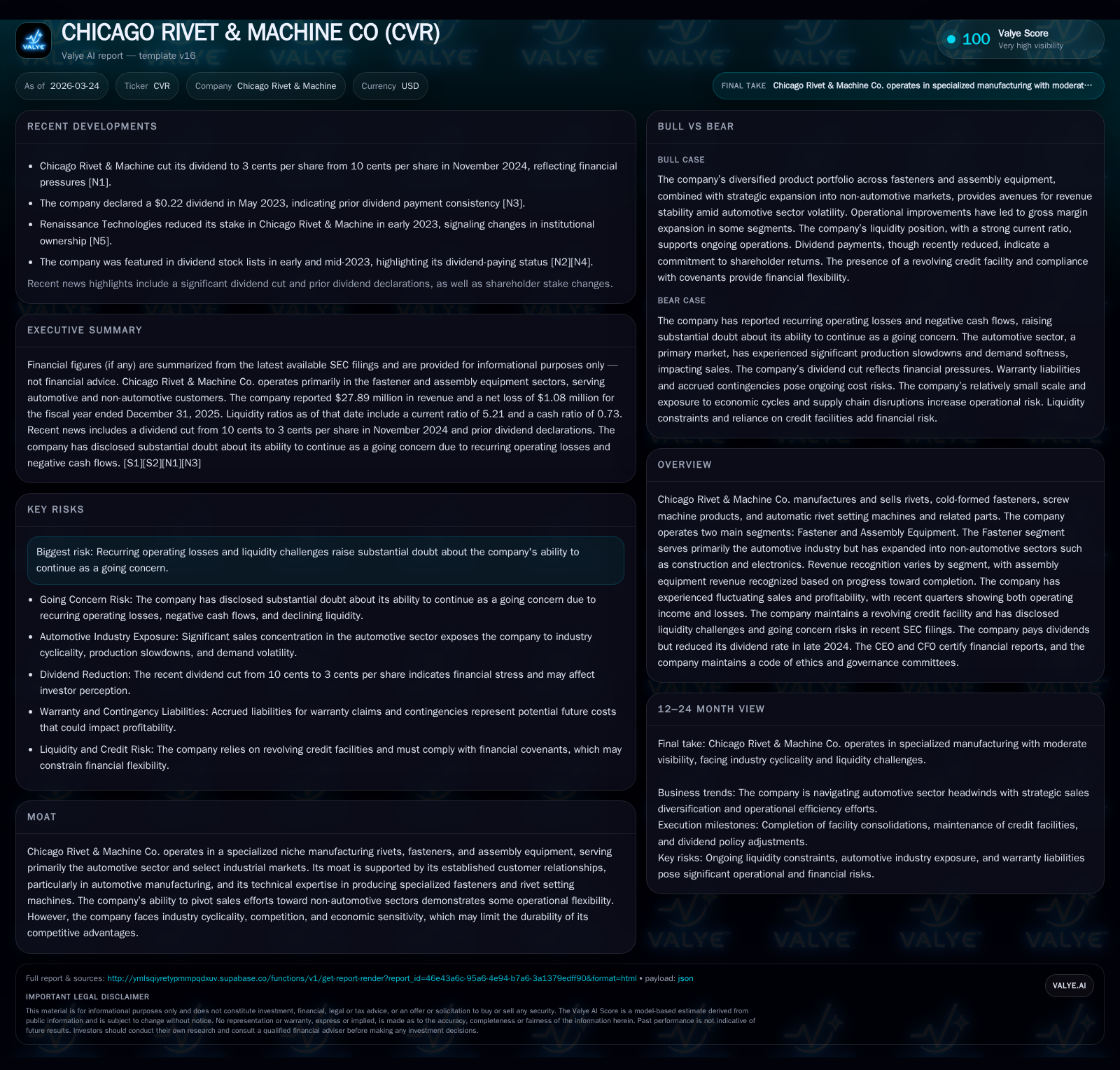
Over the past four years, Chicago Rivet & Machine has experienced significant revenue volatility marked by a sharp decline in operating income from a positive position in 2022 to recurring losses through 2024, with slight recovery signs in 2025. The company’s dual segments—primarily automotive-focused Fasteners and Assembly Equipment with progress-based revenue recognition—reflect a strategic shift toward diversifying into non-automotive sectors amid industry cyclicality. Liquidity pressure remains acute, supported by a revolving credit facility with stringent covenants due for renewal in April 2026 and substantial going concern disclosures. Proactive measures including facility consolidation, asset sales, and bolstered sales leadership aim to stabilize operations and restore margins. Capital allocation illustrates conservative cash deployment with shrinking dividends and capex, highlighting ongoing financial stress and the need for future milestone monitoring.
Historical Revenue Volatility and Profitability Trends
Chicago Rivet & Machine Co.’s financial trajectory over the last four fiscal years underscores pronounced revenue fluctuations coupled with deeply variable profitability outcomes. In FY2022, the company reported revenues of approximately $33.6 million alongside a modest operating income of $3.56 million [F1]. However, this performance deteriorated rapidly as FY2023 showed a nearly $5.8 million operating loss despite still measurable revenue near $31.5 million — signaling margin compression likely tied to operational inefficiencies or pricing pressures.
The nadir occurred during FY2024 with operating income plunging further to a loss exceeding $5.16 million while revenues fell below $27 million [F1]. A slight recovery emerged in FY2025 when sales climbed marginally to just under $28 million, yet operating income remained negative at roughly -$1.2 million, evidencing ongoing challenges scaling back losses even amid stabilizing revenues [F1]. Net income similarly mirrored this swing: from profitability at $2.87 million in FY2022 to losses north of $5.6 million in FY2024 before improving somewhat to around -$1.1 million in FY2025.
These financial swings are partially explicable by shifting segment contributions—the Fastener segment's automotive focus subjects it to demand cyclicality while the Assembly Equipment business’s progress-based revenue recognition introduces periodic topline variability as projects advance over time [S14][S21].
Historical performance (annual)
| FY | Rev ($mm) | Net ($mm) | CFO ($) | OpInc ($mm) | Rev YoY | Net YoY |
|---|---|---|---|---|---|---|
| 2025 | 28 | -1 | -1228018 | -1 | +3.3% | +80.7% |
| 2024 | 27 | -6 | -153451 | -5 | -14.3% | -27.6% |
| 2023 | 32 | -4 | -1931636 | -6 | -6.4% | -253.5% |
| 2022 | 34 | 3 | -1264954 | 4 |
Source: SEC companyfacts cache [F1].
Capital returns and efficiency (annual)
| FY | Div ($) | ROE% |
|---|---|---|
| 2025 | 115936 | -5.8 |
| 2024 | 318823 | -28.0 |
| 2023 | 618325 | -17.0 |
| 2022 | 850196 | 9.3 |
Source: SEC companyfacts cache [F1].
Segment Dynamics: Automotive Roots and Non-Automotive Expansion
Chicago Rivet & Machine Co.'s operations are concentrated into two reportable segments: Fastener and Assembly Equipment [S14][S21]. The Fastener segment comprises rivets, cold-formed fasteners including screw machine products produced primarily for automotive customers but increasingly for non-automotive industries such as construction and electronics sectors [S14]. The Assembly Equipment business manufactures automatic rivet setting machines along with associated tooling and parts.
Automotive exposure defines much of the fastener demand profile; cyclical production shifts within OEM supply chains strongly influence segment volumes [S24]. Recognizing this cyclicality risk and associated sales volatility tied to a relatively narrow customer base concentrated within the U.S., management has accelerated pursuits into non-automotive verticals—a strategic diversification aimed at stabilizing revenue flows [S14][S21]. This movement is expected to moderate historical roller-coaster impacts inherent in automotive-dependent fastener suppliers.
Notably for the Assembly Equipment segment revenue is recognized based on progress towards completion rather than point-in-time delivery; this accounting treatment introduces additional volatility as multi-phase machine orders traverse their manufacturing lifecycle [S1]. Consequently reported quarterly results may not directly parallel physical shipment or cash flow timings.
Liquidity Pressures and Capital Structure Evolution
Persistent liquidity constraints have manifested through recurring negative operating cash flows since at least FY2022 compounded by continuing operating losses that erode retained earnings [F1]. The Company sustains operations primarily through a revolving credit facility established under the March 2025 Credit Agreement offering up to $3 million ($2.5 million revolving plus $0.5 million non-revolving lines) [S4][S5][S6][S7]. Borrowings carry an interest rate floor of 7%, plus one percent over prime rate subject to no prepayment fees.
This credit line matures annually with next scheduled renewal or repayment due April 1st of 2026 [S7]. Compliance with covenants centered on minimum profitability thresholds for calendar year periods ending December 31st and tangible net worth levels has been maintained as of recent reports ending September 30th and June 30th of 2025 despite challenging operating environments [S4][S5][S7]. Nonetheless substantial doubt languishes over continued viability given recurring losses coupled with tight liquidity margins [S3][S4][S7][S11].
In October 2024 the company executed closure of its Albia facility consolidating operations into its Tyrone Pennsylvania plant aiming for economies of scale that reduce overhead burdens and improve production margin stability [S13][S24]. Early-2025 saw divestiture of Albia's related real estate generating approximately $678K net cash proceeds that bolstered working capital reserves [S6][S11]. These steps represent tactical deleveraging moves attempting to bolster covenant headroom without incurring new debt.
Management is simultaneously exploring alternative refinancing structures including potential sale leaseback transactions on owned assets or raising capital outside the existing credit agreement framework should near-term market conditions permit [S6][S11].
Strategic Responses: Cost Reductions, Facility Consolidation, and Sales Team Overhaul
Facing a confluence of downward revenue pressure and heightened liquidity strain throughout late 2024 into early/mid-2025 interval periods ([S4], [S6]), Chicago Rivet & Machine embarked on multiple corrective strategies.
Operationally notable was consolidation of Albia operations into Tyrone designed not only to cut fixed overhead costs but also enhance scale efficiencies over tooling production processes serving assembly machines—critical components bearing higher gross profit potential [S13],[S24]. This closure accompanied by asset sale recognized a one-time gain of approximately $340K supporting income statement ballast during Q1/Q2 fiscal quarters [S6],[S11].
From a commercial vantage point the company augmented sales leadership’s capabilities by appointing Mr. James T Tanner as Senior VP Sales & Marketing effective May 1st , bringing three decades’ industrial sales expertise including over ten years specifically within fastener markets—signaling renewed emphasis on pipeline development especially beyond traditional automotive accounts [S6],[S11]. This staffing decision aligns with efforts targeting mixed customer bases amid tariff-related export uncertainties impacting core markets [S4],[N# analysis].
Cost containment extended beyond plant footprint rationalization through disciplined administrative spending cuts evident via lower selling/general expenses relative to prior comparable periods [F1],[S25].[Further evidence shows tighter working capital management though inventory remains elevated reflecting cautious order fulfillment planning (see P&L + balance sheet notes)].
Outlook and Growth Constraints Amid Industry Uncertainty
Management commentary acknowledges prevailing headwinds from economic uncertainty impacting overall manufacturing demand globally—including tariff impositions that constrain export prospects—and automotive sector cyclicality continuing as key growth deterrents [S4]. While some sequential order improvements materialized early in fiscal year '25 compared to late '24 trends suggesting tentative demand stabilization trajectories exist; these are far from restored historic volumes according to disclosures.
The company’s intensified pursuit of non-automotive customers represents a critical strategic hedge against these structural limitations but conversion timelines are unclear leaving near- to medium-term sales growth visibility opaque.
Additionally operational gearing pressures typical for specialized industrial fastener manufacturers impose sharp margin risks if volume thresholds fail meet breakeven capacity levels given fixed cost absorption constraints.
Capital Allocation Patterns: Dividends, Capex, and Debt Management
The dividend policy reflects conservative cash stewardship aligned with financial stress realities; dividends paid have fallen substantially from over $850K distributed in FY2022 down below $116K by FY2025—a reduction consistent with typical industrial peers facing liquidity squeezes [F1]. This lowering curtails shareholder distributions favoring liquidity preservation.
Capital expenditure activity likewise declined meaningfully—with partial year adjusted spend nearly halved relative to early multi-million-dollar investments observed several years ago—signaling restricted reinvestment capacity driven by free cash flow deficits persisting across recent periods (-$1.88M approximate FCF calculated as CFO less capex for FY2025) [F1],[S23].[Such capital restraint potentially delays equipment modernization but safeguards balance sheet integrity under current operating conditions]
Total equity reduced from nearly $31 billion equivalent down roughly one-third by end-FY25 evidencing cumulative retained loss impacts though maintaining positive net book worth at approximately $18.8 million [F1]. ROE remains negative (-5.8%) illustrating earnings deficiencies relative to equity base reflective of historic losses.
What to Watch: Milestones and Financial Covenant Triggers
Though explicit forward guidance remains absent from filings, market participants should monitor key inflection points closely:
- Quarterly liquidity figures aligning with covenant maintenance remain crucial especially approaching credit agreement maturity set for April ‘26 renewal/repayment window ([S7], analysis).
- Recovery patterns across order volumes emanating from non-automotive verticals will signal penetration success or highlight vulnerability given reduced automotive exposure ([N# none] rely on recent statements S4).
- Progress executing alternative financing initiatives such as sale/leaseback transactions or fresh capital raises will impact medium term solvency considerations ([S6],[S11]).
- Effective realization of cost synergies after Albia consolidation remains trackable via margin improvement trends reported each period.
- Management addressing contingent liabilities related to customer fastener compliance claims resolved via installment settlements totaling approx. $1.1M will affect other accrued liabilities profile extending into calendar '29 horizon ([S18],).
This analysis is based on data available as of March 24th, 2026; it incorporates audited annual filings along with most recent quarterly updates but excludes speculative projections beyond validated disclosures.
Disclaimer: This is research-only, informational analysis and not investment advice. It may include AI-generated interpretation and general industry context. Always verify important details using primary sources.

Comments