
Brookfield Oaktree Holdings: Strategic Fund Commitments and Distribution Risks
Brookfield Oaktree Holdings LLC’s financial profile is shaped by its large limited partner interests in Oaktree’s flagship funds and cautious structural setup that impacts cash flow stability.
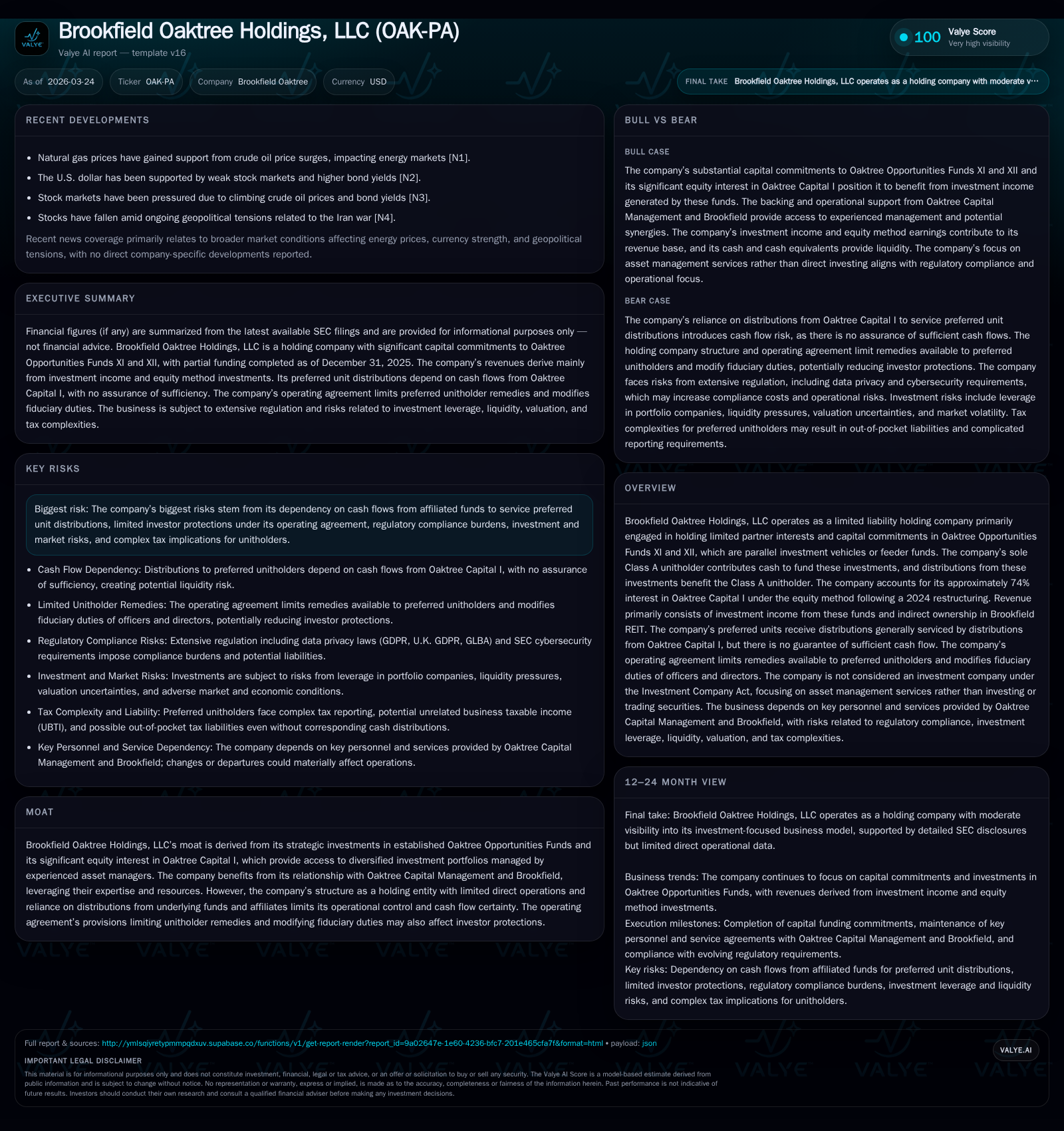
Brookfield Oaktree Holdings, LLC operates as a holding company primarily invested in limited partner stakes of Oaktree Opportunities Funds XI and XII following a key 2024 restructuring. Revenue and income have shown volatility tied to fund commitments and performance, with a significant decline in revenue since 2018 but improving net income by 2025. The company’s cash flow profile reflects notable swings, highlighting timing mismatches inherent to investment vehicles limited to distribution inflows. Growth prospects rest on successful deployment and returns from these flagship opportunistic funds but face caps due to Oaktree’s deliberate asset management philosophy restraining fund size. Preferred unit distributions depend on underlying fund distributions without guaranteed cash availability, constrained further by operating agreement provisions limiting unitholder remedies. Capital allocation is characterized by a sizable equity base and recent positive operating cash flows, yet dividend history is dated, and capital returns remain uncertain. Regulatory scrutiny and litigation risks permeate the broader investment management ecosystem where Brookfield Oaktree operates. Going forward, market conditions, fund deployment pace, and regulatory developments warrant close monitoring.
Investment Vehicle Structure and Historical Financial Trajectory
Brookfield Oaktree Holdings, LLC operates solely as a limited liability holding company engaging primarily in holding limited partner (LP) interests in two major investment vehicles: Oaktree Opportunities Fund XI, L.P., and Fund XII, L.P. Both are structured as parallel investment vehicles or feeder funds within the broader Oaktree ecosystem [S1,S10]. These LP commitments aggregate to substantial capital exposures of $750 million for Fund XI and roughly $796 million (including an additional commitment) for Fund XII as of December 31, 2025. Brookfield Oaktree has funded the majority portion of these commitments—approximately $637.5 million for Fund XI and $218.9 million for Fund XII—as capital contributions are required by operational needs [S1,S10].
A pivotal organizational development occurred in 2024 when Brookfield Oaktree restructured its investment accounting approach from consolidating operations of Oaktree Capital I to applying the equity method for its roughly 74% ownership interest post-restructuring [S1,S10]. This adjustment materially changed how revenues are recognized, shifting focus toward recognizing share-of-earnings rather than full consolidation, which partially explains recent financial statement dynamics.
Historically, revenue capture has experienced pronounced fluctuations reflecting timing differences across capital calls and distributions from the underlying funds, plus structural changes including the accounting method shift. These factors combined with evolving market valuations have led to substantial volatility in reported top-line figures.
Revenue and Income Trends Driven by Fund Commitments
Company revenue reached a historical high of approximately $594 million during fiscal year 2018 but contracted drastically the following year to around $144 million — a drop exceeding 75% year-over-year [F1]. This sharp reduction coincided with the ramp-up of newer fund commitments and corresponding shifts in how revenues were recognized amid investment pacing adjustments.
Meanwhile, net income trends present a more uneven yet generally recovering profile. After registering lower net income years earlier (data prior to available snapshot not shown), bottom-line profitability improved steadily from around $203 million in FY2022 to about $249 million by FY2025 [F1]. This recovery aligns with improved portfolio performance from core fund investments coupled with operational cost control.
Historical performance (annual)
| FY | Net ($mm) | CFO ($mm) | Capex ($) | Net YoY |
|---|---|---|---|---|
| 2025 | 249 | 471 | -19.0% | |
| 2024 | 308 | -539 | 0 | +39.0% |
| 2023 | 221 | -731 | 0 | +8.6% |
| 2022 | 204 | -1894 | 466000 |
Source: SEC companyfacts cache [F1].
Capital returns and efficiency (annual)
| FY | FCF ($mm) | ROE% |
|---|---|---|
| 2025 | 11.1 | |
| 2024 | -539 | 12.8 |
| 2023 | -731 | 9.8 |
| 2022 | -1895 | 13.2 |
Source: SEC companyfacts cache [F1].
Revenue exhibits a significant contraction post-2018; net income shows improvement into mid-2020s despite some variability.
Cash Flow Volatility and Operating Profitability Insights
Operating cash flows demonstrate notable volatility reflective of cash timing associated with capital calls from limited partners into funds versus realized distributions back to Brookfield Oaktree. Negative operating cash flow outlays dominated through fiscal years 2022 (-$1.89 billion), 2023 (-$730 million), and into early-mid 2024 (-$539 million), signaling periods of significant capital deployment aligned with investments made across Funds XI & XII during their active investment periods [F1].
FY2025 marked a sharp reversal with operating cash flow turning positive at nearly $471 million—a swing of +187% relative to prior year—which may indicate improving distributions generated by mature portfolio assets or realized gains returned from exited investments within these opportunistic funds [F1]. Capital expenditures remain negligible or zero across all recent periods given the holding company structure lacking direct operational asset bases requiring capex.
This pattern typifies holding companies heavily invested via private equity-like funds where earnings recognition based on mark-to-market can disconnect temporally from actual distributable cash received.
Growth Prospects Anchored in Oaktree Opportunities Funds XI & XII
Future growth for Brookfield Oaktree fundamentally hinges on successful deployment of committed capital into high-conviction distressed debt and opportunistic asset investments via Funds XI & XII alongside ancillary income derived from its significant equity stake in Oaktree Capital I [S1,N1]. These funds benefit from being managed by seasoned asset managers under the broader Brookfield-Oaktree banner employing disciplined risk frameworks prioritizing durable risk-adjusted returns over aggressive scaling.
As detailed directly in regulatory disclosures, a hallmark of Oaktree’s strategy is deliberate constraints on assets under management (AUM) growth. The firm often suspends marketing certain funds or refuses sizeable inflows that could dilute return profiles—both for open-ended funds via suspension periods or capped closed-end vehicle sizes—even returning previously committed capital early if necessary [S1,S3]. This approach enforces a return-focused culture but inherently caps top-line scaling potential.
Investors should recognize that while this philosophy bodes well for long-term value preservation, it constrains raw revenue expansion that would otherwise arise from progressively larger fee-bearing AUM bases common among alternative asset managers.
Distribution Mechanics and Preferred Unit Servicing Risks
A critical structural characteristic affecting Brookfield Oaktree is its reliance on distributions generated from underlying investments—primarily those through its equity interest in Oaktree Capital I—to service payments on preferred units issued [S1,S10]. These preferred units receive distributions generally serviced by dividends or other flows originating from portfolio companies controlled or invested through affiliated funds.
However, no guarantees exist regarding sufficiency or timeliness of these cash flows; shortfalls could impair preferred distributions or redemption capacity [S10,S14]. Moreover, the company’s operating agreement explicitly limits unitholders’ remedies against management failing distribution expectations or other adverse actions—contrasting with traditional corporate governance protections seen elsewhere [S25]. This limitation creates asymmetric risk for holders reliant exclusively on pass-through payments rather than standalone operational earnings streams.
Sector participants will recognize this passive holding position exposes investors directly to liquidity timing mismatches typical within complex alternative fund structures where distributions are irregular and contingent upon portfolio realization events.
Capital Allocation: Equity Position, Dividends, and Cash Flow Uses
Brookfield Oaktree’s balance sheet reflects a considerable shareholders’ equity base rising from approximately $1.55 billion at end-FY2022 to about $2.25 billion at end-FY2025—a period coinciding with portfolio maturation phases reflected also in profitability improvements [F1]. The estimated return on equity (ROE), computed conservatively as net income divided by average equity given limited detailed data points, stands near an approximate mid-teens level (~11%) suggesting modest return generation consistent with an asset-light business model focused on investment income recognition.
Dividend payments recorded historically were concentrated far earlier (with annual dividends paid between approximately $66 million–$160 million from FY2012-FY2015); no recent dividend announcements or buyback activities were disclosed indicating either retention policies or distribution limitations consistent with reinvestment needs [F1,S10].
Capital expenditures are immaterial given the non-operational nature of this holding company business model.
The strong positive operating cash flows recorded most recently support potential sustainability for preferred unit servicing though layered timing risks remain present depending on realized fund exit success.
Regulatory Landscape and Risk Factors Affecting Operations
Brookfield Oaktree operates within a densely regulated environment marked by multiple risk vectors inherent to alternative asset management ecosystems including:
- Intense U.S. securities law regimes governing private placements restrict offerings through so-called “bad actor” disqualifications impacting fundraising capabilities [S26];
- Continuous SEC examinations targeting private equity fund fee structures, valuations practices, allocation methodologies add costs and disclosure burdens [S11];
- Litigation risks tied to alleged fiduciary breaches or portfolio company exposures pose material reputation hazards ;
- Complex conflicts of interest within multi-fund strategies require meticulous governance frameworks demanding resource allocation toward compliance infrastructure [S21];
- Heightened global regulatory scrutiny outside U.S., including anti-corruption statutes (e.g., FCPA) elevate compliance challenges relevant for cross-border fund activities [S4];
- Emerging technology disruption such as AI applications generate new operational risks alongside evolving oversight uncertainty that could lead to unpredictable costs or sanctions [S15];
- Cybersecurity exposures threaten intellectual property protection critical to maintaining competitive reputation among institutional client bases involved in multi-billion-dollar commitments [S21,S27].
These regulatory pressures compound firm-level risks typical of holding entities reliant on external managers controlling underlying assets making risk mitigation partly dependent upon third-party conduct standards.
Forward Look: Milestones to Watch and Potential Constraints
Absent explicit company-issued forward financial guidance within available disclosures or filings ([N1],[S1],[S2]), prospective observers should monitor several key factors shaping Brookfield Oaktree’s near-term trajectory:
- Pace and sufficiency of capital deployment into Funds XI & XII as measured by incremental capital calls relative to remaining unfunded commitments,
- Timing and volume of distributions flowing up through partnership structures especially impacting preferred unit dividend coverage since cash generation underpins investor returns,
- Market valuation trends affecting portfolio companies within funds that drive mark-to-market earnings variability,
- Evolving regulatory landscape including SEC enforcement actions focusing on private equity industry practices which may affect fundraising capabilities or increase compliance burdens,
- Any discrete legal proceedings involving affiliated entities potentially impacting reputation or asset values,
- Macro-financial market conditions influencing credit availability which is crucial given leveraged holdings common across opportunistic strategies employed by these funds.
Collectively these elements frame a balanced outlook encompassing cautious optimism grounded by structural complexities inherent within Brookfield Oaktree’s unique model.
Disclaimer: This report does not constitute investment advice or recommendations; it summarizes publicly available data without guaranteeing completeness or accuracy regarding future outcomes.
Disclaimer: This is research-only, informational analysis and not investment advice. It may include AI-generated interpretation and general industry context. Always verify important details using primary sources.

Comments