
Aldel Financial II Inc.'s SPAC Status Reflects Early-Stage Acquisition Vehicle Dynamics
Aldel Financial II Inc., a Cayman Islands-incorporated SPAC formed in mid-2024, maintains financial stability while preparing for its initial business combination.
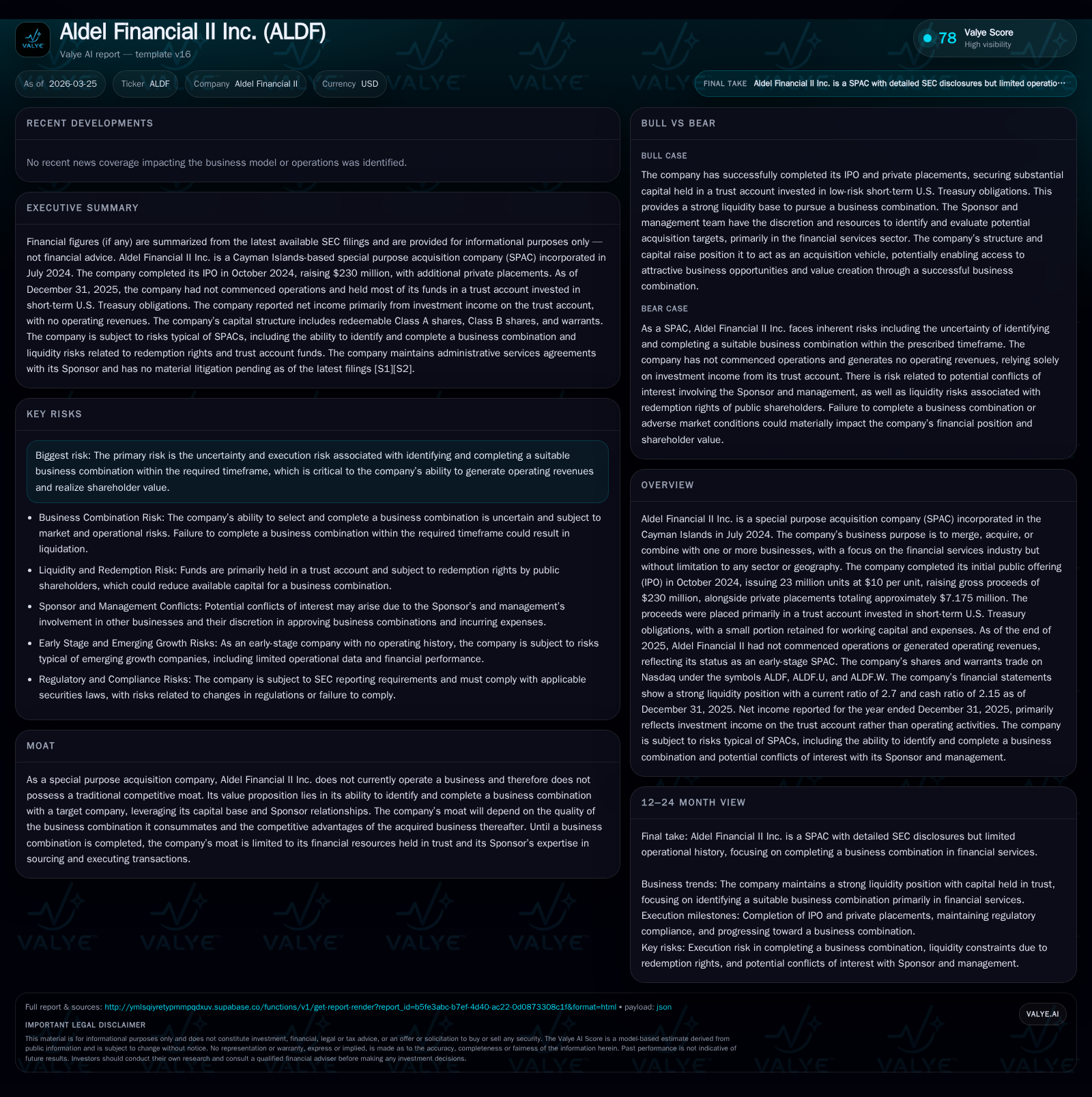
Aldel Financial II Inc. raised over $230 million in its October 2024 IPO and private placements, with proceeds held primarily in a trust invested in short-term U.S. government securities. The company has not generated operating revenues as of year-end 2025, consistent with its SPAC structure. It reported net income driven by interest income on the trust assets, offsetting operating losses from administrative expenses. The company must complete a business combination within 24 months post-IPO or liquidate, with public shareholders retaining redemption rights tied to trust account value. Future growth depends entirely on successful target identification and transaction execution within this timeframe.
Company Overview and Historical Performance
Aldel Financial II Inc. (ticker: ALDF) is a Cayman Islands-incorporated special purpose acquisition company (SPAC), formed in July 2024 with a mandate to pursue business combinations primarily focused on financial services but with broad sector flexibility [S1]. The company completed its initial public offering (IPO) on October 23, 2024, issuing approximately 23 million units at $10 each and raising gross proceeds near $230 million. Concurrently, it completed private placement transactions adding approximately $7.175 million to capital raised [S2][S4][S10].
Following the IPO, Aldel placed roughly $231.15 million of the net proceeds into a trust account invested predominantly in short-term U.S. Treasury securities consistent with SEC safe-harbor provisions for SPACs, reserving about $1.9 million for working capital and operational expenses [S4][S7][S10]. As of December 31, 2025, Aldel had not commenced operations or generated revenues given its status as an acquisition vehicle awaiting a business combination [S1][F1].
The company reported operating losses of approximately $653,000 for fiscal year 2025, reflecting general and administrative expenses associated with maintaining public company status and preliminary due diligence activities [F1]. Despite these operating losses, Aldel posted net income of about $9.23 million for the same period, primarily attributable to interest income earned on trust assets which offsets operational costs [F1]. Correspondingly, operating cash flow was positive at approximately $9.42 million during FY2025 [F1].
At year-end 2025, cash and cash equivalents stood near $542,000 while total current assets amounted to roughly $680,000 indicating adequate liquidity amid ongoing start-up expenditures [F1]. The company's equity declined from approximately $1.31 million at the end of 2024 to about $0.65 million by December 31, 2025 due to accumulated operating losses exceeding additional paid-in capital contributions during the period [F1].
Historical performance (annual)
| FY | Net ($mm) | CFO ($mm) | OpInc ($) | Net YoY |
|---|---|---|---|---|
| 2025 | 9 | 9 | -653532 | +386.6% |
| 2024 | 2 | 2 | -132836 |
Source: SEC companyfacts cache [F1].
Capital returns and efficiency (annual)
| FY | ROE% |
|---|---|
| 2025 | 1416.0 |
| 2024 | 145.3 |
Source: SEC companyfacts cache [F1].
Note: Revenues are absent as no operations were conducted; figures rounded to nearest whole USD
Growth Outlook
As a SPAC without operational activities or revenues until a business combination occurs, Aldel's future growth depends entirely on successfully identifying and closing one or more acquisitions within its regulatory timeframe [S3][S13][S17]. Its management team leverages Sponsor expertise to pursue targets primarily in financial services but retains flexibility across sectors and geographies [S1].
Potential growth drivers post-combination will depend on the scale and strategic positioning of acquired businesses. However, no definitive targets had been announced as of FY2025 year-end filings [S1]. Key constraints include the limited window of up to 24 months post-IPO to complete a deal and competitive pressures among SPACs vying for attractive targets [S13]. Failure to complete a business combination within this period triggers mandatory liquidation procedures where public shares are redeemed at trust account value plus accrued interest—a downside protection typical among SPACs [S10][S25].
Milestones to Monitor
Investors should track disclosures related to:
- Announcements regarding progress toward potential business combinations.
- Execution of definitive agreements.
- Notices for shareholder votes approving proposed transactions.
- Redemption statistics during tender offers.
- Any amendments extending the combination deadline.
Due diligence costs are expected to increase as negotiations advance and may impact near-term expenses [S3]. Deferred underwriting fees totaling approximately 3.75% of gross IPO proceeds become payable only upon successful business combination consummation aligning sponsor incentives with investors [S11][S23].
Returns and Capital Allocation
Return metrics such as ROE are not indicative prior to business combination due to absence of operational earnings; however based on FY2025 data:
- Net income relative to equity implies an approximate ROE exceeding 1400%, driven by investment income rather than core operations [F1].
- Operating cash flow significantly exceeded operating losses due to trust asset earnings offsetting administrative expenses [F1].
- No dividends have been declared or paid given lack of operating profits; dividend policy remains discretionary after transaction completion [S5].
- No share repurchases have occurred; Sponsor holds Founder Shares purchased nominally with voting commitments favoring business combinations until consummation [S14][S25].
Sponsor support includes administrative services contracted at fixed monthly fees ($20,000), limiting overhead impact during this pre-combination phase [S8][S9]. The balance sheet is free of debt as of December 31, 2025 simplifying capital structure before potential transaction-related financing changes post-acquisition [S7][S12].
Conclusion
Aldel Financial II Inc. exemplifies an early-stage SPAC: substantial capital securely held awaiting merger prospects; modest operating expenses offset by investment returns; aligned sponsor interests via equity holdings and service agreements; principal uncertainties center on ability to consummate acquisitions within regulatory deadlines.
Market participants should prioritize monitoring transaction announcements or strategic updates filed with the SEC or Nasdaq while recognizing that financial statement improvements will largely reflect investment yields until operational businesses are integrated.
Disclaimer: This analysis is based exclusively on publicly available SEC filings through March 25th, 2026 and does not constitute investment advice or recommendations regarding Aldel Financial II Inc.'s securities.
Disclaimer: This is research-only, informational analysis and not investment advice. It may include AI-generated interpretation and general industry context. Always verify important details using primary sources.

Comments