
ITHAX Acquisition Corp III: From Capital Raise to Search for Target
A Cayman Islands-based SPAC, ITHAX III launched with a robust IPO capital structure, now poised to identify an acquisition amid inherent SPAC execution risks.
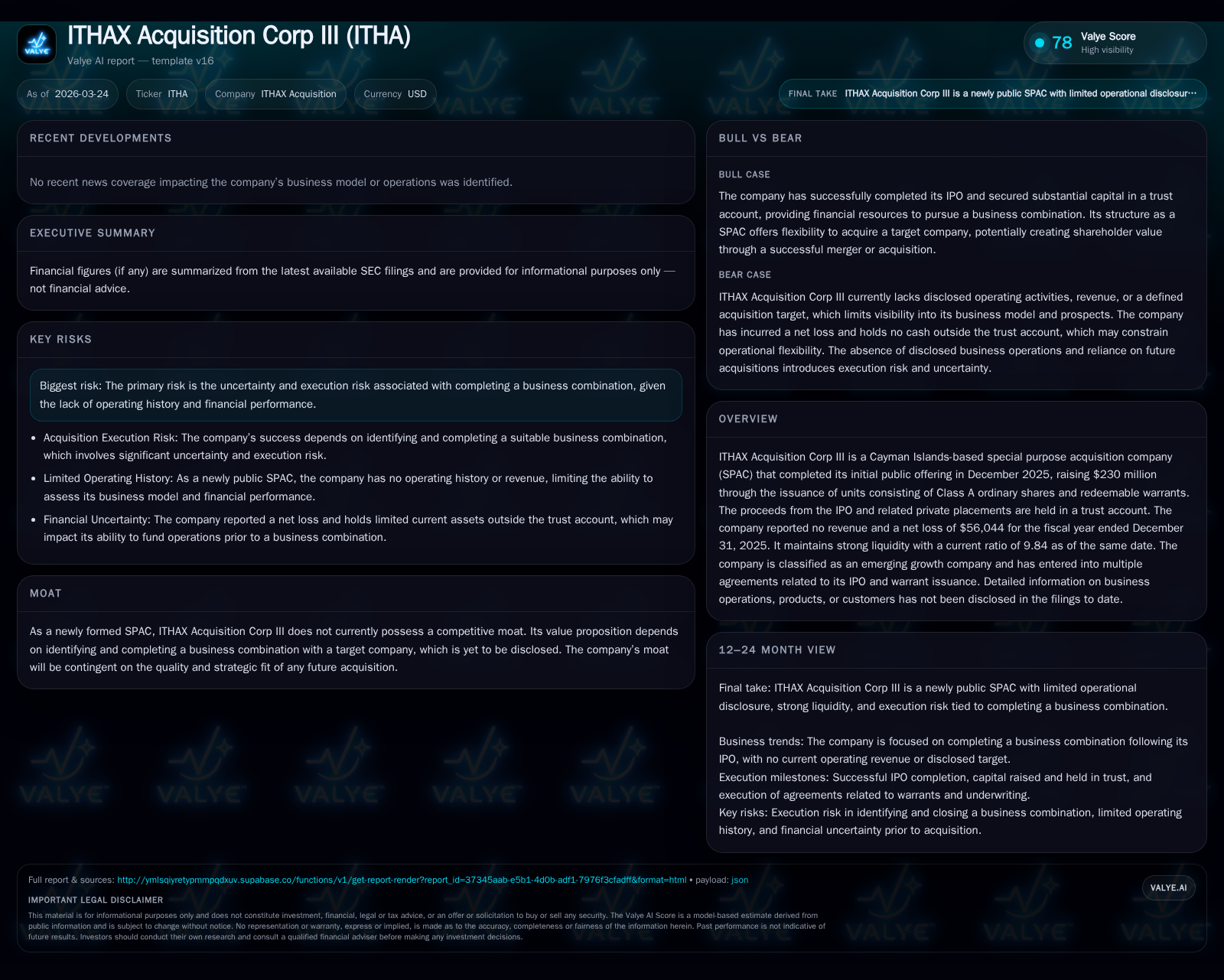
ITHAX Acquisition Corp III completed its initial public offering in December 2025, raising $230 million and establishing a solid liquidity base with capital held in trust. The company has yet to announce any target acquisition, reflecting typical SPAC uncertainties centered on successful deal execution within regulatory timelines. With negligible operating history and a modest net loss, investor focus will gravitate toward milestone announcements and capital allocation mechanisms, especially warrants and sponsor stakes. Tracking progress will hinge on business combination developments and the associated market responses.
Foundation via IPO: Capital Structure and Initial Funding
In December 2025, ITHAX Acquisition Corp III consummated its initial public offering (IPO), issuing 23 million units priced at $10 each. This transaction included a full exercise of the underwriter’s 3 million unit over-allotment option, generating gross proceeds of $230 million [S9][S12][F1]. Each unit comprises one Class A ordinary share plus one-half of one redeemable warrant exercisable at an $11.50 strike price per share, establishing complex capital layers typical of recent SPAC structures. Concurrently, the company sold warrants privately: 3.5 million Sponsor Private Placement Warrants to its sponsor entity and 2 million Representative Private Placement Warrants to Cantor Fitzgerald & Co., collectively raising $5.5 million [S9][S13][S20]. These private placement warrants differ from public warrants by being non-redeemable by the company while held by insiders and are subject to certain transfer restrictions until after a business combination [S14].
Nearly all funds raised—including IPO proceeds net of underwriting discounts ($224.5 million) plus private placement proceeds—were deposited into an interest-bearing, U.S.-based trust account managed by J.P. Morgan Chase Bank and Continental Stock Transfer & Trust Company as trustee [S12][S13][S17]. This arrangement safeguards investor capital until either an initial business combination occurs or liquidation is initiated.
Financial Snapshot: Operating Results and Liquidity at Inception
Having commenced operations post-IPO closure, ITHAX reported no revenue for the fiscal year ended December 31, 2025, consistent with its status as a shell company pending acquisition activity [F1][S1]. The net loss totaled $56,044—attributable primarily to administrative expenses associated with regulatory compliance and transaction-related services [F1]. Operating income was negative $133,876 reflecting these pre-operating costs [F1].
Liquidity metrics underscore financial health with current assets at approximately $958,865 against current liabilities near $97,468 yielding an exceptionally robust current ratio of 9.84 [F1]. This substantial liquidity buffer reflects the locked-in IPO proceeds held in trust plus payable obligations such as accrued administrative fees or underwriter commissions [S13][S14]. The company’s approximate return on equity stands at 0.6% based on limited net loss over equity levels [F1], indicating minimal operational erosion thus far.
SPAC Model Constraints: Execution Risk and Lack of Operating History
ITHAX Acquisition Corp III typifies the quintessential SPAC profile: it is an emerging growth company with no direct business operations or revenue stream apart from investment income tied to IPO proceeds in trust [S6][S7]. Its intrinsic value depends entirely on identifying and consummating a business combination within SEC-mandated timelines—typically within 24 months post-IPO—or returning investor funds.
SEC filings emphasize execution risks including potential failure to source suitable targets or consummate agreements within deadlines [S4][S5]. Additional regulatory challenges include managing shareholder redemption rights that can dilute deal economics or scuttle transactions if high redemption volumes occur. Legal exposures stem mainly from these "empty shell" operational risks inherent in SPACs absent business activities [S4]. The lack of operating history also reduces transparency for investors evaluating early-stage progress.
Investor Expectations for Business Combination Milestones
With no acquisitions announced or publicly revealed pipeline information available to date, critical milestones remain prospective events yet to materialize. Investors typically monitor several key phases: disclosure of potential merger targets; announcement of definitive agreements signifying de-SPAC progression; proxy material release for shareholder votes on proposed transactions; successful consummation achieving operational status.
Given these factors, absent disclosures from ITHAX itself or secondary reports as of March 2026, stakeholders should track share price movements around rumored deals or SEC filings reflecting merger proxies or timeline extensions. Achieving these milestones often resets market sentiment towards establishing credible valuation benchmarks post-deal completion.
Capital Allocation Strategy: Warrants, Sponsor Interests, and Share Mechanics
An essential element shaping ITHAX’s capital framework is the distribution and terms of various warrants issued during IPO-related private placements and public offerings [S8][S9][S10][S16][F1]. Public investors received half warrant per unit tradable separately after January 2026 under the symbols “ITHAW” for warrants and “ITHA” for shares post-unit separation [S18].
Sponsor private placement warrants number 3.5 million units purchased at $1 each entitle holders to purchase Class A shares on terms slightly more favorable than public warrants. These private warrants cannot be redeemed by the company nor transferred freely until after a business combination has closed according to contractual lockups [S14][S20]. Such structural arrangements create potential dilution risks upon exercise but align incentives between sponsors and public shareholders by tying payoffs to successful deal closure.
The interplay between redeemable warrants exercisable at $11.50 strike price post-combination introduces nuanced leverage into equity ownership that investors should incorporate into valuation scenarios following merger announcements.
Liquidity Profile and Current Ratio Insights
The liquidity posture as reflected by near-$959K current assets encompasses primarily cash and investments held within the trust account at J.P. Morgan Chase Bank pursuant to escrow agreements safeguarding IPO proceeds [F1][S12][S13][S14]. Current liabilities approximately $97K include accrued expenses related mostly to administrative fees payable but represent only a small fraction relative to assets.
Maintaining such elevated current ratios—nearly tenfold coverage—is standard for SPACs focused on preserving investor capital pending deployment towards qualifying acquisitions or eventual liquidation upon failure scenarios mandated by SEC rules within stipulated periods [S17]. This configuration underscores priority on capital preservation over operational spending.
Key Risks Highlighted in SEC Filings: Regulatory and Legal Considerations
SEC-mandated risk factors articulate principal concerns surrounding "empty shell" status leading to return-of-capital risk if management fails timely deal execution [S4][S5]. Compliance risk centers on strict adherence to reporting deadlines tied to filing merger proxies or amendments extending negotiation periods; failure triggers forced liquidation processes.
Legal proceedings disclosures remain clean as expected given the company's recent formation but serve as caution regarding litigation exposure associated with potential claims from disappointed shareholders or failed combinations later down the line [S4]. Regulatory risk also encompasses shareholder voting dynamics that may impact approved transaction structures.
Metrics for Monitoring Future Progress
Absent explicit disclosed guidance or pipeline details from ITHAX Acquisition Corp III combined with standard SPAC market practices suggest investors should focus monitoring efforts on:
- Timing and content of merger announcements or letters of intent signaling probable deal flow,
- Shareholder proxy filings setting dates for vote on proposed combinations,
- Volume shifts indicating warrant exercises or share redemptions,
- Stock price premiums relative to trust account per-share value indicating market confidence,
- Official extensions requested under SEC rules affecting deal deadline compressions.
These indicators collectively build a forward-view framework useful to assess the company’s trajectory toward completing its mission beyond its foundational capital raise phase.
Financial Snapshot — FY Dec 2025
Historical performance (annual)
| FY |
|---|
| 2025 |
Source: SEC companyfacts cache [F1].
Disclaimer: This analysis is based solely on information publicly filed up to March 24, 2026. It focuses on factual financials and documented disclosures without projecting future performance or issuing investment advice.
Disclaimer: This is research-only, informational analysis and not investment advice. It may include AI-generated interpretation and general industry context. Always verify important details using primary sources.

Comments