
Charging Robotics Advances Wireless EV Charging for Automated Parking Amid Financial Constraints
Charging Robotics pioneers resonant induction wireless EV charging with initial Israeli contracts while managing operating losses, liquidity risks, and expanding into electric micro-vehicles through its Revoltz stake.
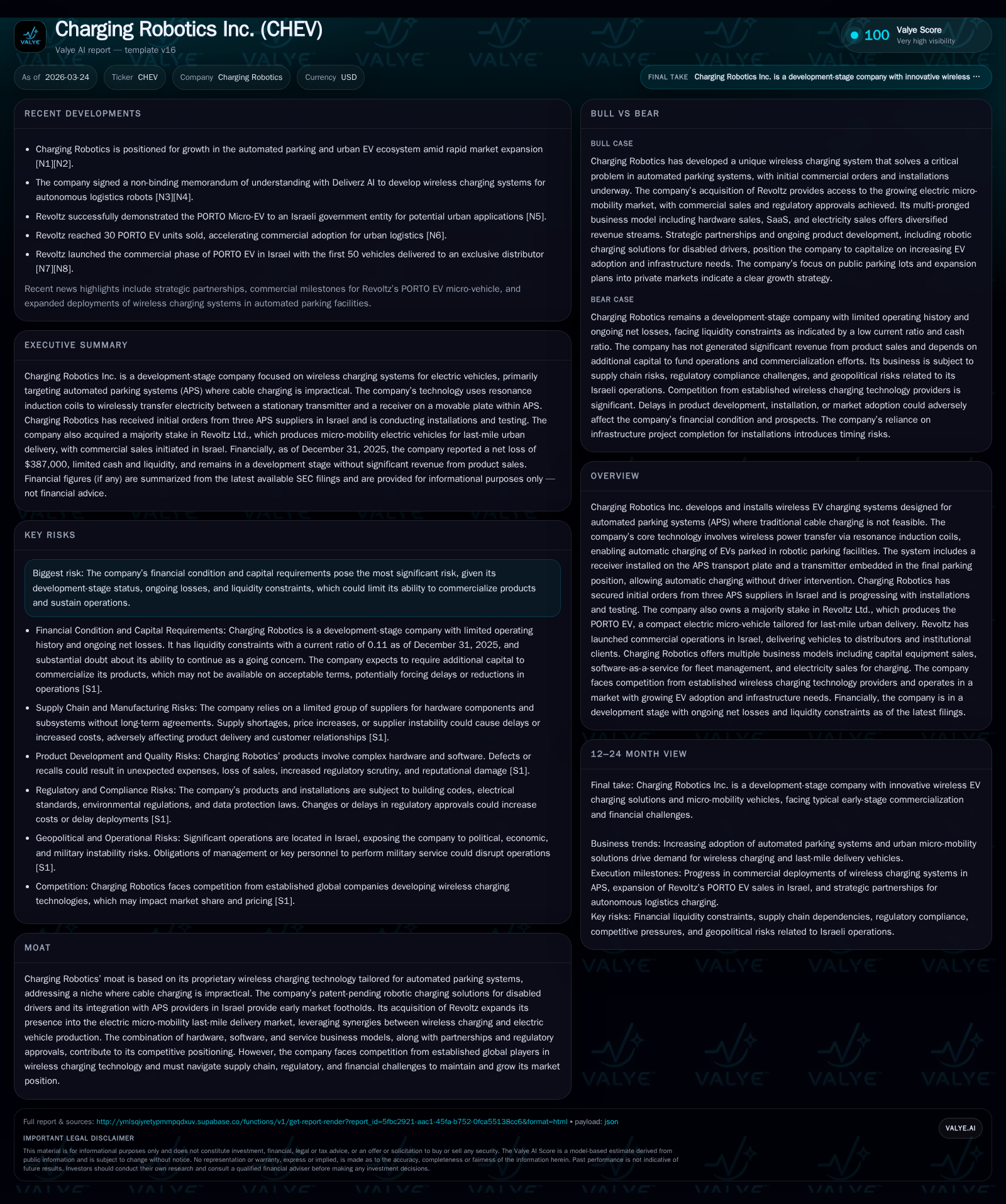
Charging Robotics Inc. pioneers wireless EV charging tailored for automated parking systems (APS), addressing scenarios where manual cable connection is unfeasible. The company holds initial orders from Israeli APS suppliers and is progressing with installations, while continuing to operate at a development-stage financial deficit with liquidity constraints. Its stake in Revoltz Ltd., a manufacturer of compact electric delivery vehicles, diversifies its presence into urban micro-mobility. Growth depends on scaling adoption, managing capital needs, and navigating competitive and regulatory risks.
Financial Performance Overview
Charging Robotics Inc. remains in the development stage with growing operating losses alongside nominal revenue recognition. In FY2025, operating losses increased sharply to approximately -$1.897 million from -$777,000 in FY2024 [F1]. Despite wider operating losses, net loss narrowed to -$387,000 in FY2025 versus -$842,000 the prior year [F1].
Operating cash flows continue to be negative, with $-1.053 million used in FY2025, reflecting increased investment in R&D and operations [F1]. Liquidity pressures are pronounced: current assets of $255,000 versus current liabilities of $2.271 million yield a current ratio of 0.11 at year-end 2025 [F1]. Total equity improved to $1.592 million but remains modest given ongoing losses.
Historical performance (annual)
| FY | Net ($) | CFO ($) | OpInc ($) | Net YoY |
|---|---|---|---|---|
| 2025 | -387000 | -1053000 | -1897000 | +54.0% |
| 2024 | -842000 | -610000 | -777000 | -8.2% |
| 2023 | -778000 | -617000 | -740000 | |
| 2021 | -102223 | -65936 | -102169 |
Source: SEC companyfacts cache [F1].
Capital returns and efficiency (annual)
| FY | ROE% |
|---|---|
| 2025 | -24.3 |
| 2024 | 137.4 |
| 2023 | 1051.4 |
| 2021 | -196.9 |
Source: SEC companyfacts cache [F1].
This pattern highlights substantial capital consumption with limited sales traction and acute short-term liquidity challenges [F1].
Proprietary Wireless Charging Technology
The company's core technology centers on a wireless charging system using resonant induction coils designed for automated parking systems (APS), where cable-based charging is infeasible [S4],[S22]. Power transfers wirelessly over an approximate 40mm air gap between transmitter coils installed at final parking locations and receiver coils mounted on transport plates moving the vehicles.
Charging initiates automatically once the vehicle is positioned on the APS plate at its final location; a mobile application triggers the process while sensing mechanisms ensure coil alignment for efficient energy transfer without driver intervention [S22].
Additionally, a patent-pending tethered robotic charger targets disabled drivers by autonomously navigating beneath vehicles using lidar sensors to enable wireless charging—a niche extension demonstrating product diversification [S22].
Market Strategy and Partnerships
Charging Robotics pursues a B2B approach targeting owners and operators of public parking spaces including malls, offices, hospitals, entertainment venues, and sports centers [S4]. It has secured initial orders from three Israeli APS suppliers currently engaged in installation pilots.
The business model comprises three main revenue streams [S4],[S5]:
- Hardware Sales: Capital equipment sold upfront with recurring service revenues post-warranty.
- Software-as-a-Service (SaaS): Subscription-based applications co-developed for EV fleet management delivering battery optimization features.
- Electricity Sales: Operation of charging infrastructure offering various pricing plans supported by proprietary wireless hardware and potential energy storage integration.
Strategic collaborations extend to EV manufacturers and infrastructure companies aimed at co-developing robotic solutions and accelerating market access [S4]. Building global brand recognition is a key objective.
Operational Risks and Competitive Landscape
Financial disclosures note going concern risks due to limited revenues against high cost structures and tight liquidity that may impede commercialization absent additional financing [S1],[S20].
Competition includes multinational incumbents such as Robert Bosch GmbH, Continental AG, WiTricity Corporation, Qualcomm Technologies (WiTricity), HELLA KGaA Hueck & Co., and ZTE Corp developing wireless charging technologies broadly applicable beyond APS [S22].
Supply chain dependencies on specialized components combined with geopolitical exposures related to its Israeli base pose operational risks [S6]. Regulatory compliance involving electrical safety standards and grid interconnection rules introduces complexity that can delay deployment or increase costs [S23].
Intellectual property protection offers advantages but also exposes the company to potential costly litigation or licensing obligations from third-party claims [S6],[S7],[S11],[S12],[S13]. Product defects inherent in complex electromechanical systems could lead to recalls or warranty costs affecting reputation and margins [S9],[S13]. Cybersecurity vulnerabilities remain a concern given reliance on data platforms [S7],[S15].
Diversification via Revoltz Acquisition
Charging Robotics holds a majority stake in Revoltz Ltd., which develops electric micro-vehicles optimized for last-mile urban delivery—the PORTO EV being commercially launched in Israel’s logistics sector [S14],.
PORTO EV combines compact dimensions for urban maneuverability with payload capacity akin to small hatchbacks. Integration of wireless charging technology supports continuous fleet operation critical for delivery efficiency.
This strategic move aligns Charging Robotics with electrification trends in sustainable urban logistics while expanding its ecosystem control along the delivery value chain.
Capital Allocation and Financial Health
The company does not pay dividends or conduct share repurchases; capital allocation prioritizes commercialization efforts and R&D investments consistent with developmental priorities [F1],[S29].
Return on equity stands negative at approximately -24%, reflecting ongoing net losses relative to modest equity levels primarily raised through financings rather than operational earnings [F1].
Liquidity metrics underscore pressing funding needs: minimal cash reserves combined with substantial current liabilities result in a current ratio of just 0.11 highlighting near-term solvency concerns requiring new capital infusions or operational adjustments [F1],[S20].
Outlook and Milestones
While no explicit revenue forecasts or detailed commercial milestones have been publicly disclosed beyond initial Israeli pilot deployments [N/A], key focus areas include scaling APS system rollouts among existing partners and expanding geographic reach internationally.
Securing additional financing rounds sufficient to cover cash burn remains critical for sustaining development momentum. Progress toward SaaS subscription growth and electricity resale uptake will serve as important indicators of monetization success.
Monitoring intellectual property developments including patent grants or disputes will be essential given their impact on competitive barriers.
Summary
Charging Robotics Inc. is advancing innovative wireless EV charging tailored for automated parking environments where traditional cable charging fails. Despite technical progress and initial market penetration in Israel coupled with diversification into last-mile electric vehicles via Revoltz Ltd., the company faces significant financial headwinds typified by steep operating losses and liquidity stress.
Risks span competitive pressures from established global players, regulatory complexities across jurisdictions, supply chain vulnerabilities tied to geopolitical factors, intellectual property uncertainties including litigation exposure plus operational challenges linked to product maturity.
Investors should weigh these factors alongside technological differentiation when assessing Charging Robotics’ prospects amid its transition from development-stage losses toward commercialization scale.
This report is provided solely for informational purposes without offering investment advice or recommendations regarding Charging Robotics Inc.'s securities or prospects.
Disclaimer: This is research-only, informational analysis and not investment advice. It may include AI-generated interpretation and general industry context. Always verify important details using primary sources.

Comments