
Bold Eagle Acquisition Corp. Faces Strategic Deadline with Trustee-Funded SPAC Model
As a SPAC without operations, Bold Eagle’s ability to complete a business combination by October 2026 is critical to preserving shareholder value.
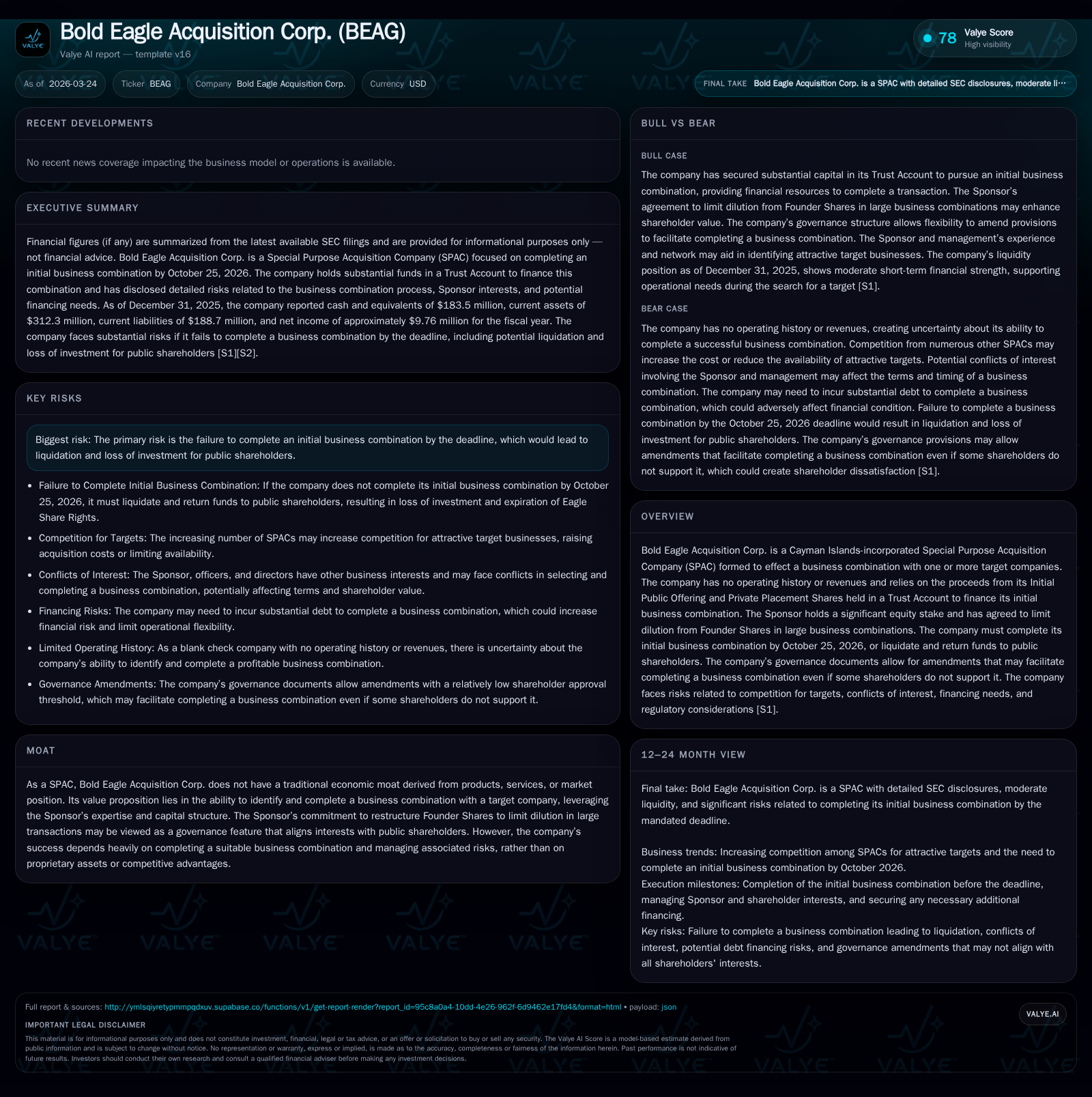
Bold Eagle Acquisition Corp. is a Cayman Islands-incorporated Special Purpose Acquisition Company focused on completing an initial business combination by October 25, 2026. With no operating history or revenue, its value hinges on identifying an attractive acquisition target and managing dilution and redemption risks. The Sponsor retains substantial equity with governance provisions to limit dilution in large transactions, but public shareholders face risks of liquidity constraints and potential loss if the business combination deadline lapses. Absent a deal, liquidation will return trust account funds to shareholders. The company has reported net income largely from non-operational sources with negative operating cash flows, underscoring its blank check nature.
Company Overview
Bold Eagle Acquisition Corp., incorporated in the Cayman Islands, operates as a Special Purpose Acquisition Company (SPAC). It has no operational activities or revenue-generating business lines since its inception. The company's primary purpose is to raise funds through an Initial Public Offering (IPO) and Private Placement shares to finance a future business combination — a merger or acquisition with one or more target companies [S1].
The proceeds from its IPO (held in a Trust Account) amount to approximately $249 million net of underwriting fees [S14]. These funds are escrowed and are intended solely for use in completing the initial business combination before the hard deadline of October 25, 2026. Failure to consummate such a combination by that date obligates Bold Eagle to liquidate and return monies from the Trust Account proportionally to public shareholders [S1][S26]. This puts significant operational pressure on management's ability to find an appropriate target within this timeframe.
Historical Financial Performance
Given its blank-check nature, Bold Eagle does not generate revenues from operations but incurs recurring costs associated with maintaining corporate structure, compliance, legal fees, due diligence efforts on acquisition targets, and organizational expenses. Consequently, the company has reported operating losses each year as expected.
Historical performance (annual)
| FY | Net ($mm) | CFO ($) | OpInc ($) | Net YoY |
|---|---|---|---|---|
| 2025 | 10 | -776908 | -1037395 | +377.7% |
| 2024 | 2 | -269546 | -253368 |
Source: SEC companyfacts cache [F1].
Capital returns and efficiency (annual)
| FY | ROE% |
|---|---|
| 2025 | -123.6 |
| 2024 | -26.0 |
Source: SEC companyfacts cache [F1].
- Operating income deteriorated significantly between FY2024 and FY2025 by over 300%, driven by increased administrative expenses related to acquisition efforts [F1].
- Net income appears positive primarily due to non-operating income items such as gains related to financial instruments or revaluations rather than core profitability [F1].
- Operating cash flow remains negative reflecting ongoing outflows for administrative overhead and transaction-related activities [F1].
- Equity figures are negative due to accumulated losses relative to contributed capital reflective of SPAC accounting treatment [F1].
Capital Structure and Ownership
The Sponsor initially subscribed for Founder Shares at nominal cost ($0.0004 per share) but has since surrendered shares reducing their stake over time from an original issuance of 57.5 million Founder Shares down to roughly 5.16 million shares outstanding [S7][S24]. Alongside these founder shares, they hold Private Placement Shares purchased at $10 per share totaling around $3.58 million investment. Collectively after these adjustments the Sponsor owns about 17.6% of total issued shares [S24].
A key governance feature is the sponsor's commitment via letter agreement that upon consummation of a business combination yielding a pro forma combined equity value exceeding $3 billion, Founder Shares will be restructured so their ownership represents approximately 1% of combined company equity immediately after closing. This mechanism is designed explicitly to limit dilution impact on new public investors [S22]. However, this letter agreement can be amended without shareholder consent — representing a material governance risk [S6].
Public shareholders hold redeemable Class A ordinary shares originally priced at $10 per share during IPO. Redemption rights allow them to withdraw their investment for cash from the Trust Account during proposed business combination approvals. There is no maximum redemption threshold limiting redemptions which introduces uncertainty into deal funding logistics [S15][S18]. The ability for significant redemptions can create leverage issues during negotiations with targets.
Business Combination Strategy and Risks
Bold Eagle intends to seek one or more acquisitions within its completion window but faces intense competition among numerous other SPACs vying for similar targets [S1][S6]. Generally targeting private companies where public information may be scarce increases due diligence complexity and risk of overpaying or acquiring underperforming businesses [S15][S16]. Simultaneous multiple acquisitions increase transaction complexity — including regulatory filings requiring pro forma combined financials — which could delay or hinder closing the initial business combination [S16].
There is also enhanced risk around conflicts of interest as sponsors and insiders hold substantial voting power — they have agreed contractually to vote in favor of all proposed combinations irrespective of public shareholder sentiment [S1][S28]. This could enable completion of acquisitions despite majority public dissent accompanied by redemption activity that dilutes remaining shareholder value.
Furthermore, redemptions coupled with deferred underwriting fees ($9 million held in Trust Account) may reduce available funds below levels needed for optimal transaction structuring [S14][S23]. In some scenarios, additional debt or equity financing might be required post-announcement but prior to close—there are no guarantees such funding would be available on favorable terms; failure here could force deal abandonment or restructuring [S14][S20].
Tax implications also complicate matters particularly if acquiring foreign entities necessitates multi-jurisdictional compliance which can increase audit exposures and complexity—possibly impacting post-merger profitability adversely [S17][S27].
Governance Provisions
The company’s memorandum grants significant powers including staggered board terms and authority for the issuance of new preference shares without shareholder approval—provisions which can deter hostile takeovers but entrench incumbent management [S27]. A forum selection clause mandates Cayman Islands courts oversee related disputes potentially increasing litigation costs while limiting shareholder access to other courts [S11][S27].
Additionally, shareholders’ voting power may be diluted upon successful completion of the business combination because Founder Shares were acquired at nominal cost but confer substantial economic interests thereafter—further heightening alignment concerns despite anti-dilution restructuring commitments in large deals [S22][S24].
Returns and Capital Allocation
To date Bold Eagle has distributed no dividends nor engaged in share repurchase programs consistent with its SPAC lifecycle stage where capital preservation until deal closing dominates strategy. The net proceeds residing within the Trust Account—approximately $249 million less deferred underwriting commissions—serve as collateralized funds reserved explicitly for deployment into one or multiple acquisitions [F1][S14][S19].
Operating cash flow remains negative reflecting ongoing expenses linked mostly to professional fees required for deal sourcing and administrative maintenance but these costs are modest compared with capital held in trust [F1].
Return metrics such as ROE show a distorted negative figure (-123%) driven by minimal operating income offset by non-operational gains skewing earnings positively though equity remains deeply negative by accounting design standards—making traditional profitability analysis difficult prior to combination closure [F1].
What To Watch Going Forward (Analysis)
Critical milestones include identifying one or more suitable acquisition targets delivering acceptable valuation multiples given competitive pricing pressure among SPACs approaching liquidity deadlines. Management’s ability to negotiate structures minimizing redemption risk will determine feasibility of closings within trust constraints—as high redemptions erode deal capacity significantly.
Market conditions will also influence availability of complementary financing required beyond trust escrow when targeting companies valued above trust proceeds alone—raising risk exposure. Regulatory developments surrounding SPACs' increasingly complex scrutiny could add compliance hurdles affecting timelines.
Finally investor sentiment towards SPACs continues evolving amid broader market cycles; this impacts trading liquidity constraints on Class A shares pre-combination thus indirectly influencing deal feasibility.
Disclaimer: This report summarizes publicly available data and SEC filings regarding Bold Eagle Acquisition Corp., focusing on historical performance metrics pertinent up through fiscal year-end 2025 alongside structural corporate details relevant as of March 24, 2026. It does not constitute investment advice nor predict future outcomes relating to any prospective business combinations or equity value performance.
Disclaimer: This is research-only, informational analysis and not investment advice. It may include AI-generated interpretation and general industry context. Always verify important details using primary sources.

Comments