
Scholastic Corp’s Shifting Revenue Streams and Capital Strategy in FY2025
Scholastic's financial evolution in FY2025 reveals revenue contraction against modest profit gains, shaped by diversified segments and a changing capital framework.
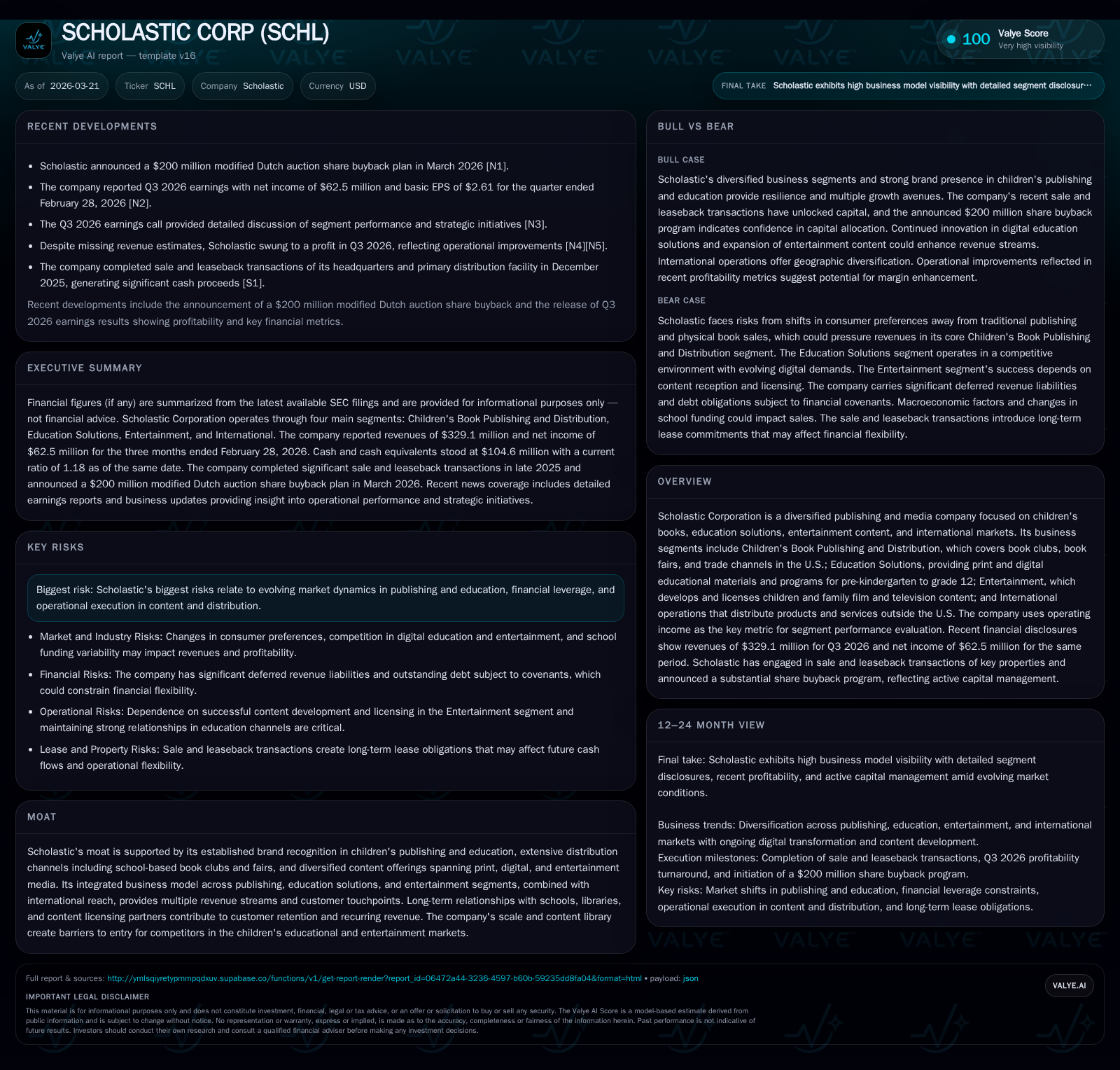
Scholastic Corporation reported a complex fiscal year 2025 marked by a roughly 10% revenue decline coexisting with a 9% rise in operating income, highlighting operational resilience amid top-line pressures. Net income reversed sharply into negative territory, reflecting non-operating challenges and impairments. The company executed significant debt reductions and orchestrated a disciplined capital allocation strategy incorporating dividends and substantial buybacks. Looking forward, growth will hinge on digital transformation successes, segment-specific execution, and prudent leverage management.
Three Years of Financial Evolution: Revenue and Profit Drivers
Fiscal year 2025 encapsulated Scholastic Corporation's ongoing battle with macro shifts in publishing and education markets reflected clearly in its financials. Total revenue fell approximately 10.1% to $1.487 billion compared to the prior year [F1]. Despite the declining top line, operating income edged up by around 9% to $15.8 million [F1], pointing to cost controls or segment mix effects mitigating margin erosion. However, net income swung negative to a loss of $1.9 million from a positive $12.1 million the previous year—a stark reversal primarily driven by impairments and adverse non-operating items [F1], corollary with disclosures of nearly $9.4 million impairment charges recognized during fiscal 2026 quarters [S20].
Operating cash flow (CFO) weakened by approximately 19.7% to $124.2 million for FY2025 compared with FY2024 [F1]. This fall was tempered by reduced capital expenditures (capex), which dropped about 21.8% year-on-year enabling positive free cash flow of an estimated $29.2 million despite revenue headwinds [F1].
This financial tension describes a shift toward more selective investment amid top-line pressure due partly to evolving consumer preferences away from traditional print to digital content formats and disruptions in school-based distribution channels integral to Scholastic's legacy [S28].
Historical performance (annual)
| FY | Net ($mm) | CFO ($mm) | OpInc ($mm) | Net YoY |
|---|---|---|---|---|
| 2025 | -2 | 124 | 16 | -115.7% |
| 2024 | 12 | 155 | 15 | -86.0% |
| 2023 | 86 | 149 | 106 | +6.7% |
| 2022 | 81 | 226 | 97 |
Source: SEC companyfacts cache [F1].
Capital returns and efficiency (annual)
| FY | Div ($mm) | Buybacks ($mm) | ROE% |
|---|---|---|---|
| 2025 | 23 | 70 | |
| 2024 | 25 | 158 | 1.2 |
| 2023 | 26 | 132 | 7.4 |
| 2022 | 21 | 33 | 6.6 |
Source: SEC companyfacts cache [F1].
Children’s Book Publishing and Distribution remains core but under pressure as traditional school reading events—book clubs/fairs—adjust post-pandemic with altered customer engagement patterns [N1]. The shift towards digital curricula reduces reliance on physical books, constraining growth but also pushing innovation in omnichannel distribution complexity [S28]. Despite this, this segment still delivers major contribution to revenues but at compressed margins.
Education Solutions, targeting pre-K through grade 12 schools/libraries with print and digital educational materials including classroom programs, faces a critical junction as digital curriculum penetration accelerates industry-wide [N2]. The company is actively aligning offerings toward scalable EdTech program models though execution risk persists given integration challenges [N2], [S28].
The Entertainment segment operates on content licensing leverage developed through recent acquisition of premium children’s content producers like 9 Story Media Group (purchased June 2024) [S17]. This division has mixed profitability impacted by episodic investments balanced by recurring licensing income streams but bears risks of project impairments witnessed recently [S20].
International operations provide geographic diversification but demand nuanced adaptation to local channel partner retention issues amid regional regulatory/market factors especially after winding down certain UK children’s book investments as per disclosures [S20], [N2].
Together these segments underpin Scholastic’s moat—anchored in content library monetization across book publishing and screen media coupled with established distribution touchpoints spanning schools globally.
Leverage, Liquidity, and Debt Profile Amid Refinancing Moves
Managing financial leverage emerged as a focal point over FY2025 into early fiscal 2026 with significant progress reported:
- As of November 30, 2025 Scholastic's long-term debt included $275 million under the U.S Credit Agreement at an average interest rate of approximately 5.7%, alongside smaller unsecured international credit lines totaling about $31.6 million [S4],[S8],[S16].
- By February 28, 2026 all revolving credit borrowings were fully repaid totaling a $350 million reduction from May-January period enabling zero outstanding bank debt under the facility ([S6],[S7],[S11]).
- The credit agreement expires November 26, 2029 with covenants aligned for maintaining leverage not exceeding approximately 2.75x net consolidated ratio—which Scholastic currently complies with—providing funding flexibility for dividends or buybacks within limits ([S4],[S6]).
- The facility includes an accordion provision permitting incremental borrowing capacity up to an additional $150 million if operationally warranted ([S7]).
This deleveraging shift improves cost of capital dynamics amid rising interest rate environments evidenced by tightening borrowing margins linked directly to net leverage ratios [S4], supporting financial discipline without compromising strategic agility.
Capital Allocation Dynamics: Dividends, Share Buybacks, and Cash Flow
Despite top-line headwinds Scholastic maintained commitment to balanced capital returns:
- Dividends hovered consistently around $22-25 million annually through FY23-FY25 reflecting steady payout policy aligned with modest ROE outcomes near zero or marginally negative due to net losses in latest periods ([F1],[S24]).
- Share repurchases demonstrated higher variability with FY25 contracting sharply to about $70 million from prior years’ amplitudes exceeding $130-$150 million marks ([F1],[N7]). A new $200 million modified Dutch auction tender offer was authorized March 19, 2026 exemplifying renewed shareholder capital return focus pending execution ([N7],[S3]).
- Operating cash flow softness (-19.7%) combined with capex prudence (-21.8%) enabled free cash flow generation circa $29 million despite uncertain revenue trends ([F1]), showcasing effective cash conversion cycle management.
This capital allocation reflects calibrated balancing between returning cash to shareholders while preserving liquidity for strategic investments including content development initiatives.
Growth Outlook: Strategic Initiatives and Market Constraints
Looking ahead through recent earnings commentary reveals mixed prospects:
- Management highlights cautious optimism about stabilizing revenue trajectories supported partially by education solutions adoption expansion bolstered via new print/digital hybrid programs targeting sustained penetration curves [N2]. However, digital transformation roadmaps require continued execution focus given evolving competitive intensity.
- Persistent consumer preference shifts away from traditional printed children’s books towards interactive/digital mediums underscore channel partner dynamics challenges especially school-centric sales events disruption from pandemic aftermath still lingering [N3],[N10].
- International operations must overcome geopolitical/market operability issues including winding down historically less profitable UK ventures—a process affecting investment write-downs but potentially freeing resources for growth markets ([S20],[N2]).
- Entertainment segment benefits from synergistic cross-media IP monetization yet susceptible to project-level risk necessitating cautious portfolio management.
Integration of these diverse facets defines Scholastic’s growth envelope constrained by market structural changes yet propelled by brand-driven omnichannel content ecosystems.
Key Milestones to Monitor Going Forward
Operationally critical checkpoints include:
- Execution trajectory for the announced $200 million modified Dutch auction buyback offer commencing late March extending through April offering potential upside support at prevailing price bands ($36-$40/share) ([N7]).
- Quarterly revenue cadence closely tied to seasonality fluctuations emanating from book fairs/clubs representing significant proportion of segment sales—variability here warrants close monitoring through earning cycles ([N1]).
- Continued debt refinancing progress including leveraging accordion option capacity if needed or managing maturity profiles prudently contributing toward maintaining low net leverage ratios enhancing funding optionality ([S6]).
- Adoption metrics for newly launched Education Solutions products blending print/digital curricula will serve as leading indicators for scaling EdTech program capabilities determining medium-term top-line revival potential.
These events encapsulate essential signals for mapping Scholastic’s recovery arc amidst shifting market paradigms.
This analysis synthesizes publicly filed financial documentation alongside recent earnings calls without offering investment recommendations or price forecasts but aims to delineate operational contours shaping Scholastic Corporation’s strategic posture through fiscal challenges and capital redeployment strategies.
Disclaimer: This is research-only, informational analysis and not investment advice. It may include AI-generated interpretation and general industry context. Always verify important details using primary sources.

Comments