
Urban One’s Fiscal Struggles and Strategic Debt Maneuvers in 2025
Urban One faces mounting losses amid industry pressures, implementing substantial debt restructuring and maintaining liquidity through a reverse stock split and refinancing efforts.
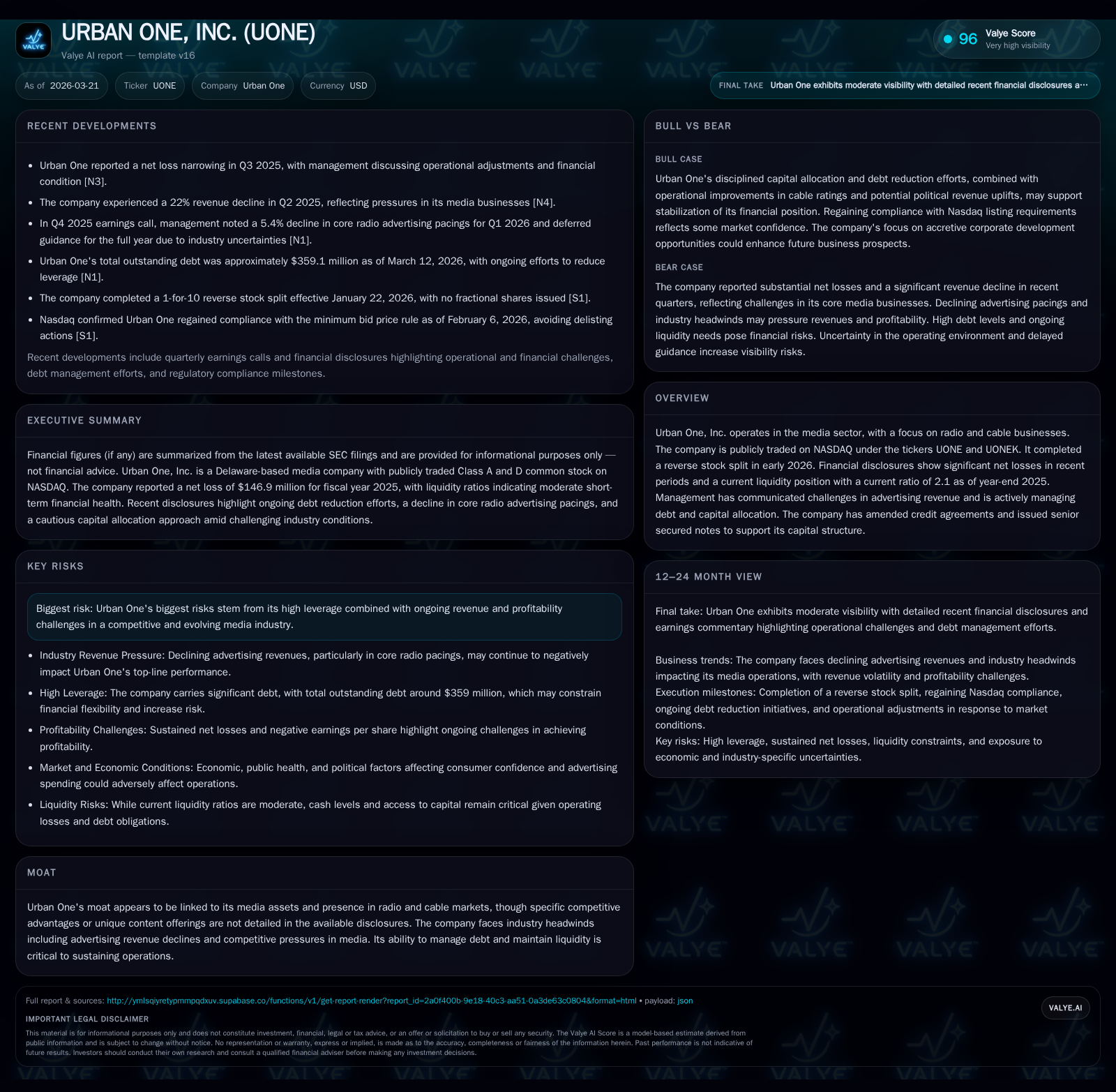
Urban One, Inc. experienced steep declines in profitability through 2025 despite relatively stable revenue, pressured primarily by shrinking advertising in its core radio segment and broader media headwinds. The company undertook a 1-for-10 reverse stock split to regain Nasdaq compliance and completed a multi-layered debt restructuring, issuing first and second lien senior secured notes with complex intercreditor agreements. Cash flow constraints became apparent as operating cash flow plummeted while capital expenditures rose, resulting in negative free cash flow. Limited buybacks continued alongside a pause in dividends reflecting cautious capital deployment. Looking ahead, management flags potential political advertising revenue as a near-term catalyst but acknowledges persistent competitive challenges and financial covenant risks.
Urban One's Revenue and Profit Trends: From Stability to Decline
Urban One historically generated roughly stable top-line revenue around $110–114 million annually during the mid-2010s, with revenues at approximately $113.5 million in FY2018 [F1]. However, this stability masked deteriorating profitability starting in 2023. Operating income swung drastically from an operating profit of about $94.7 million in FY2022 into escalating losses culminating at -$170.1 million by FY2025 [F1]. Net income followed suit, turning from a positive $37.3 million in FY2022 to a significant net loss of -$146.9 million for FY2025 [F1].
This dramatic swing reflects accelerated pressure on operational margins amidst weak advertising demand—a cornerstone revenue driver—compounded by increased costs across the media portfolio. The resulting erosion depressed returns sharply, pushing ROE to an approximate negative 597% ratio owing to shrinking shareholders’ equity, which dropped markedly from roughly $333.8 million in FY2022 to about $24.6 million by FY2025 [F1].
Historical performance (annual)
| FY | Net ($mm) | CFO ($mm) | OpInc ($mm) | Capex ($mm) | Net YoY |
|---|---|---|---|---|---|
| 2025 | -147 | 4 | -170 | 10 | -39.4% |
| 2024 | -105 | 37 | -76 | 7 | -5241.2% |
| 2023 | 2 | 65 | -32 | 8 | -94.5% |
| 2022 | 37 | 67 | 95 | 7 |
Source: SEC companyfacts cache [F1].
Capital returns and efficiency (annual)
| FY | Buybacks ($mm) | FCF ($mm) | ROE% |
|---|---|---|---|
| 2025 | 3 | -6 | -597.0 |
| 2024 | 8 | 30 | -61.7 |
| 2023 | 2 | 57 | 0.7 |
| 2022 | 27 | 60 | 11.2 |
Source: SEC companyfacts cache [F1].
Net losses have thus been symptomatic not solely of raw operational decline but indicative of strategic challenges adapting the African-American targeted multimedia portfolio to evolving advertiser behavior.
Effects of Advertising Headwinds on Core Radio and Cable Segments
Urban One’s radio broadcasting business is the largest franchise targeting African-American urban consumers via an aggregate of predominantly FM/AM stations plus HD channels concentrated across major metropolitan areas with high demographic concentration [S1]. Historically reliant on local and national advertising sales, this segment has encountered material setbacks owing to tighter advertiser budgets.
During Q1 of 2026 management reported core radio pacing down about 5.4% year-over-year—a term describing current advertising sales run rates relative to prior baselines—reflecting pronounced pressure within traditional linear media segments [N1]. This decline contrasts with reported improvements in cable television ratings for their TV One and CLEO TV networks which target the same demographic using multi-platform content [S3]. Political advertising presents a potential incremental uplift opportunity ahead given election cycles facilitating greater spending targeting urban constituents.
The company continues emphasizing audience targeting strategies combining syndicated shows under Reach Media—including marquee programs such as Rickey Smiley Morning Show—and digital platforms like Interactive One serving social content over iONE Digital and others tailored for cultural relevance [S1]. Yet shifting advertiser preferences towards digital formats impose competitive barriers despite these diversified media holdings.
Capital Structure Overhaul: Refinancing, Credit Agreements and Note Issuances
Facing mounting losses and liquidity pressures Urban One undertook comprehensive capital structure adjustments late in calendar year 2025 summarized as follows:
- Second Lien Senior Secured Notes: Issuance of approximately $291 million aggregate principal amount at a coupon rate of ~7.625%, maturing in 2031; these rank subordinate only to first lien debt but superior to unsecured creditors [S11], [S12].
- First Lien Senior Secured Notes: Issued ~$60.6 million principal amount carrying a higher interest rate (10.50%), reflecting increased risk premium on senior secured obligations [S5], [S7], [S8].
- Amended Asset-Backed Lending (ABL) Facility: Amended credit agreement providing up to $75 million initially with incremental capacity for an additional $25 million structured with pari passu security interests aligned with other senior notes [S4], [S22].
Intercreditor agreements define lien priorities among credit instruments delineating collateral rights under "first lien," "second lien," or junior security categories along with restrictive covenants limiting incremental indebtedness issuance asset disposals below book thresholds discretionary dividends share repurchases beyond limits tied to leverage ratios or EBITDA adjustments [S4–S8].
This orchestration aims at extending maturity profiles approaching or exceeding five years while calibrating coupon rates commensurate with risk perception inherent to Urban One's volatile sector.
Cash Flow Constraints and Implications for Liquidity Management
Operating cash flow compressed precipitously from nearly $67 million in FY2022 down to roughly $4.16 million by FY2025—a decline exceeding 88% year-over-year—intensifying liquidity challenges despite positive accounting operating cash flows [F1]. Concurrently capital expenditures increased materially reaching over $10 million annually amid investments presumably tied to digital platform enhancements or technical upgrades [F1]. The net effect is a negative free cash flow trend (operating cash flow minus capex) approximated at -$5.9 million for FY2025.
Despite this strain Urban One maintains a current ratio above two times (2.1x), sustained by current asset composition including cash balances near $25.5 million ending FY2025 versus current liabilities around $78 million [F1]. This buffer offers temporary operational runway but leaves limited margin should advertising trends worsen or capital needs accelerate.
Strategic Capital Allocation: Limited Buybacks and Dividend Absence
Reflective of its challenged financial position under tightened credit covenants restricting dividends or material distributions [S4] Urban One suspended dividend payments entirely throughout recent years while sharply curtailing share repurchases—down to roughly $2.76 million during FY2025 compared with over $26 million spent on buybacks back in FY2022 [F1], [S10], [S13], [S21].
This conservative posture aligns with standard leveraged balance sheet discipline prioritizing deleveraging readiness over shareholder return enhancement amid volatile earnings.
Compliance Risks and Nasdaq Listing Challenges Following Reverse Stock Split
On January 22nd 2026 Urban One executed a mandatory reverse stock split at the ratio of one-for-ten across all classes of common stock including publicly traded Class A (UONE) and Class D (UONEK) shares effectively reducing share count by ninety percent to lift the trading price per share above Nasdaq’s minimum bid price rule threshold of one dollar per share [S13].
The measure successfully restored compliance by early February as confirmed by Nasdaq Staff's recognition that the closing bid price met requisite standards for ten consecutive business days ending February sixth ensuring delisting risk abatement temporarily [S6].
However Nasdaq’s rules impose strict limitations against subsequent reverse splits within defined timeframes and immediate delisting consequences should pricing fail again or other listing violated criteria ensue limiting management flexibility amid ongoing market uncertainties[S1].
Prospects for Revenue Rebound Amid Competitive Urban Media Landscape
Forward-looking comments acknowledge continued softness with first quarter radio pacing down about -5.4% but also emphasize encouraging signs like improved cable network ratings alongside political advertising inflows anticipated as potential revenue catalysts linked to electoral cycles slated through coming quarters[N1],[S3].
Urban One’s strategic emphasis on multi-platform integration targeting African-American audiences remains intact though competitive pressure intensifies both from digital pure-play entrants impacting advertiser budgets and consolidation tendencies within traditional broadcast venues.
Financial Metrics to Monitor: What Comes Next for Urban One?
Absent definitive forward guidance beyond cautious optimism regarding rating gains and political ad boosts key metrics warranting scrutiny include:
- Quarterly updates on radio advertising pacings capturing real-time revenue momentum shifts;
- Monitoring debt covenant compliance signals post-refinancing sensitive to leverage ratios;
- Cash balance trends coupled with capital expenditure plans informing liquidity runway;
- Audience engagement metrics within core African-American urban markets relevant for advertiser valuation.
Management must navigate enhancing operational efficiencies alongside prudent capital stewardship given elevated leverage coupled with sectoral structural challenges outlined extensively across SEC filings.
This analysis summarizes publicly available financial data and regulatory disclosures as of March 21st 2026 without providing investment recommendations or price targets.
Disclaimer: This is research-only, informational analysis and not investment advice. It may include AI-generated interpretation and general industry context. Always verify important details using primary sources.

Comments