
GrowGeneration Corp.: Proprietary Brands and Multi-Channel Growth Drive Market Leadership
GrowGeneration leverages proprietary brands and diversified distribution channels to strengthen its position in the fragmented hydroponic and gardening market.
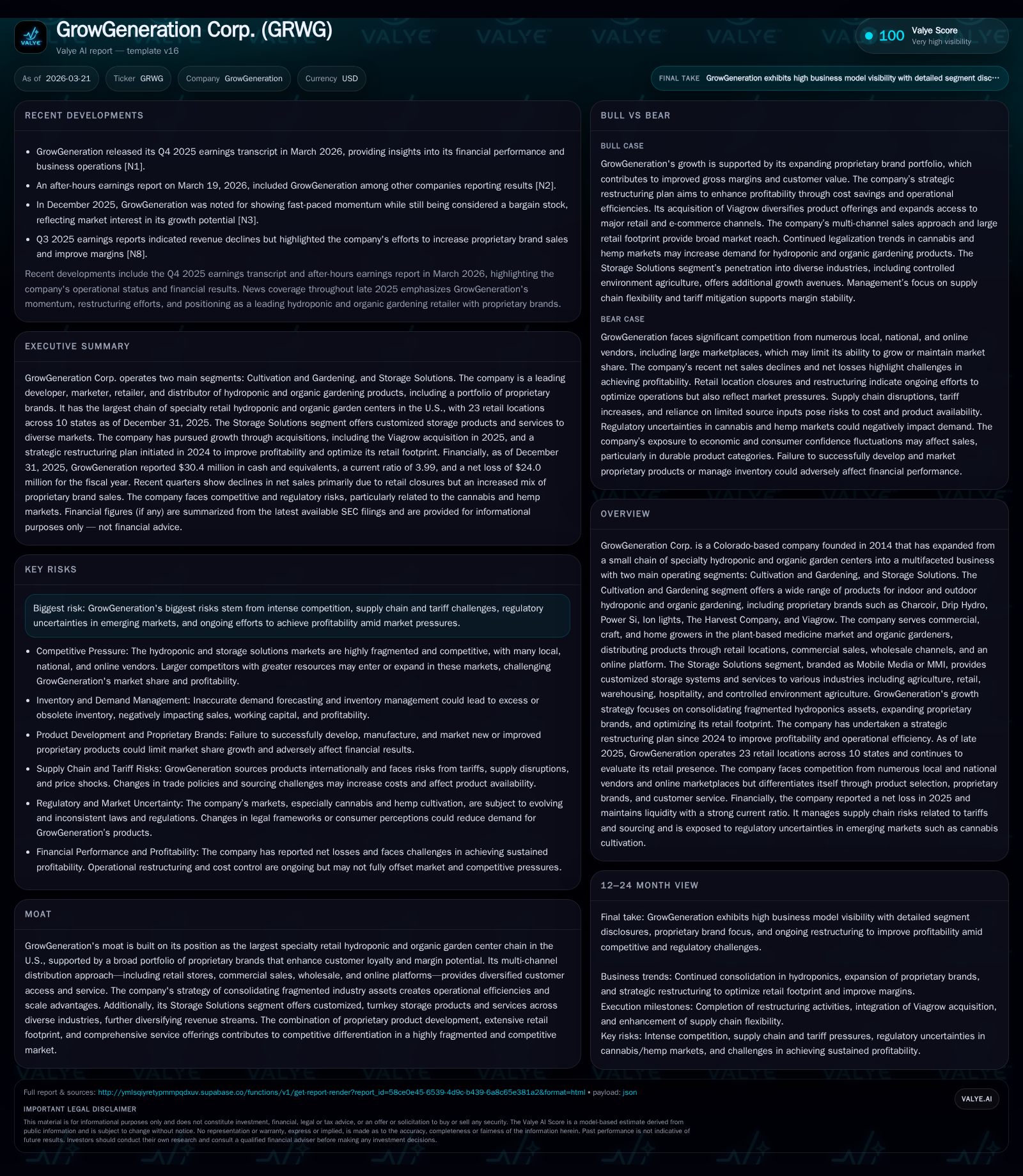
GrowGeneration Corp. has evolved from a niche hydroponic garden center operator into the largest specialty hydroponic and organic gardening retailer in the U.S., supported by two main segments: Cultivation & Gardening and Storage Solutions. Its growth is powered by expanding proprietary product brands and a multi-channel distribution network encompassing retail, commercial, wholesale, and e-commerce. While operating losses have narrowed alongside revenue gains, profitability remains elusive amid regulatory, supply chain, and competitive challenges. Investors should monitor progress on margin improvement through proprietary brand penetration, tariff mitigation strategies, and operational efficiencies as key drivers of a sustainable profit trajectory.
From Seed to Scale: Charting Historical Growth and Revenue Drivers
Founded in Colorado in 2014 as a modest chain of specialty hydroponic garden centers, GrowGeneration Corp. has aggressively scaled into the largest specialty retailer in the U.S. for hydroponic and organic gardening supplies with a commanding physical footprint spanning over 563,000 square feet across 23 locations nationwide as of December 31, 2025 [S4][S8]. This rapid expansion was driven by strategic acquisitions including a notable purchase of Viagrow assets in June 2025 which broadened proprietary brand offerings and amplified reach into mass-market retail customers [S9][S16].
Financially, GrowGeneration's top-line has grown explosively from approximately $14.4 million in revenue in FY2017 to over $193 million by FY2020—a compound annual growth rate reflecting consolidation efforts within a fragmented sector [F1]. However, operating income has remained negative throughout this period despite a marked improvement from a -$167.9 million operating loss in FY2022 to -$25.6 million in FY2025. Similarly, net losses narrowed materially (FY2025 net loss: -$24 million), highlighting ongoing margin pressures amid growth investments [F1].
Seasonal biases persist with sales typically peaking in Q2-Q3 aligning with outdoor growing seasons; this seasonality additionally affects storage segment sales which follow retail capital expenditure cycles [S16].
Historical performance (annual)
| FY | Net ($mm) | CFO ($mm) | OpInc ($mm) | Net YoY |
|---|---|---|---|---|
| 2025 | -24 | -9 | -26 | +51.4% |
| 2024 | -50 | -2 | -52 | -6.5% |
| 2023 | -46 | 1 | -50 | +71.6% |
| 2022 | -164 | 12 | -168 |
Source: SEC companyfacts cache [F1].
Capital returns and efficiency (annual)
| FY | Buybacks ($mm) | ROE% |
|---|---|---|
| 2025 | 0 | -24.7 |
| 2024 | 6 | -41.2 |
| 2023 | -26.8 | |
| 2022 | -75.7 |
Source: SEC companyfacts cache [F1].
*Note: Financial data post-2020 reflect most recent available fiscal years per SEC filings; blank cells indicate no detailed data reported for those years.[F1]
Harnessing Proprietary Brands to Boost Margins and Customer Loyalty
At the core of GrowGeneration’s margin improvement strategy lies its portfolio of proprietary brands including Charcoir cocos substrates and pots; Drip Hydro nutrients; Power Si monosilicic acid additives; Ion lighting solutions; The Harvest Company organic gardening products; and Viagrow tools—all developed with deep grower expertise to meet evolving cultivation needs [S4][S5]. These intellectual property assets differentiate GrowGeneration’s offering against commoditized third-party products typically sold by competitors or generalist retailers.
Proprietary brands deliver several strategic benefits: higher gross margins relative to third-party products; enhanced customer loyalty through unique formulations or designs; control over supply chain inputs allowing agility against tariff or disruption risks; and opportunities for direct innovation responding swiftly to emerging cultivation technologies or regulatory demands [S15]. Nonetheless this approach carries risks including maintaining rigorous quality standards amid complex manufacturing processes prone to disruption; the necessity for ongoing investment in R&D and marketing; intellectual property enforcement challenges especially given counterfeit or grey-market threats; potential product recalls; and vendor relationship strain when company products compete directly with resellers’ other supplier lines [S15].
GrowGeneration actively invests in expanding these proprietary lines domestically and internationally while advancing assembly processes domestically for select SKUs to mitigate tariff exposure on imported componentry [S9][S26].
Multi-Channel Distribution: Integrating Retail, Commercial, Wholesale, and E-Commerce
GrowGeneration’s multi-faceted distribution platform covers diverse customer profiles—from home gardeners to large commercial cultivators—through omni-channel integration.
Specialty retail centers provide extensive product assortments coupled with expert ‘white glove service’ tailored for commercial growers requiring customized solutions beyond standard offerings [S8][S10]. Complementing this are wholesale partnerships supplying independent dealers and major mass-market retailers enabling scale economies.
The commercial division serves professional cultivators with consultative services including site assessments—leveraging centralized 'pick-pack-ship' fulfillment capabilities ensuring timely delivery across geography—critical given cultivation cycles' time sensitivity [S8][N1]. Meanwhile growgeneration.com supports online order placement via a B2B portal enhancing accessibility amidst digital commerce trends accelerated by pandemic-era shifts.
This integrated approach expands customer touchpoints facilitating cross-selling proprietary products while improving inventory turns through strategically located logistics hubs nationwide [S8]. As retail footprint rationalization continues addressing fixed cost redundancies alongside deeper e-commerce penetration without physical overheads [N1][S6], channel synergy will be an increasingly important lever for profitable scaling.
Market Fragmentation and Industry Dynamics Shaping Growth Opportunities and Hurdles
The specialty hydroponic market is highly fragmented with hundreds of small local independent retailers competing alongside GrowGeneration’s consolidated network—the largest player by count of stores nationwide—with varied capabilities from pure brick-and-mortar storefronts to sophisticated e-commerce operators [S1][S29]. Such fragmentation offers acquisition opportunities enabling incremental scale gains but exposes GrowGeneration to heightened competition from well-funded generalist home improvement chains encroaching via online offerings or direct vendor relationships.
Large distributors outside traditional horticulture applying broadline models could pivot into this niche exerting pricing pressure or stealing share through logistics advantages.
Intense competition necessitates continuous investment not only in product innovation but also technology-enabled inventory optimization responsive pricing models balancing volume growth with margin preservation—particularly important since cost overruns can quickly erode profit structures within specialized consumable-rich categories dominating hydroponic tailwinds [S1][S29].
Evolving Regulatory Landscape and Supply Chain Implications on Cost Structure
U.S. trade policy changes effective early 2025 introduced baseline tariffs averaging about 10% on certain imported goods critical to GrowGeneration’s proprietary manufacturing inputs sourced internationally—a complex tariff matrix under Executive Order 14257 impacting less than 10% of total cost of goods sold but enough to pressure margins requiring active mitigation tactics [S2][S7][N1].
Management partially offsets these increases via targeted price adjustments while pursuing supplier diversification favoring lower-tariff regions like Southeast Asia or domestic manufacturing expansions reducing logistical dependencies downstream [S9][S26].
Regulatory uncertainty remains regarding federally illegal plant-based medicines such as cannabis despite state-level legalization frameworks—posing credit risks notably if industry clients face bankruptcy restrictions impairing receivables collections or if future legislation limits cultivation site build-outs constraining durable product demand foundational to revenue stability versus consumable replenishment lifecycles typical thereafter [S11][S21][N1].
Compliance complexities add costs linked to environmental safety regulations governing input materials or liability insurance exposures requiring robust controls amplifying operating overheads.[S21]
Financial Health: Operating Loss Reduction, Cash Flow Trends, and Capital Allocation
Financial statements disclose progressive narrowing of operating losses—from -$51.9 million recorded for FY2024 toward -$25.6 million by FY2025—as operational scale matures combined with cost control efforts reduce drag on earnings though profitability remains out of reach currently [F1].
Net loss reduction mirrors this trend at -$24 million versus prior larger deficits consistent with ongoing investment supporting expansion.
Operating cash flow turned sharply negative again after positive mid-cycle results indicating working capital challenges possibly due to inventory buildup ahead of tariff impacts or delayed receivables collections (-$9.45M CFO in FY2025 vs +$1.42M FY2023), underscoring execution risks around liquidity management crucial as capex intensity appears restrained historically falling steeply after infrastructure build-out phases past peak levels prior to FY2018 (~89% YoY capex decline) [F1][S12][N1].
Year-end balance sheet positioning reveals robust liquid asset buffers reflected by approximately $30 million cash & equivalents bolstered by strong current ratio near four times signaling short-term financial flexibility supportive amid lingering structural losses providing runway for strategic initiatives though external financing needs remain plausible given equity shrinkage from $216M FY2022 toward $97M FY2025—reflective of recapitalization necessity potentially tied to prior share issuances or accumulated deficit dilution impacting book value creation metrics like ROE roughly negative -25% consistent with continued loss-making operations during growth phases [F1][S12].
Share Repurchases as a Signal of Confidence amid Path to Profitability
Recent disclosures reveal GrowGeneration’s board authorized a $10 million stock repurchase program commencing post customary regulatory clearances evidencing executive confidence even absent current positive operating cash flows—a vote-of-confidence signal aimed at absorbing undervaluation perceptions stemming from near-term earnings challenges typical within evolving specialty retail platforms transitioning through consolidation phases [N1][S3][F1].
No dividends have been issued historically aligning capital returns toward reinvestment into growth initiatives while deploying buybacks opportunistically once operating income trends demonstrate durability—consistent with disciplined capital allocation governance frameworks observed across emerging vertical market consolidators.
What Investors Should Watch: Strategic Milestones and Profitability Catalysts
Stakeholders should monitor key operational milestones including increased penetration rates of proprietary brand sales across all channels since margin uplift therefrom represents primary path toward sustainable profitability as emphasized by management commentary highlighting innovation pipeline importance alongside supply chain adaptability facing tariff-induced cost headwinds [N1][S2].
Equally critical will be outcomes related to regulatory clarity progression particularly within cannabis adjacent cultivation markets where legal uncertainties pose upside opportunity upon normalization plus downside default risks impairing demand forecasts—any acceleration toward federal acceptance or relaxed enforcement could materially widen market access complementing existing footprint positioning.
Operational improvements focusing on streamlining warehouse logistics efficiency leveraging centralized 'pick-pack-ship' capabilities integrated with digital ordering platforms may reduce fulfillment costs tightening expense leverage ratios expected amid greater scale utilization economics enabled via carefully calibrated store footprint rationalization targeting overlapping regions boosting same-store productivity metrics without sacrificing end-customer accessibility.[N1]
In sum GrowGeneration stands at an inflection poised between maturing growth investments toward margin recovery while contending against competitive forces inherent across specialty consumer durable-consumable hybrid markets complicated further by tariffs regulatory flux highlighting need for agile management execution balancing innovation investment against prudent financial stewardship.
This report is prepared solely for informational purposes based on publicly available data sources cited herein. It does not offer investment advice nor suggest specific trading actions regarding GrowGeneration Corp.
Disclaimer: This is research-only, informational analysis and not investment advice. It may include AI-generated interpretation and general industry context. Always verify important details using primary sources.

Comments