
Peoples Financial’s Loan Portfolio Dynamics and Returns Amid Credit Challenges
An in-depth review of Peoples Financial Corp’s evolving loan composition, credit quality mechanisms, and capital return strategy against a backdrop of earnings volatility.
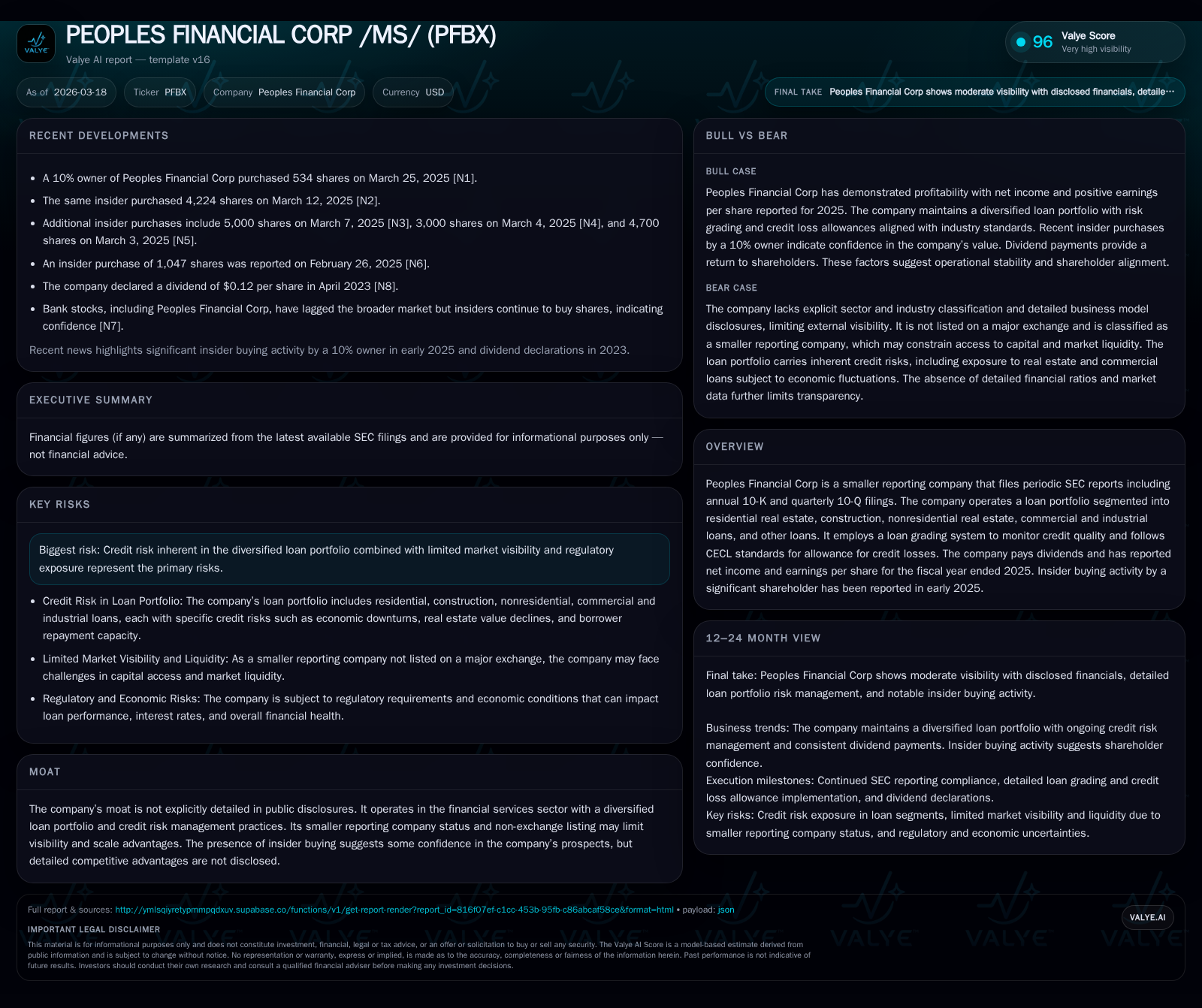
Peoples Financial Corp experienced a sharp decline in net income through 2025, with earnings contracting approximately 82% year-over-year largely due to heightened credit loss provisions and margin compression. The company manages a diversified loan portfolio segmented across residential, construction, nonresidential real estate, commercial and industrial loans with a detailed loan grading system aligned with CECL methodology to monitor credit risk. Liquidity remains supported by positive operating cash flow despite reductions, while disciplined capital allocation continues via dividends and modest buybacks. Looking ahead, credit environment pressures and moderate economic headwinds present challenges, though insider buying signals some confidence in the underlying underwriting discipline.
Financial Performance Swings: Dissecting the Collapse in Net Income for 2025
Historical performance (annual)
| FY | Net ($mm) | CFO ($mm) | Net YoY |
|---|---|---|---|
| 2025 | 4 | 5 | -82.0% |
| 2024 | 22 | 6 | +136.8% |
| 2023 | 9 | 9 | +2.5% |
| 2022 | 9 | 8 |
Source: SEC companyfacts cache [F1].
Capital returns and efficiency (annual)
| FY | Div ($mm) | Buybacks ($mm) | ROE% |
|---|---|---|---|
| 2025 | 2 | 1 | 3.9 |
| 2024 | 2 | 1 | 24.1 |
| 2023 | 2 | 0 | 13.2 |
| 2022 | 1 | 3 | 16.2 |
Source: SEC companyfacts cache [F1].
Peoples Financial Corp's net income contracted sharply from $21.7 million in FY2024 to roughly $3.9 million in FY2025, an approximate decline of 82% year-over-year [F1]. This dramatic reduction reflects elevated provision expenses linked to asset quality deterioration amidst tightening underwriting conditions noted in Q3 filings [S2]. Operating margins were compressed as net interest income faced headwinds from credit losses and competitive pressures on loan yields. Noninterest income shifts played a lesser role compared to rising loan loss expense burdens that absorbed substantial earnings power during the year.
This volatility underscores the material sensitivity of profitability to credit impairments within its loan book. The bank's smaller scale possibly exacerbates exposure concentration risks and limits revenue diversification avenues relative to larger financial institutions .
Loan Portfolio Composition and Credit Risk Controls: Grading System and CECL Implementation
The company's lending assets are segmented into distinct categories: residential real estate mortgages; construction loans encompassing both residential and commercial builds; nonresidential real estate financing; commercial and industrial (C&I) loans; and an 'other' category capturing varied exposures [S4][S5]. Each segment carries distinct credit risk characteristics:
- Residential mortgage loans bear sensitivity to local economic conditions including unemployment rates and home price volatility.
- Construction loans are vulnerable to cost overruns, marketing time elongation for finished properties, and fluctuations in long-term financing availability.
- Nonresidential real estate credits face industry concentration risk along with challenges monitoring collateral condition amid occupancy rate variability.
- C&I loans expose the bank to inventory obsolescence risks and difficulties assessing accounts receivable quality.
- Other loans encompass personal property collateral which is inherently harder to value or monitor.
The company employs a comprehensive loan grading system ranging from A (excellent quality) through F (highly problematic), integrating factors such as repayment capacity, borrower net worth trends, employment stability, loan-to-value (LTV) ratios fluctuations, loan structure conformity with policy, and payment history integrity [S10][S25]. This internally consistent framework informs the determination of allowances for credit losses pursuant to CECL standards requiring forward-looking assessments based on past events, current conditions, and reasonable forecasts [S19][S22].
Operating Cash Flow and Free Cash Flow Trends: Underlying Drivers of Liquidity
Despite the deterioration in net income, operating cash flow (CFO) remained positive at approximately $4.5 million for FY2025 but declined by over 25% from $6 million the previous year [F1], signaling pressure on underlying cash-generative capacity. Capital expenditure outlays fell precipitously—down about 84.5%—to $302 thousand in FY2025 reflecting a conservative approach toward funding growth initiatives or maintenance investments amid uncertain earnings outlooks [F1][S7].
This cash flow profile implies cautious liquidity management focusing on sustaining operations while preserving capital buffers through expenditure restraint rather than aggressive expansion.
Capital Allocation Priorities: Dividends, Share Repurchases, and Equity Trends
Peoples Financial maintained its tradition of returning cash to shareholders even amid profit challenges with dividend distributions totaling approximately $1.66 million in FY2025 compared to $2.04 million in FY2024 indicating slight moderation aligned with earnings contraction [F1][S3]. Concurrently, share buybacks persisted at a modest pace ($792K reported for FY2024), reflecting disciplined capital deployment without overextending financial resources.
Equity surged markedly over four years—from about $55 million at end-2022 to nearly $101 million at end-2025—boosted likely by retained earnings accumulation before impairment impacts alongside possible equity injections or revaluation adjustments [F1]. Return on equity (ROE), approximated at around 3.9% for FY2025 based on available data, suffered commensurate declines due to profit compression but sets a baseline for performance improvement should credit conditions normalize.
Credit Risk Exposure Across Loan Segments: Real Estate, Commercial & Industrial, and Other Loans
Detailed risk disclosures highlight specific vulnerabilities within each loan segment:
- Nonresidential real estate credits face downturn risks related to occupancy rates that can undermine cash flows essential for debt servicing.
- Construction portfolios contend with cost escalation potential coupled with market demand shifts that elongate selling timelines driving additional carrying costs [S4][S5].
- Commercial & Industrial loans are challenged by practical constraints inherent in collateral monitoring where assets like inventory or receivables may rapidly lose value or become obsolete.
- 'Other loans' carry regulatory risks compounded by economic shifts locally impacting borrower repayment capacity.
These factors collectively necessitate vigilant collateral valuation processes alongside dynamic risk score updates within the grading bands which integrate LTV movement monitoring critical for preemptive provisioning decisions under CECL methodology .
Regulatory and Legal Footprint: Risk Factors Affecting Prospects
The regulatory landscape governing Peoples Financial remains stringent particularly given its status as a smaller reporting entity operating regionally across portions of Mississippi, Louisiana and Alabama within defined trade areas [S18][S6]. Legal proceedings exist per disclosures but do not currently impose measurable adverse effects on operational continuity [S1][S6]. Nonetheless compliance demands contribute fixed overhead burdens limiting strategic agility. Any changes in regulatory capital requirements or stress testing expectations could materially influence future capital planning or growth pacing.
Growth Outlook and Headwinds: Insights from the Latest SEC Disclosures
Explicit forward guidance is absent from available disclosures; however several disclosure nuances underscore growth constraints tied chiefly to macroeconomic headwinds impacting core borrowers such as elevated unemployment risk exposure within residential segments and uncertainty surrounding commercial real estate valuations [N3][S2]. The firm’s commentary suggests reliance on maintaining rigorous underwriting practices coupled with proactive portfolio segmentation to contain credit deterioration rather than aggressive expansion.
That said insider buying activity during early 2025 hints at internal confidence—potentially reflecting belief that current valuation levels offer upside pending market recovery or stabilization of earnings drivers.
What to Watch Next: Catalysts for Recovery or Further Headwinds
Important near-term indicators include:
- Monitoring changes in delinquency rates especially loans aging beyond 30-, 60-, or 90-days past due across segments.
- Provision charge-off trends which will directly affect earnings sustainability.
- Movements in key sector occupancy levels influencing nonresidential loans.
- Any updates regarding regulatory directives that might influence capital thresholds or reporting requirements.
- Decisions related to renewing or expanding share repurchase programs reflecting management’s confidence level.
Close attention to these metrics will provide valuable insight into whether Peoples Financial can navigate through current episodic stress towards more normalized profitability while balancing continued prudent capital returns considerations.
This analysis leverages publicly disclosed financial data alongside regulatory filings through March 18, 2026. It aims solely at offering an institutional investor perspective on corporate performance dynamics without offering investment advice or specific recommendations.
Disclaimer: This is research-only, informational analysis and not investment advice. It may include AI-generated interpretation and general industry context. Always verify important details using primary sources.

Comments