
Lifeward Ltd. Faces Critical Liquidity and Regulatory Challenges Impacting Growth Trajectory
Powered exoskeleton pioneer Lifeward contends with declining revenue, ongoing losses, and regulatory hurdles while pursuing next-generation product innovation.
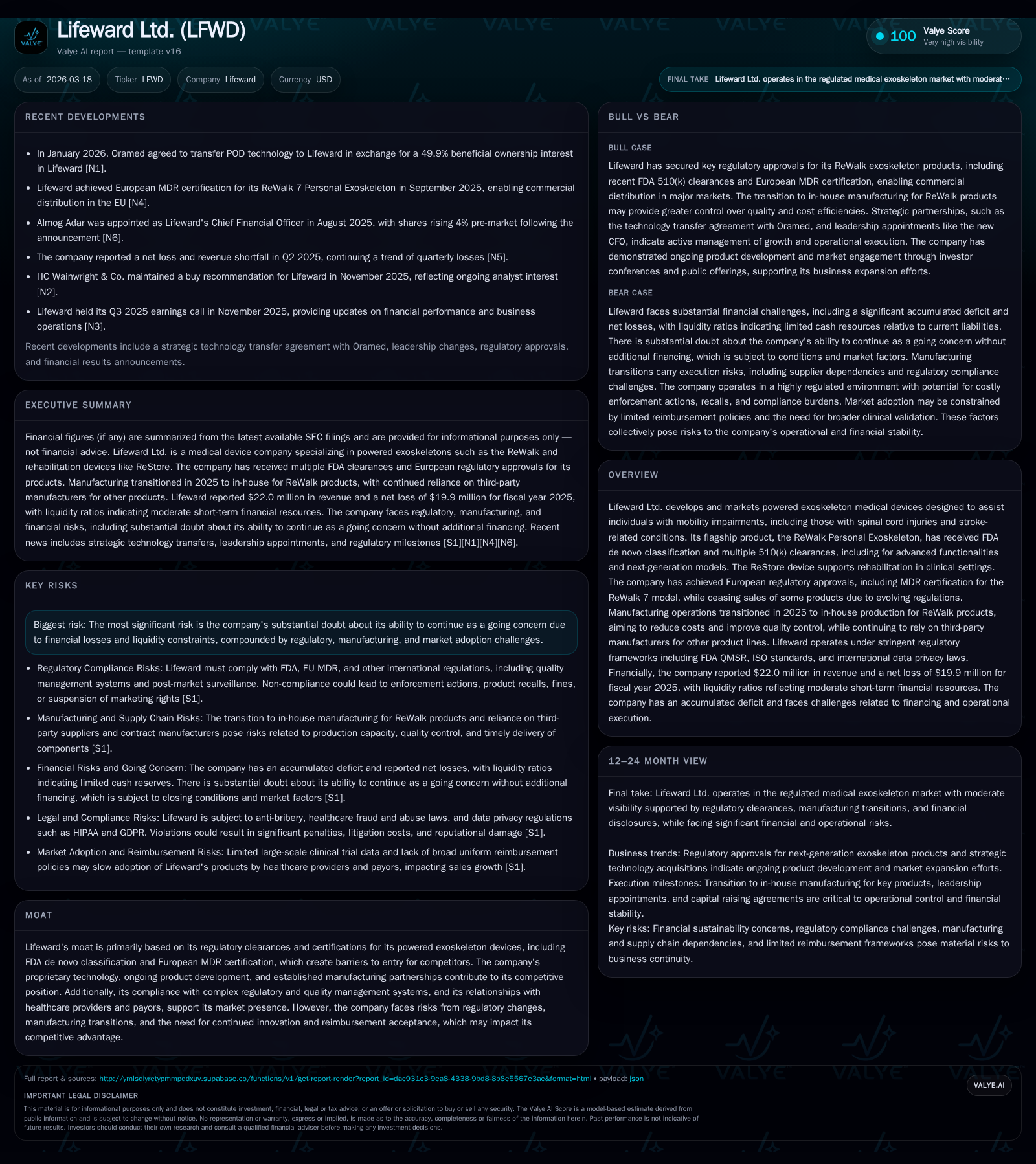
Lifeward Ltd., a developer of powered exoskeleton medical devices, saw revenue grow markedly from 2022 through 2024 before declining in 2025. Despite incremental FDA approvals and European certifications for its ReWalk devices, the company remains unprofitable with significant operating losses and negative cash flows, raising substantial doubt about its ability to continue as a going concern. Its transition to in-house manufacturing aims to improve cost control but introduces operational risk. Future growth depends on successful integration of acquisitions like AlterG, further regulatory clearances, and market adoption amidst evolving reimbursement challenges. Capital constraints and compliance burdens intensify near-term risks.
Historical Financial Performance
Lifeward Ltd.'s revenue grew rapidly from FY2022 through FY2024 before contracting in FY2025. Revenue increased from $5.5 million in 2022 to $13.9 million in 2023 — an increase exceeding 150%, driven by expansion of sales efforts around its powered exoskeleton products such as the ReWalk Personal Exoskeleton.
In FY2024, revenue rose further to approximately $25.7 million before declining about 14% to $22 million in FY2025 [F1]. This recent decline aligns with discontinuation of some legacy products amid evolving regulatory demands and reimbursement pressures.
Operating income remained deeply negative during this period due to investments in R&D, manufacturing transitions, and regulatory compliance. Losses improved from roughly -$29.3 million in FY2024 to about -$19.7 million in FY2025—a one-third reduction indicating some operational efficiencies yet continued unprofitability [F1]. Net income followed similar trends with losses narrowing slightly from -$28.9 million (FY2024) to -$19.9 million (FY2025).
Operating cash flow has been consistently negative (-$17.9M in FY2022 worsening to -$21.7M in FY2024 then improving moderately to -$16.8M in FY2025). Capital expenditures were minimal but increased modestly with the shift toward internal manufacturing of ReWalk units starting in 2025 [F1].
Equity has contracted significantly—from nearly $68 million at end-2022 down to approximately $8.4 million by end-2025—reflecting accumulated losses eroding shareholder value [F1]. The current ratio stood near 1.31 at year-end 2025, signaling limited liquidity buffer relative to short-term liabilities.
Historical performance (annual)
| FY | Rev ($mm) | Net ($mm) | CFO ($mm) | OpInc ($mm) | Rev YoY | Net YoY |
|---|---|---|---|---|---|---|
| 2025 | 22 | -20 | -17 | -20 | -14.1% | +31.2% |
| 2024 | 26 | -29 | -22 | -29 | +85.2% | -30.8% |
| 2023 | 14 | -22 | -21 | -24 | +151.4% | -13.1% |
| 2022 | 6 | -20 | -18 | -19 |
Source: SEC companyfacts cache [F1].
Capital returns and efficiency (annual)
| FY | FCF ($mm) | ROE% |
|---|---|---|
| 2025 | -17 | -236.8 |
| 2024 | -22 | -153.5 |
| 2023 | -21 | -47.6 |
| 2022 | -18 | -28.7 |
Source: SEC companyfacts cache [F1].
Note: Percentages are calculated only where data for consecutive years are available; figures rounded.
Industry Position and Regulatory Milestones
Lifeward's flagship ReWalk Personal Exoskeleton has secured key regulatory approvals supporting its market presence.
The FDA granted de novo classification for the original ReWalk device as a Class II powered exoskeleton in June 2014—a pathway for novel moderate-risk devices without predicates [S1,S13]. Subsequent FDA clearances via multiple 510(k)s expanded ReWalk's indications—most recently adding stair and curb functionality (March 2023), followed by clearance of the next-generation ReWalk model (ReWalk 7) with enhanced power management features (March 2025) [S1,S13].
In Europe, Lifeward obtained Medical Device Regulation (EU MDR) certification for ReWalk models including the ReWalk 7 series following full MDR implementation post-May-2021 [S13]. Older product lines have been phased out due to advancing compliance requirements.
The rehabilitation-focused ReStore device received FDA clearance via a June-2019 issued 510(k), targeting supervised clinical use for stroke patients with hemiparesis or hemiplegia [S13].
Lifeward maintains adherence to ISO13485:2016 quality management standards essential for global medical device market access and undergoes periodic audits including unannounced inspections of manufacturing facilities [S16].
Despite these achievements establishing barriers through regulatory complexity and technological innovation—including proprietary AI-based sensing under development—the company remains exposed to regulatory scrutiny risks stemming from historical user safety incidents reported since product launches as well as potential recalls or enforcement actions [S10,S14,S24].
Growth Outlook and Operational Challenges
Key growth drivers include:
- Product innovation: Next-generation ReWalk models feature AI-driven power management enhancements aimed at improving safety and usability for individuals with spinal cord injuries.
- Regulatory progress: Ongoing maintenance of FDA clearances and EU certifications alongside preparation for emerging regulations such as the EU AI Act effective August 2026 affecting AI-enabled medical devices [S23].
- Market adoption: Success depends on acceptance by healthcare payors—particularly U.S CMS programs—with reimbursement policies influencing unit economics given warranty term adjustments [S17].
- Acquisition integration: The August-11-23 acquisition of AlterG expands product offerings but presents integration risks potentially impacting financial results [S1].
- Manufacturing transition: Bringing production of key exoskeletons in-house starting early-2025 aims at cost reduction but introduces scale-up risks affecting supply chain stability and overhead costs.
Challenges tempering growth potential include:
- Withdrawal or discontinuation of legacy products due to evolving regulatory standards.
- Competition intensifying from alternative mobility technologies requiring differentiation.
- Liquidity constraints limiting investment capacity into R&D and commercial expansion initiatives [S1,F1].
- Complex legal environment involving anti-corruption laws, fraud statutes, intellectual property litigation risks diverting management focus and resources .
Capital Allocation & Returns Analysis
Persistent net losses have substantially eroded equity—from over $68 million at end-FY22 down below $8.4 million by end-FY25—resulting in an approximate negative return on equity near -237% based on net loss relative to equity per latest filings [F1].
Operating cash flows remain deeply negative (-$16.8 million last fiscal year), showing marginal improvement yet evidencing ongoing cash burn; capital expenditures are minimal relative to cash outflows indicating a focus on preserving liquidity rather than expansion investments [F1].
No dividends or share repurchases are reported; instead, capital allocation priorities center on survival financing including issuance plans for senior secured convertible notes totaling up to $10 million per recent agreements signed January 26 aimed at extending operational runway into near term periods [S19,S27].
Risks Summary Highlights
Lifeward faces multiple material risks that could impact outlook:
- Substantial doubt about going concern status due to recurring operating losses compounded by limited cash reserves (
$2.17M) versus current liabilities ($12M+) impacting sustainability [S1,F1,S19]. - Exposure to patent infringement claims common within medical device sector posing financial and operational burdens if litigated adversely [S11,S24].
- Regulatory enforcement risk including prior FDA warning letters related to marketing practices or reporting gaps alongside follow-up actions after product incident reports requiring voluntary corrections [S10,S15].
- Product liability risk inherent given reliance on complex hardware/software integrations where failures could cause serious injury or death; insurance coverage may be insufficient against large claims [S14,S20].
- Compliance demands under extensive global laws covering anti-corruption (e.g., FCPA), data privacy including GDPR/NIS2 impose administrative complexities diverting resources from growth activities .
- Market adoption uncertainty tied closely with payor reimbursement policies critical given premium pricing structures and warranty commitments impacting margins and sales mix economics [S17].
- Operational integration risks related to AlterG acquisition involving cultural fit/product portfolio alignment plus internal manufacturing ramp-up challenges potentially disrupting supply chains or inflating overhead costs [S1,S17].
Conclusion
Lifeward Ltd operates at the intersection of advanced medical robotics innovation and stringent multi-jurisdictional regulation where it holds meaningful IP advantages evidenced by pivotal clearances such as FDA de novo classification complemented by EU MDR conformity.
Historical revenue growth demonstrates underlying demand tempered by steep financial losses reflective of early-stage commercialization typical among novel med-tech companies pursuing broader adoption.
Near-term prospects depend heavily on securing sustainable capital funding while navigating complex external compliance demands alongside successful integration of strategic acquisitions and internal manufacturing transitions. Substantial liquidity concerns disclosed explicitly highlight existential threats absent prompt mitigation. This blend of technological promise balanced against operational execution risk illustrates core challenges facing emergent med-tech innovators seeking safety validations matched with scalable commercial traction.
This analysis is based solely on information extracted from Lifeward Ltd.'s SEC filings as of March 18, 2026 ([F1], [S#]) along with Valye News proprietary summaries reflecting company disclosures without speculative assumptions or investment recommendations.
Disclaimer: This is research-only, informational analysis and not investment advice. It may include AI-generated interpretation and general industry context. Always verify important details using primary sources.

Comments