
Abeona Therapeutics Advances Commercialization of ZEVASKYN Amid Continued Investment Phase
The FDA approval and launch of ZEVASKYN mark a pivotal step for Abeona Therapeutics as it scales manufacturing and commercial capabilities while managing ongoing operating losses.
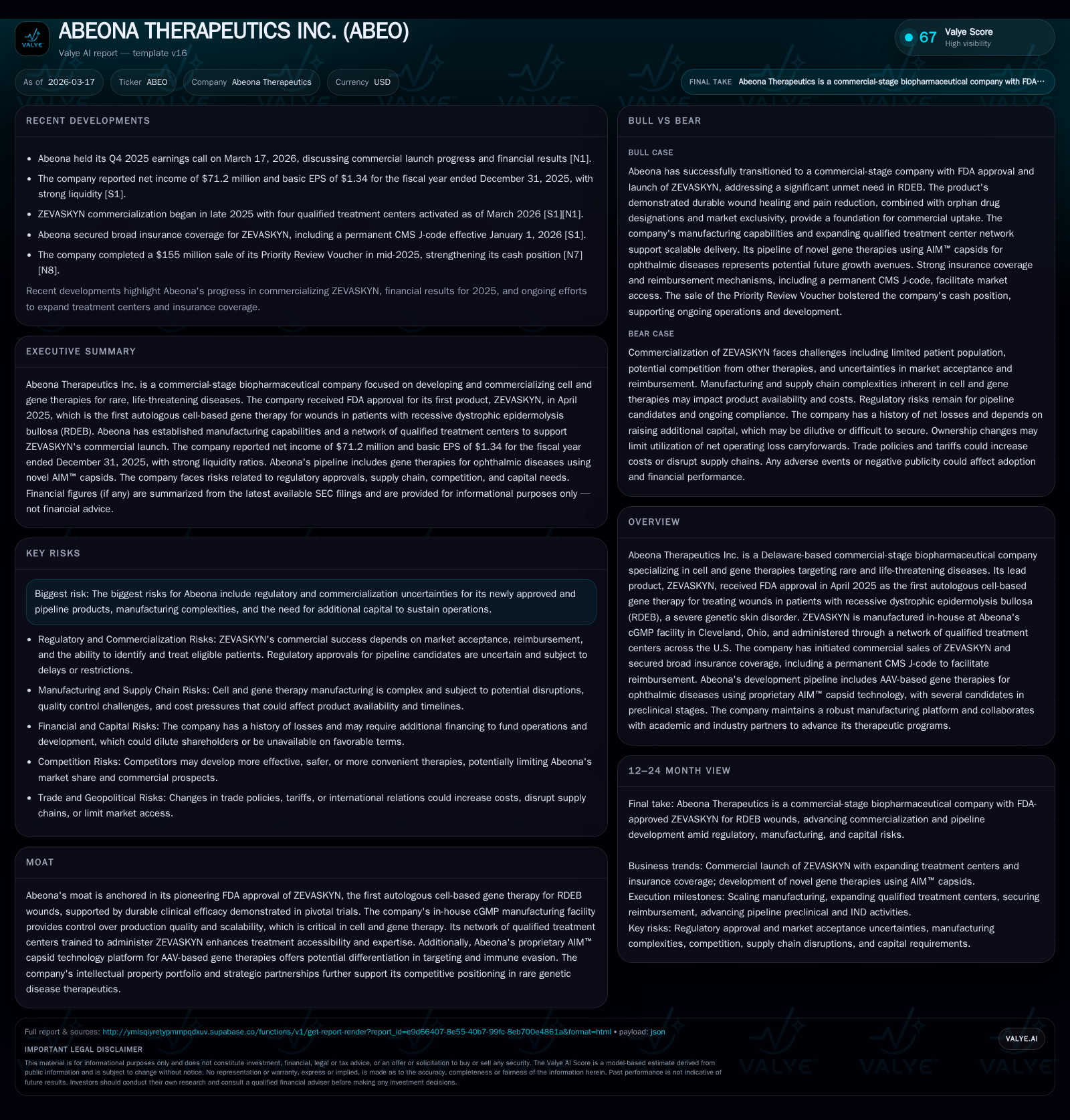
Abeona Therapeutics secured FDA approval for ZEVASKYN in April 2025, the first autologous cell-based gene therapy for recessive dystrophic epidermolysis bullosa wounds. The company has initiated commercialization with an expanding network of qualified treatment centers and secured critical reimbursement designations including a permanent CMS J-code. Despite this progress, Abeona reported a significant operating loss of $89.4 million in FY2025 amid elevated investments in manufacturing scale-up and commercialization infrastructure. Its pipeline includes early-stage AAV-based ophthalmic gene therapies leveraging proprietary capsid technology, reflecting a long-term growth focus amid regulatory and operational challenges.
Company Overview and Historical Performance
Abeona Therapeutics Inc., headquartered in Delaware with operations in Cleveland, Ohio, is a commercial-stage biopharmaceutical company specializing in cell and gene therapies for rare diseases. Its flagship product, ZEVASKYN® (prademagene zamikeracel), received FDA approval in April 2025 as the first autologous cell-based gene therapy for treating wounds caused by recessive dystrophic epidermolysis bullosa (RDEB), a rare genetic skin disorder characterized by severe blistering.[S1]
ZEVASKYN is manufactured exclusively at Abeona’s cGMP-compliant facility in Cleveland, enabling tight control over quality and scalability—a critical capability given the personalized nature of autologous therapies. The product is distributed via a network of qualified treatment centers trained for administration; as of early 2026, four such centers have been activated with plans to expand access.[S1][N1]
The approval also conferred orphan drug and rare pediatric disease designations, providing regulatory incentives that support commercialization efforts.[S1]
Historical Financial Performance
While top-line revenue data beyond 2018 is unavailable,[F1] Abeona’s financial results show significant investment activity consistent with transitioning from development to commercialization:
Historical performance (annual)
| FY | Net ($mm) | CFO ($mm) | OpInc ($mm) | Capex ($mm) | Net YoY |
|---|---|---|---|---|---|
| 2025 | 71 | -76 | -89 | 8 | +211.7% |
| 2024 | -64 | -56 | -64 | 2 | -17.6% |
| 2023 | -54 | -37 | -47 | 0 | -36.5% |
| 2022 | -40 | -43 | -51 | 0 |
Source: SEC companyfacts cache [F1].
Capital returns and efficiency (annual)
| FY | Buybacks ($mm) | FCF ($mm) | ROE% |
|---|---|---|---|
| 2025 | -84 | 44.7 | |
| 2024 | -58 | -144.7 | |
| 2023 | 25 | -37 | -365.5 |
| 2022 | 25 | -44 | -148.3 |
Source: SEC companyfacts cache [F1].
Data sourced from latest audited filings; revenue post-2018 not disclosed explicitly.
Operating losses have grown notably alongside commercialization investments—widening from approximately $64.2 million loss in FY2024 to $89.4 million loss in FY2025.[F1] Net income swung positive in FY2025 primarily due to one-time accounting or non-operating gains.[F1] Operating cash flow remains negative at $76.3 million for FY2025 reflecting substantial reinvestment into manufacturing capacity expansion and R&D programs.[F1]
Capital expenditures increased more than threefold year-over-year to nearly $8 million in FY2025 consistent with scaling up the Cleveland manufacturing facility to meet anticipated demand.[F1] Concurrently shareholder equity expanded significantly from $44 million at end-2024 to over $159 million at end-2025 evidencing successful capital raises supporting this transition.[F1]
Growth Outlook and Pipeline Development
Abeona’s near-term growth engine is the commercial rollout of ZEVASKYN supported by its unique positioning as the only approved autologous cell-based gene therapy for RDEB wounds.[S1][N1] Expansion of the qualified treatment center network beyond the initial four sites activated will be critical to increasing patient access within this ultra-rare population.[S1]
Reimbursement dynamics are bolstered by permanent CMS J-code designation facilitating streamlined claims processing—an essential factor influencing payer adoption and patient access.[N1]
Longer term pipeline advances focus on adeno-associated virus (AAV)-based gene therapies targeting ophthalmic diseases using proprietary AIM™ capsid technology. These programs remain preclinical but represent potential future revenue diversification opportunities contingent upon successful clinical progression and regulatory approvals.[S1]
Milestones and Monitoring Points
No explicit numeric guidance has been provided publicly; however key milestones include:[N1]
- Expansion of qualified treatment centers beyond current four locations.
- Early commercial uptake trends informing revenue recognition.
- Regulatory updates on supplemental indications or label expansions for ZEVASKYN.
- Progression of ophthalmic AAV-based gene therapy candidates through preclinical toward clinical stages.
- Capital raising initiatives ensuring liquidity amid ongoing negative cash flows.
Capital Allocation and Returns Analysis
Despite reported net income positivity in FY2025 driven by non-operating factors,[F1] Abeona continues to operate at substantial operating losses ($89.4 million) and negative operating cash flows (-$76.3 million), indicating reliance on external financing rather than internal cash generation.[F1]
Free cash flow remains negative at approximately -$84.3 million after accounting for capital expenditures.[F1] Historically recorded share repurchases ceased after FY2023 suggesting current prioritization of cash conservation during the product launch phase.[F1]
Return on equity approximates 44.7% based on latest net income versus equity figures; however this figure should be interpreted cautiously given the unusual accounting impacts underlying net income positivity.[F1]
Capital deployment priorities appear focused on:
- Expanding cGMP manufacturing infrastructure to support anticipated commercial demand,
- Building out clinical development and commercial sales infrastructure,
- Investing in early-stage pipeline discovery programs,
- Maintaining financial flexibility through equity financing amid persistent high operating burn rates.
Industry Context and Risk Factors
Cell and gene therapy represents a transformative yet complex biotechnology sector characterized by individualized manufacturing demands and evolving regulatory frameworks.[S28][N1] Autologous therapies such as ZEVASKYN entail higher per-patient costs but offer potentially durable therapeutic benefits justifying premium pricing structures.
Securing reimbursement codes like CMS J-codes materially improves market access velocity by simplifying payor billing processes—a notable barrier for novel therapies addressing rare diseases.[N1][S6]
Competition includes multiple players developing advanced gene therapies; however Abeona holds first-to-market status for RDEB wound indication supported by intellectual property protections and specialized manufacturing expertise.[S28]
Risks include evolving regulatory requirements potentially lengthening approval timelines or imposing additional post-marketing obligations,[S23,S24] manufacturing scale-up challenges affecting supply reliability,[S25] reimbursement pressures amid healthcare cost containment trends, potential intellectual property litigation,[S21] product liability exposure,[S17,S25] and ongoing capital intensity necessitating additional funding rounds.[S1,S24,S27]
Operational execution challenges encompass expanding commercialization beyond initial launch sites requiring coordination with specialized treatment centers capable of delivering complex autologous procedures—failure here could constrain uptake despite clinical efficacy.[S1]
International expansion plans are not detailed but would introduce further regulatory complexities alongside global supply chain risks related to trade policies impacting pharmaceutical inputs.[S2,S24]
Conclusion
Since FDA approval of ZEVASKYN in April 2025, Abeona Therapeutics has transitioned into a commercial-stage company addressing an unmet need in rare genetic skin disorders through innovative cell-based gene therapy. The company leverages proprietary technology platforms both in autologous cellular treatments and novel capsid designs targeting ophthalmic diseases.
Operating losses have deepened due to necessary upfront investments scaling manufacturing capacity and building commercial infrastructure typical of biotech companies launching complex biologic products. Sustained capital raising has fortified the balance sheet enabling this transition.
Key near-term focus areas include expanding qualified treatment center networks to broaden patient access; securing payer reimbursement arrangements including CMS policy adherence; advancing pipeline assets through preclinical development; maintaining intellectual property defenses; and managing regulatory compliance amidst evolving standards.
Balancing short-term liquidity needs with long-term product development horizons remains critical as Abeona navigates commercialization challenges inherent to pioneering cell and gene therapy modalities.
This analysis relies solely on publicly available information as of March 17, 2026 [F1][N1][N2]. It does not constitute investment advice or recommendations regarding securities transactions involving Abeona Therapeutics Inc., nor should it substitute tailored professional counsel.
Disclaimer: This is research-only, informational analysis and not investment advice. It may include AI-generated interpretation and general industry context. Always verify important details using primary sources.

Comments