
Bicycle Therapeutics Harnesses Phage Display to Overcome Development Hurdles
Leveraging its proprietary synthetic peptide platform and extensive phage display library, Bicycle Therapeutics addresses clinical-stage challenges in oncology drug development.
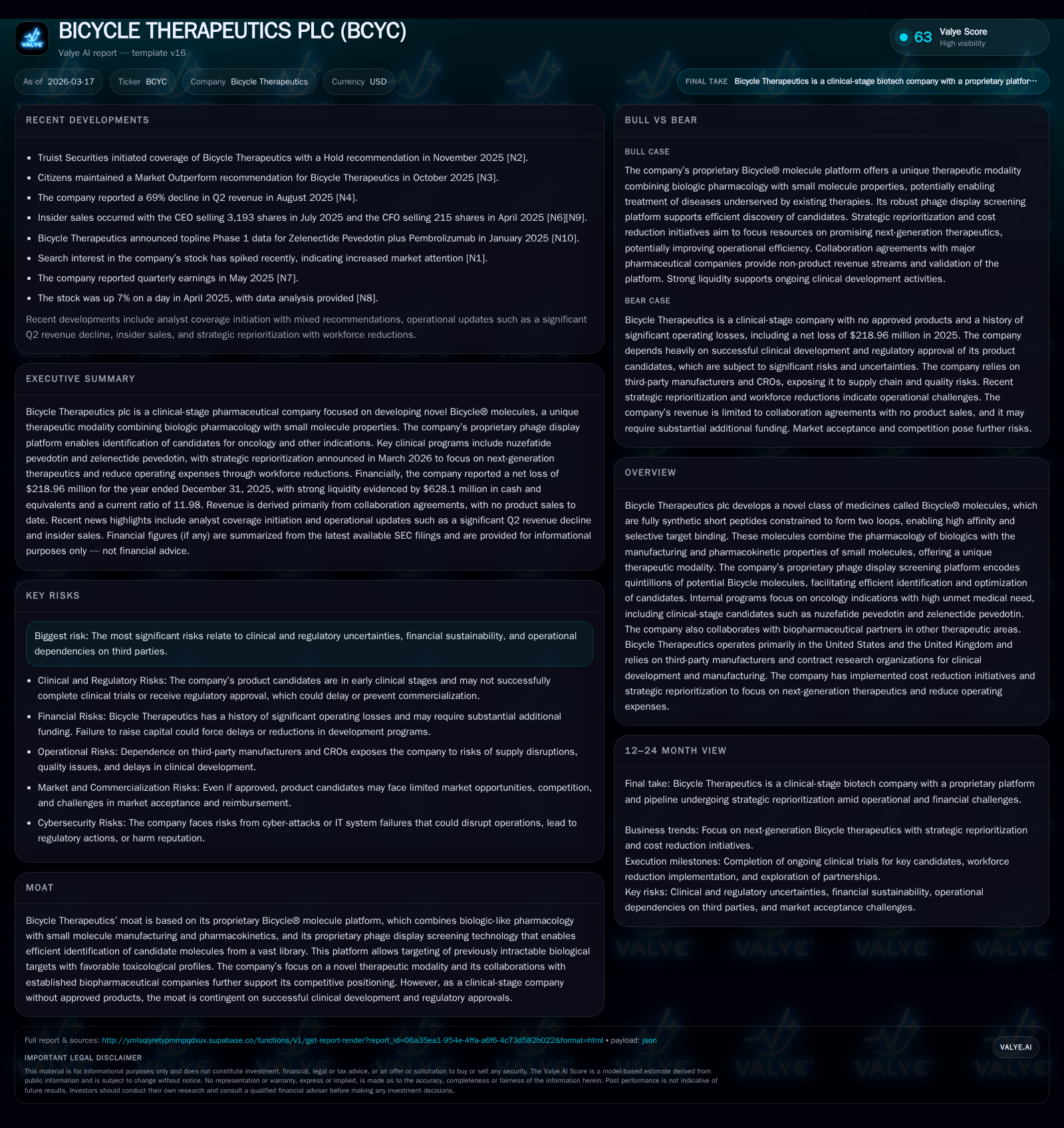
Bicycle Therapeutics plc focuses on an innovative class of fully synthetic two-loop peptides called Bicycle® molecules, which aim to combine biologic-like target affinity with small molecule manufacturing efficiency. Despite no product revenues to date and mounting operating losses, the company’s growing pipeline—anchored by clinical-stage oncology candidates nuzefatide pevedotin and zelenectide pevedotin—demonstrates potential for addressing high unmet medical needs. The firm maintains a robust cash position from recent equity raises, providing runway amid ongoing R&D investment, while navigating significant regulatory and clinical risks. Strong cybersecurity oversight reflects operational diligence critical for protecting intellectual property and clinical data integrity.
A Novel Therapeutic Modality Shaping Bicycle’s Growth Trajectory
Bicycle Therapeutics pioneers a distinctive therapeutic approach using its proprietary Bicycle® molecules—fully synthetic short peptides structurally constrained into two loops. This design offers unique binding properties characterized by high affinity and selectivity for biological targets, marrying the advantages of biologics with the manufacturability and pharmacokinetic benefits typical of small molecules . The core innovation lies in its phage display screening platform that encodes quintillions of potential molecular configurations, facilitating rapid discovery and refinement of candidates against challenging targets.
This technology underpinning Bicycle’s pipeline is particularly suited to oncology indications where traditional modalities often encounter limitations. Candidates such as nuzefatide pevedotin (targeting EphA2) and zelenectide pevedotin (targeting Nectin-4) exemplify this approach by focusing on tumor-specific antigens with high unmet medical needs, aiming to achieve both efficacy and an improved safety profile relative to existing therapies.
Historical Financial Trajectory: Operating Losses and Capital Safety Nets
With no approved products or revenue from product sales through FY2025, Bicycle Therapeutics’ financial profile is dominated by research and development expenditures alongside administrative costs. Operating losses have steepened abruptly over recent years amid expanded pipeline activity:
Historical performance (annual)
| FY | Net ($mm) | CFO ($mm) | OpInc ($mm) | Capex ($mm) | Net YoY |
|---|---|---|---|---|---|
| 2025 | -219 | -250 | -247 | 2 | -29.5% |
| 2024 | -169 | -165 | -210 | 1 | +6.4% |
| 2023 | -181 | -61 | -190 | 3 | -60.3% |
| 2022 | -113 | -86 | -117 | 19 |
Source: SEC companyfacts cache [F1].
Capital returns and efficiency (annual)
| FY | FCF ($mm) | ROE% |
|---|---|---|
| 2025 | -252 | -35.9 |
| 2024 | -166 | -21.3 |
| 2023 | -64 | -48.7 |
| 2022 | -105 | -41.6 |
Source: SEC companyfacts cache [F1].
The disproportionate rise in capital expenditures in FY2022 was followed by a reduction aligned with the shift toward clinical trial costs rather than fixed asset purchases [F1]. Despite these losses and negative cash flows from operations intensifying over time—reaching an approximate free cash flow deficit of $252 million in FY2025—the company sustains a substantial liquidity cushion with year-end cash and equivalents at $628 million against current liabilities below $57 million (current ratio ~12), providing ample runway for near-term development [F1][S11][S16].
Equity growth has historically funded these operating deficits through public offerings and private placements raising several hundred million dollars in aggregate in recent years [S11]. This capital raises strategy underpins ongoing R&D investment but implies dilution risk inherent to pre-revenue biopharma ventures.
Development Pipeline: Key Oncology Programs Driving Future Potential
Bicycle's clinical portfolio centers on synthetic peptide-drug conjugates designed to selectively bind tumor-associated antigens delivering cytotoxic payloads or modulating immune responses. Among internal lead assets are nuzefatide pevedotin targeting EphA2—a receptor frequently overexpressed in aggressive tumors—and zelenectide pevedotin acting on Nectin-4—a validated cancer antigen exploited in antibody-drug conjugate therapies .
The company’s proprietary phage display screening enhances candidate discovery efficiency by enabling ultra-high diversity libraries which can identify molecules hitting previously intractable targets with tailored affinity profiles . Such technology could translate into accelerated lead optimization cycles contrasted with traditional biologic discovery routes.
Collaborations with biopharmaceutical partners diversify development risk exposure and extend application breadth beyond oncology . However, as these programs remain in clinical phases without regulatory approvals yet secured—and given the novel chemical-biologic hybrid nature—the pathway is expected to be scrutinized rigorously by regulators under FDA and EMA frameworks pending further validation milestones.
Clinical and Regulatory Challenges: Risks Embedded in Innovation
Clinical-stage biotech entities like Bicycle Therapeutics confront multifaceted risks tied to the unpredictable nature of trial outcomes coupled with stringent regulatory evaluation processes [S1][S2]. Their hybrid modality fuses characteristics of biologics and small molecules; consequently they may face complex regulatory categorizations leading to potentially protracted review timelines.
Patient enrollment difficulties further compound trial progress uncertainties affecting time-to-readout projections [S2]. Early clinical results might not extrapolate linearly to later phases—a common challenge exacerbated by novel mechanism uncertainties.
Moreover compliance obligations encompass adherence not only to FDA mandates but also anti-corruption statutes like the UK Bribery Act and US FCPA due to international operations [S5][S8][S9]. Privacy laws govern sensitive health data management imposing significant compliance overheads especially with evolving data privacy regulations across jurisdictions [S6][S7][S8].
Operational resilience is enhanced by a comprehensive cybersecurity governance structure featuring a quarterly convening Information Risk Operating Committee (IROC) that elevates cyber risk mitigation within enterprise risk management processes overseen by senior executives including cybersecurity VP reporting directly to COO—a critical differentiator safeguarding IP assets amidst third-party dependencies integral to drug development workflows [S1]. This structured oversight helps preempt disruptions from cyber threats or data breaches that could materially impact regulatory standing or commercial prospects.
Capital Structure, Liquidity, and Returns: Balancing Investment with Burn
Bicycle Therapeutics operates under a capital-intensive model characteristic of pre-commercial biotech firms reliant on equity financing supplemented by collaboration income aimed at upstream R&D funding [S11][S24]. As of December 31, 2025 the company held approximately $628 million in cash equivalents [F1], sufficient for operational expenses forecasted through at least the next twelve months absent significant deviations.
Operating cash flow continues deeply negative (-$249.7 million FY2025), reflecting ramped-up spending primarily allocated across expanding clinical trial activities focused on oncology assets [F1][S26]. Capital expenditures remain modest relative to the burn rate ($2.35M FY2025), confirming a predominant focus on intangible R&D rather than fixed asset growth.
With no approved therapeutics generating revenue yet reported through FY2023 [F1], return metrics such as ROE are consequently negative (~-36% FY2025 based on net loss over equity) signaling ongoing investment phase without profitability or dividend distributions [F1]. There have been no share buybacks reflecting prioritization of capital preservation for development investment.
Leasing commitments under ASC Topic 842 accounting include substantial right-of-use (ROU) operating lease assets corresponding primarily to laboratory facilities in Cambridge UK and Massachusetts USA—highlighting geographic diversification of key infrastructure supporting clinical programs [S1][S4][S16][S27].
Financial Outlook: Milestones to Monitor and Forward-Looking Considerations
Explicit forward-looking guidance remains limited following the company’s latest Form 8-K filing dated March 17th 2026 [S3] with no specific upcoming regulatory submissions or trial readouts publicly announced at that time. Market commentary indicates heightened investor interest evidenced by increasing search activity reported concurrently [N1].
Key milestones warrant attention include:
- Clinical trial enrollment progression rates impacting timeline visibility,
- Phase advancement announcements especially pivotal Phase II/III transitions for lead candidates,
- Potential new partnership deals or milestone payments enhancing liquidity,
- Subsequent equity raises contingent on financing needs,
- Regulatory interactions reflecting evolving agency feedback on novel modalities.
These will collectively shape the pace at which Bicycle can transition from an R&D-driven entity to one capable of commercial generating revenues.
Cybersecurity Governance and Operational Resilience in Biopharma Context
Bicycle Therapeutics maintains a robust cybersecurity framework integral to managing information risks inherent in complex drug discovery collaborations necessitating third-party data exchanges globally. The Information Risk Operating Committee (IROC), composed of senior leaders from IT security, finance, legal and operations functions meets regularly—usually quarterly—to align cybersecurity initiatives tightly within overall enterprise risk management strategies [S1].
This committee’s role encompasses budget approval for cybersecurity measures; incident response escalation involving top executives; policy enforcement; audit review; board reporting via the Audit Committee; all reflecting industry best practices vital for protecting sensitive intellectual property (IP) critical for competitive advantage as well as ensuring regulatory compliance during clinical data collection phases.
Their Chief Information Security Officer functions under oversight from the COO directly lending organizational weight toward timely threat detection/remediation efforts—a substantial value-add distinguishing them within a sector where cyber threats increasingly imperil clinical programs’ confidentiality and continuity.
This analysis reflects information available as of March 17th 2026 compiled from SEC filings ([F1],) and relevant market news ([N1]). It does not constitute investment advice but aims to provide an informed overview contextualized within typical challenges facing clinical-stage biopharma innovators developing novel therapeutic modalities such as Bicycle Therapeutics plc.
Disclaimer: This is research-only, informational analysis and not investment advice. It may include AI-generated interpretation and general industry context. Always verify important details using primary sources.

Comments