
Gap Inc. Reports Modest Growth amid Operational Stabilization
Gap Inc. sustains incremental revenue gains driven by its brand portfolio and omni-channel retailing while managing supply chain costs and balancing capital returns.
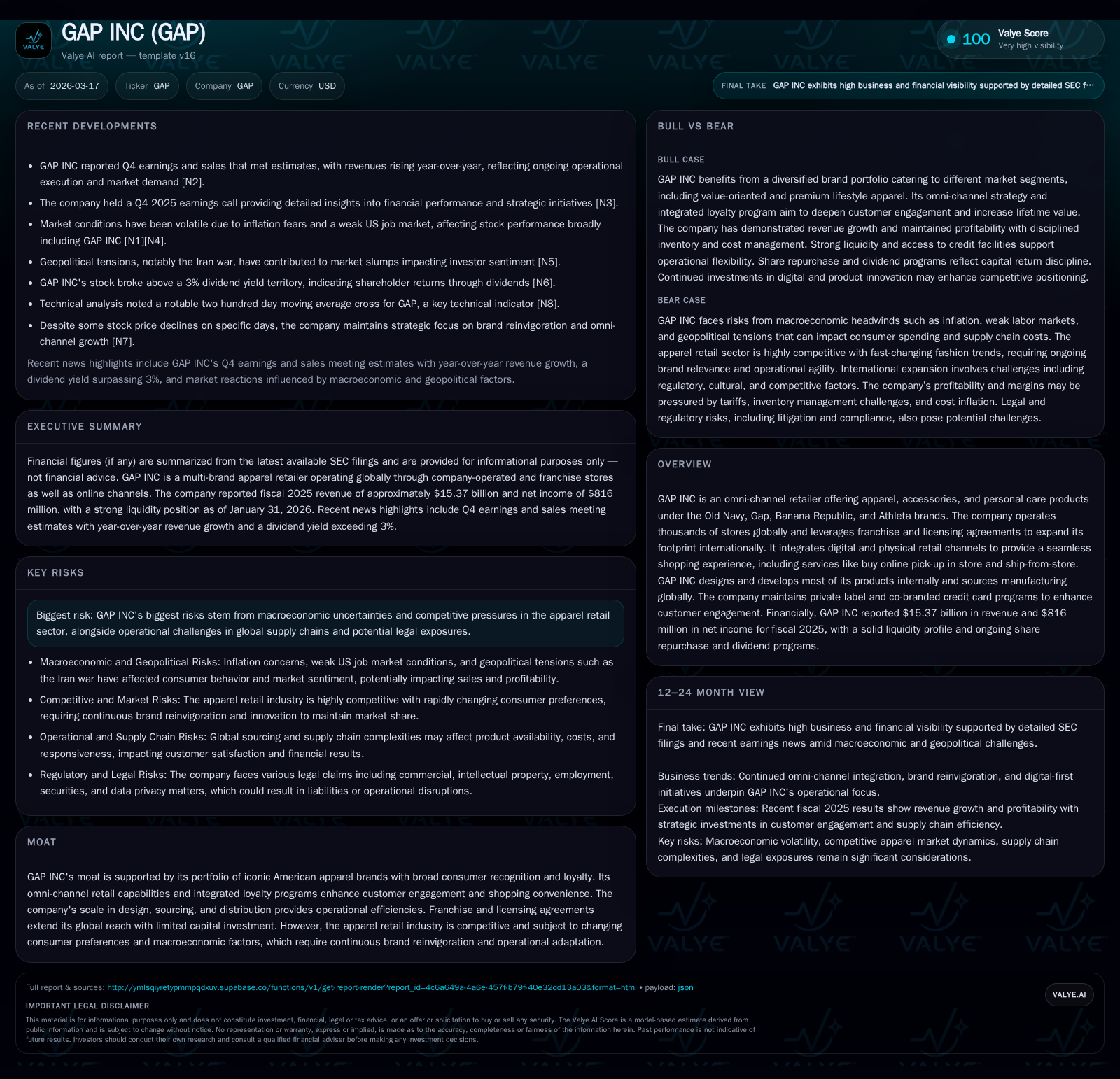
Gap Inc. closed fiscal 2025 with $15.37 billion in revenue, reflecting a modest 1.9% increase year-over-year, supported by the strength of its iconic brands and expanding digital-physical retail integration. Operating income showed slight improvement while net income contracted slightly, influenced by ongoing supply chain pressures and higher sourcing costs. The company continues to invest in omni-channel capabilities and product innovation, alongside moderate capital expenditures, while maintaining a disciplined approach to dividends and share repurchases. Going forward, execution on supply chain agility and consumer trend responsiveness will be critical amid macroeconomic uncertainty and competitive industry dynamics.
Growth Trajectory and Key Drivers over the Past Three Years
Gap Inc.'s fiscal performance through FY2025 highlights modest but consistent top-line growth paired with operational improvements following prior volatility. Revenue advanced from approximately $15.09 billion in FY2024 to $15.37 billion in FY2025 — a 1.9% increase — supported chiefly by steady demand across its brand portfolio complemented by accelerated online sales [F1]. Operating income edged up slightly by 0.3% year-over-year to $1.115 billion from $1.112 billion, reflecting improved cost control measures somewhat offsetting increased sourcing expenses [F1]. Meanwhile, net income contracted by 3.3% to $816 million from $844 million as tariff-related costs and supply chain pressures continued to weigh [F1]. Operating cash flows declined 13%, impacted by working capital changes during inventory management challenges; nevertheless, capital expenditures were kept disciplined, growing only 5.1% to about $470 million [F1], evidencing calibrated reinvestment that supports modernization without compromising liquidity.
Historical performance (annual)
| FY | Rev ($bn) | Net ($mm) | CFO ($mm) | OpInc ($mm) | Rev YoY | Net YoY |
|---|---|---|---|---|---|---|
| 2025 | 15.4 | 816 | 1293 | 1115 | +1.9% | -3.3% |
| 2024 | 15.1 | 844 | 1486 | 1112 | +1.3% | +68.1% |
| 2023 | 14.9 | 502 | 1532 | 560 | -4.7% | +348.5% |
| 2022 | 15.6 | -202 | 607 | -69 |
Source: SEC companyfacts cache [F1].
Capital returns and efficiency (annual)
| FY | Div ($mm) | Buybacks ($mm) | FCF ($mm) |
|---|---|---|---|
| 2025 | 247 | 155 | 823 |
| 2024 | 225 | 75 | 1039 |
| 2023 | 222 | 0 | 1112 |
| 2022 | 220 | 123 | -78 |
Source: SEC companyfacts cache [F1].
Table: Gap Inc.'s historical financial performance shows a steady recovery from FY22 loss towards operational stabilization in FY25.
Brand Portfolio and Omni-Channel Retailing as Competitive Advantages
At the crux of Gap Inc.'s resilience is its portfolio of venerable American brands—Old Navy, Gap, Banana Republic, and Athleta—that enjoy broad recognition across diverse consumer segments [S11]. Old Navy acts as the value-oriented anchor attracting large volumes especially in North America, while Athleta targets the growing athleisure category with a loyal following among active consumers.
The company’s omnichannel strategy is a critical competitive differentiator in an intensely fragmented apparel market characterized by low entry barriers that fuel rapid change [S5][N2]. Gap leverages integrated digital-physical platforms offering services such as buy online pick-up in store (BOPIS), ship-from-store logistics optimization, and order-in-store options that meet evolving consumer preferences for flexibility [S11][N19]. Enhancements such as mobile-enabled shopping and an upgraded Encore loyalty program which unifies rewards across all brands are designed to deepen customer engagement through personalization using first-party data insights [N2][S19]. This integrated ecosystem helps mitigate traffic leakages to competitors while reinforcing brand loyalty.
Supply Chain Complexity and Operational Constraints Impacting Margins
A key challenge facing Gap Inc., common across global apparel retailers, lies in managing complex supply chains concentrated primarily in lower-cost geographies that present volatility risks [S6][S22]. Approximately 27% of merchandise is sourced from Vietnam factories, another significant source being Indonesia at around 21%, both regions subject to production delays and rising labor costs [S6]. These factors coupled with increased transportation expenses driven by fuel price inflation, geopolitical tensions affecting tariffs (notably US trade policy shifts), port congestion issues, and occasional factory closures add layers of unpredictability on cost structures [S6][S14].
Maintaining seasonal inventory levels that align with weather-dependent demand patterns requires agility; any miscalculation can result in excess markdowns or stockouts damaging margins or consumer perception [S22]. To counter these risks Gap is investing in digital product creation tools and AI-assisted inventory analytics aimed at improving response speed to shifting trends and localization of assortments—a necessity given divergent demand profiles across regions [S20][S22]. However, successful execution remains critical lest supply disruptions erode profitability.
Capital Allocation: Balance Between Shareholder Returns and Reinvestment
Financial discipline is apparent in Gap’s methodical capital allocation balancing reinvestment with shareholder distributions. The company reported approximately $470 million in capital expenditures for FY25—a moderate increase from prior years—primarily directed towards optimizing stores infrastructure, technology enhancements including AI applications for customer engagement and inventory management system upgrades [F1][S26].
On shareholder returns footing, dividend payments advanced steadily with $247 million paid out during FY25 compared with $225 million prior year reflecting a continued commitment to regular income streams for investors [F1][N9]. Share repurchase activity picked up meaningfully totaling $155 million in FY25 versus $75 million previously suggesting confidence in intrinsic valuation while maintaining flexibility given ample liquidity reserves [F1][S15]. Return on equity approximated around a robust ~21.5%, underscoring efficient use of equity capital amid stable earnings generation [F1].[^roe]
[^roe]: Calculated as latest annual net income over latest annual shareholder equity.
Earnings Performance and What to Watch in Upcoming Quarters
Q4 Fiscal 2025 results aligned closely with consensus expectations showing revenues rising year-over-year but net income experiencing some contraction amid margin pressures from elevated merchandise costs tied to tariffs as well as higher freight expenses [N1][N3][N14]. The company highlighted ongoing initiatives to enhance omni-channel fulfillment efficiency paired with inventory optimization projects as key priorities heading into the high-sales holiday season where execution risks are amplified given peak volume demands.
Investors should monitor subsequent quarters for improvements in comparable store sales growth trajectory particularly within flagship Old Navy segment as well as margin stabilization efforts tied to supply chain cost control measures against an uncertain macroeconomic backdrop evidenced by inflation concerns dampening discretionary spending noted around market commentary contemporaneous with these releases [N6][N7].
Financial Health: Liquidity, Debt Profile, and Cash Flow Trends
Gap Inc.’s liquidity position remains solid with cash plus equivalents totaling approximately $2.6 billion at fiscal year-end providing ample cushion for operations or opportunistic investments if needed [F1][S4]. Current assets stand at $5.78 billion relative to current liabilities of about $3.30 billion yielding a comfortable current ratio of roughly 1.75x indicative of strong short-term financial stability [F1].
Long-term debt exposure includes senior notes totalling $1.5 billion maturing in tranches through the late-2020s at attractive fixed interest rates below market average (~3.625%-3.875%), complementing access to a $2.2-billion asset-based revolving credit facility bearing variable interest linked to SOFR but with zero utilization currently—underscoring conservative leverage usage consistent with capital preservation focus common among apparel retailers managing volatile working capital cycles [S4][S10][S18].[\footnote] This prudent financing mix supports ongoing liquidity needs without excessive interest burden.
[\footnote]: Zero borrowings under ABL facilitate preserves optionality while meeting seasonal working capital demands.
Future Revenue Levers and Risks from Market and Macroeconomic Factors
Looking ahead, Gap aims to capitalize on multiple growth levers including accelerating penetration through digital channels plus expansion of franchise/licensing agreements internationally where capital investment risks are mitigated via third-party operators expanding footprint across Asia, Europe, Latin America, Middle East & Africa markets [S8][N2].[\growth]
Additionally, industry-tailored deployment of AI technologies focused on inventory planning promises improved sell-through rates via better demand forecasting enabling localized assortments adjusted rapidly according to real-time customer behavior insights — vital for tuning product relevance amid fickle trends characteristic of fashion retail dynamics [S20].[\technology]
However, these upside potentials are tempered by persistent headwinds such as intensifying price competition exerting downward pressure on margins; evolving consumer tastes necessitating constant brand reinvigoration efforts; tariff escalations inflating costs; global geopolitical instability influencing sourcing reliability; plus macroeconomic uncertainties spurred by inflationary pressures potentially curtailing discretionary apparel spend as evidenced since Q4 fiscal updates reporting softer-job-market indicators compressing consumer confidence levels within key U.S markets affecting retailer sentiment broadly [N6][N7].[\risks]
[\growth]: Franchise/licensing model expands international scale while lowering capital intensity. [\technology]: AI-enabled demand analytics enhance supply chain responsiveness. [\risks]: Inflation impact on discretionary spending among core customer demographics remain cautionary.
This analysis synthesizes quarterly transcripts, recent media reports alongside thorough review of SEC filings including the annual Form 10-K dated March 17, 2026 ([S1]) supplemented by detailed financial data ([F1]). The information herein is presented for informational purposes without making investment recommendations or forecasts beyond disclosed facts.
Readers should consider larger economic conditions impacting apparel retail broadly when evaluating Gap Inc's future prospects.
Disclaimer: This is research-only, informational analysis and not investment advice. It may include AI-generated interpretation and general industry context. Always verify important details using primary sources.

Comments