
CEA Industries Navigates Digital Asset Volatility and Governance Challenges
CEA Industries faces significant earnings volatility and strategic uncertainty amid concentrated BNB holdings, shareholder activism, and evolving regulatory risks.
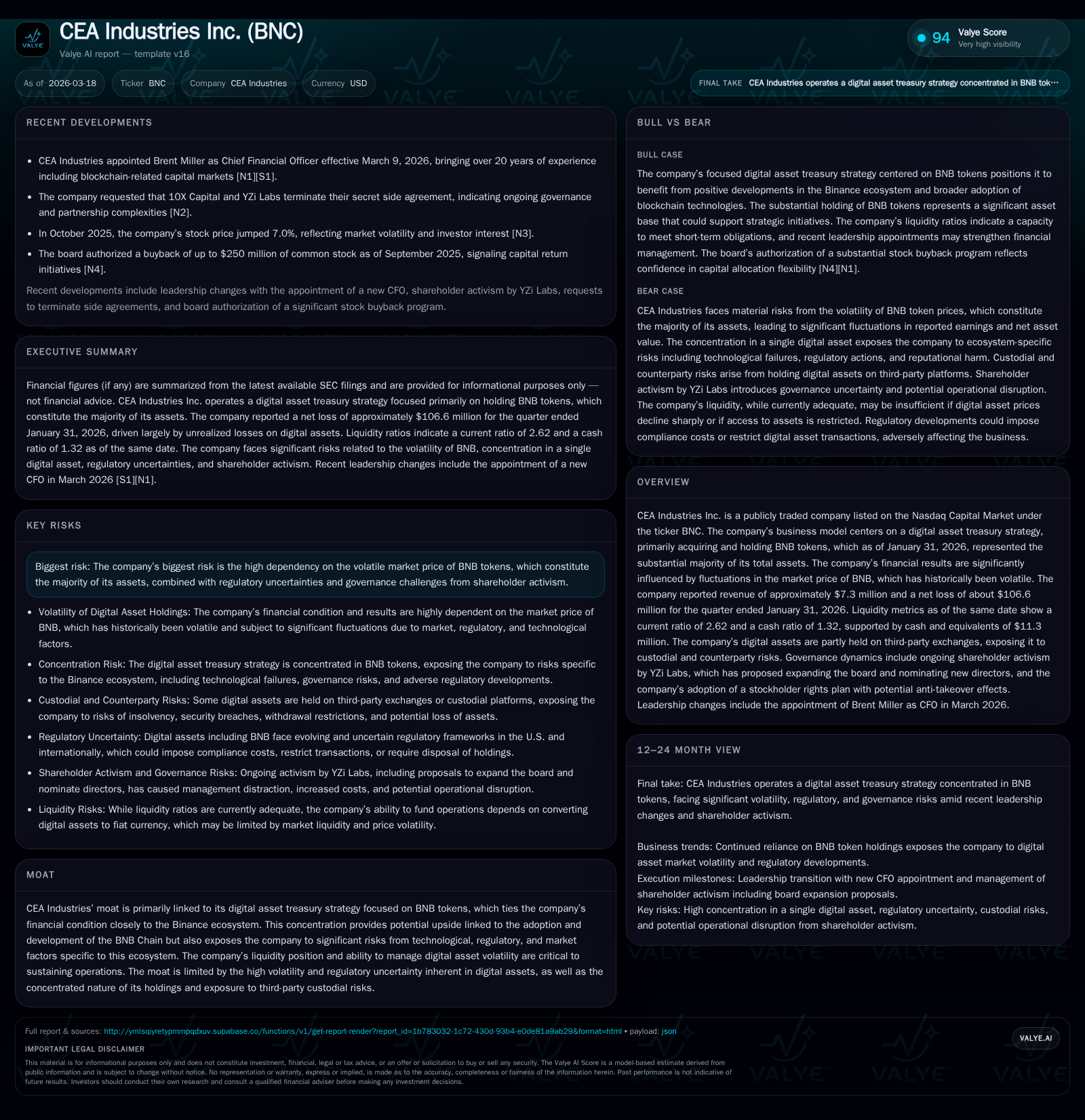
CEA Industries Inc. holds a concentrated digital asset treasury with over 515,000 BNB tokens valued at approximately $403 million as of January 2026. This concentration subjects the company to substantial earnings volatility, evidenced by a $159.8 million unrealized loss on digital assets during Q1 FY2026. Despite steady revenue growth through 2018, the company has posted persistent operating losses and negative cash flows in recent years. Liquidity remains supported by $11.3 million in cash and equivalents and a current ratio of 2.62, but custodial risks and market illiquidity pose challenges. Governance is unsettled due to an activist campaign seeking board expansion, while regulatory uncertainty around BNB’s classification could materially affect liquidity and valuation. Capital allocation reflects constrained conditions with ongoing operating cash flow deficits, minimal capital expenditures, no dividends or buybacks, and an approximate -17% return on equity. The appointment of Brent Miller as CFO signals renewed focus on managing treasury volatility and operational resilience.
Historical Financial Performance
CEA Industries demonstrated steady revenue growth from FY2015 through FY2018, increasing from roughly $7.9 million to nearly $9.6 million, with a notable year-over-year jump of approximately 33% from FY2017 to FY2018 [F1]. Despite this top-line growth, operating income remained negative across recent years, narrowing from -$3.17 million in FY2024 to -$1.38 million in FY2025 (through April) [F1]. Net income followed a similar trajectory with losses moderating but persisting at approximately -$1.37 million for FY2025 [F1]. Operating cash flow was also negative at about -$1.06 million in FY2025, alongside historically low capital expenditures under $70K annually.
Historical performance (annual)
| FY | Net ($mm) | CFO ($mm) | OpInc ($mm) | Capex ($) | Net YoY |
|---|---|---|---|---|---|
| 2025 | -1 | -1 | -1 | +56.5% | |
| 2024 | -3 | -3 | -3 | -8.1% | |
| 2023 | -3 | -6 | -3 | 30348 | +47.0% |
| 2022 | -5 | -3 | -6 | 30348 |
Source: SEC companyfacts cache [F1].
Capital returns and efficiency (annual)
| FY | FCF ($mm) | ROE% |
|---|---|---|
| 2025 | -17.3 | |
| 2024 | -34.2 | |
| 2023 | -6 | -23.7 |
| 2022 | -3 | -36.9 |
Source: SEC companyfacts cache [F1].
*FY2025 figures cover period ended April; revenue data not available [F1]
Concentration in BNB Tokens: Opportunities and Risks
A defining feature of CEA’s financial position is its digital asset treasury strategy focused almost exclusively on BNB tokens. As of January 31, 2026,
CEA held approximately 515,544 BNB tokens valued at around $402.8 million—comprising the substantial majority of total assets [S2][S8]. This concentration exposes the company to amplified market risk given BNB's historical price volatility.
In Q1 FY2026 alone (ended January), CEA recognized an unrealized loss of $159.8 million attributable to declines in BNB’s market price [S14]. Fair value accounting standards require these mark-to-market adjustments to be reflected in earnings immediately,
resulting in significant earnings volatility disconnected from core operational performance [S7].
Furthermore,
the company remains exposed to technological risks related to the Binance Chain network's validator structure and broader ecosystem developments,
as well as regulatory uncertainties impacting digital asset classification and trading frameworks globally [S4][S22].
Liquidity Profile Amid Crypto Market Dynamics
As of January 31, 2026,
CEA reported current assets totaling $22.46 million against current liabilities near $8.57 million,
yielding a healthy current ratio of approximately 2.62 [F1]. Cash and equivalents stood at $11.3 million providing operational liquidity buffers [F1].
Despite these metrics,
the bulk of CEA’s asset base comprises volatile digital assets held partially on third-party custodial platforms,
introducing counterparty risk including insolvency or withdrawal restrictions that have previously affected crypto exchanges industry-wide [S5][S14].
Such custody arrangements may limit immediate access or recovery potential during market stress or regulatory interventions.
Governance Challenges: Activist Campaign Impact
Governance dynamics have become increasingly complex due to an activist campaign by YZi Labs,
which seeks to expand the board from six to thirteen members including seven nominees aligned with its interests [N2][S11]. This campaign has imposed significant management distraction costs,
legal expenses defending corporate governance provisions,
and heightened uncertainty around strategic direction [S6][S22].
In response, the Board adopted a stockholder rights plan designed to deter unsolicited control attempts while appointing Brent Miller as CFO,
a move signaling prioritization of financial stewardship amid turbulent governance conditions [N1][S17].
Regulatory Environment: Uncertainty Surrounding Digital Assets
Regulatory classification of BNB remains uncertain within the United States and other jurisdictions.
If deemed a security under applicable laws such as the Securities Act or Investment Company Act,
the company could face substantial compliance obligations or forced divestitures that would materially impair liquidity and valuation [S4][S7][S22].
Additional risks include delisting from trading platforms and increased anti-money laundering compliance burdens.
Tax treatment ambiguity further complicates financial planning.
These factors collectively underscore significant medium-term regulatory risks inherent in CEA’s concentrated digital asset exposure.
Capital Allocation Summary: Cash Flow Constraints and Returns Analysis
Capital allocation reflects constrained financial flexibility.
Operating cash flow was negative by roughly $1.06 million for FY2025 against minimal capital expenditure levels generally below $70K annually [F1].
No dividends have been declared nor share repurchases conducted since moderate buybacks totaling approximately $400K were last recorded in FY2019 [F1][S15][S17].
Return on equity approximates negative 17%, calculated using latest net income against equity levels below $8 million at end-FY2025,
demonstrating ongoing capital inefficiency driven by structural losses despite earlier revenue gains [F1].
Outlook: Key Factors for Investors to Monitor
Looking forward, investors should closely monitor:
- Market price fluctuations for BNB which will significantly influence earnings volatility due to fair value accounting impacts.
- Progression of regulatory clarity regarding digital asset classification particularly decisions by U.S. federal authorities.
- Developments stemming from shareholder activism campaigns that may reshape board composition and strategic priorities.
- Leadership initiatives under new CFO Brent Miller focusing on managing treasury volatility and operational resilience.
- Potential diversification efforts within digital asset holdings which might mitigate concentration risk but introduce new complexities.
This analysis is for informational purposes only and does not constitute investment advice.
Disclaimer: This is research-only, informational analysis and not investment advice. It may include AI-generated interpretation and general industry context. Always verify important details using primary sources.

Comments