
Theriva Biologics Advances Oncolytic Virus Trials Amid Financial Challenges
Theriva progresses clinical development of VCN-01 with key regulatory designations while navigating persistent losses and capital constraints.
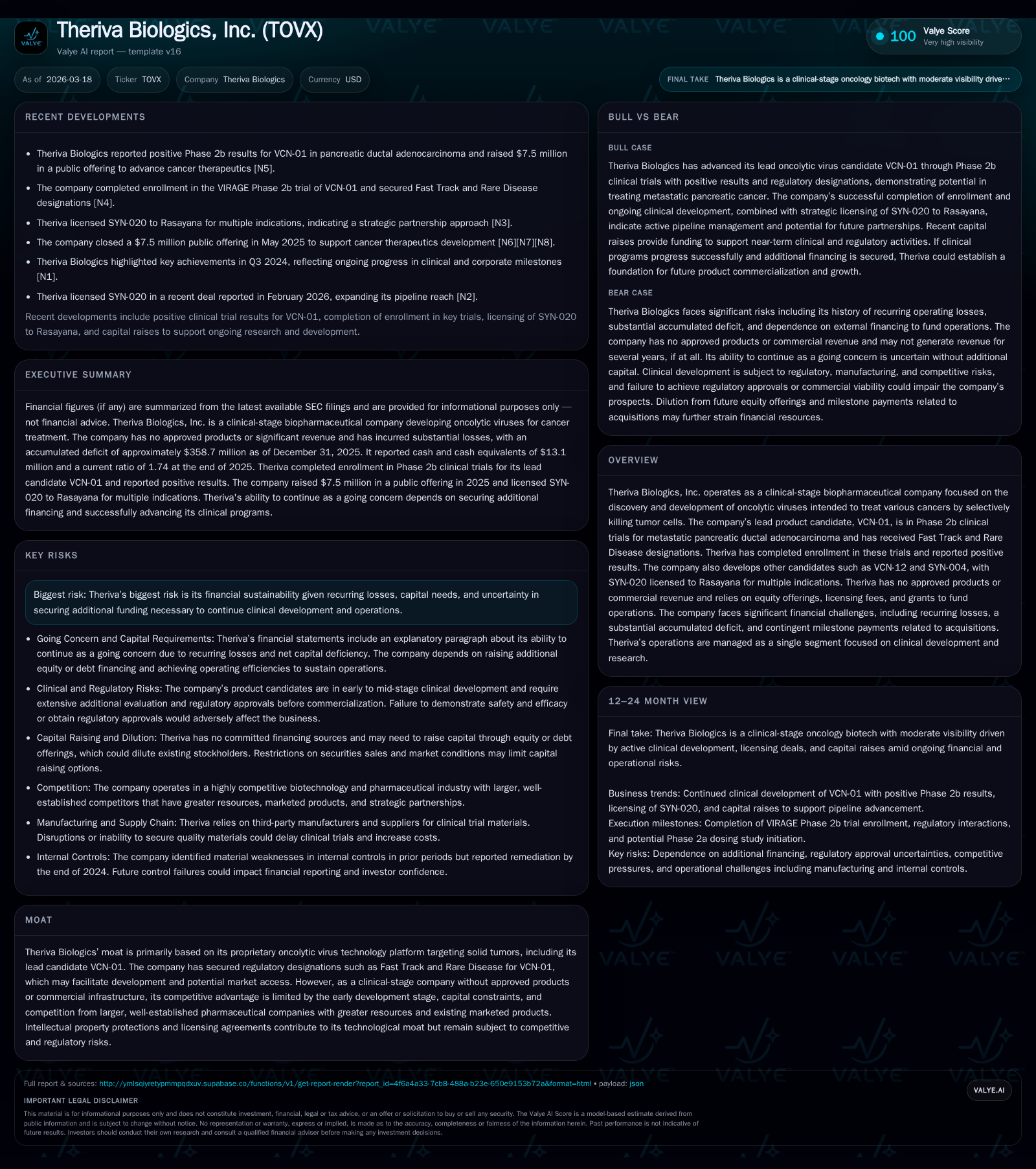
Theriva Biologics continues to develop its lead oncolytic virus candidate VCN-01 for metastatic pancreatic cancer, supported by FDA Fast Track and Rare Disease designations. Despite operational milestones including Phase 2b enrollment completion and licensing deals such as SYN-020 with Rasayana Pharmaceuticals, the company faces ongoing financial strain with no revenue, an accumulated deficit of approximately $358.7 million, negative operating cash flow of $16.7 million in 2025, and $13.1 million in cash at year-end. Contingent milestone payments and limited runway into early 2027 underscore the need for additional capital to sustain operations. Investors should monitor clinical readouts, milestone developments, and financing strategies closely [F1][N1][N2][N3][S1][S3].
Operational Performance and Historical Financials
Theriva Biologics is a clinical-stage biotech company focused on developing oncolytic viruses engineered to selectively infect and destroy tumor cells. The company’s financial results reflect significant investment in R&D without any approved products or revenues to date.
Operating income losses have remained sizable over recent years: -$21.6 million in FY2022, worsening to -$26.3 million in FY2024 before a slight improvement to -$24.1 million in FY2025 [F1]. These losses correspond with increased clinical trial activity, particularly advancing the lead candidate VCN-01.
Net income has consistently been negative reflecting ongoing investment:
Historical performance (annual)
| FY | Net ($mm) | CFO ($mm) | OpInc ($mm) | Capex ($) | Net YoY |
|---|---|---|---|---|---|
| 2025 | -17 | -24 | 35000 | ||
| 2024 | -17 | -26 | 1000 | ||
| 2023 | -18 | -19 | -21 | 202000 | +6.8% |
| 2022 | -20 | -19 | -22 | 116000 | -38.0% |
Source: SEC companyfacts cache [F1].
Capital returns and efficiency (annual)
| FY | FCF ($mm) |
|---|---|
| 2025 | -17 |
| 2024 | -17 |
| 2023 | -19 |
| 2022 | -19 |
Source: SEC companyfacts cache [F1].
These figures confirm the absence of revenue generation and highlight the company's reliance on external financing sources.
Clinical Development Progress
The company’s lead asset VCN-01 is a genetically modified human adenovirus designed to degrade tumor extracellular matrix via hyaluronidase expression, enabling enhanced viral spread within solid tumors. VCN-01 is currently in Phase 2b trials targeting metastatic pancreatic ductal adenocarcinoma (PDAC), a condition with high unmet medical need.
The FDA granted VCN-01 Fast Track and Rare Disease designations supporting an accelerated regulatory pathway for this indication [N1]. The company recently completed enrollment in this pivotal Phase 2b study—a critical milestone towards potential future registration filings.
Additional pipeline candidates include VCN-12 and SYN-004, while SYN-020 has been licensed out to Rasayana Pharmaceuticals for multiple indications generating non-dilutive income streams [N2][N3].
Financial Position and Liquidity
As of December 31, 2025, Theriva held cash and cash equivalents totaling approximately $13.1 million against current liabilities near $10 million, yielding a current ratio around 1.74 [F1][S5][S7]. Operating activities consumed about $16.7 million in cash during FY2025 alone [F1], indicating limited liquidity runway projected into early 2027 under present spending levels.
The company carries an accumulated deficit close to $358.7 million reflecting sustained operational losses since inception [F1][S1].
Notably, contingent milestone obligations related to acquisition agreements total up to $70.2 million; $7.3 million has been paid already, while a deferred $5 million payment remains under negotiation with Grifols—potentially impacting liquidity if triggered unexpectedly [S1].
Auditor reports express substantial doubt about the company’s ability to continue as a going concern absent additional capital raises or operational adjustments [S1].
Capital Allocation and Shareholder Returns
Theriva does not pay dividends nor has it conducted share repurchases given its developmental stage and capital constraints [F1]. Instead, available funds prioritize research programs with minimal capital expenditure—only about $35K spent on fixed assets in FY2025—highlighting a focus on intangible pipeline investments over infrastructure expansion.
Funding primarily derives from equity financings alongside licensing fees such as those from the SYN-020 agreement with Rasayana Pharmaceuticals that provide some non-dilutive resources but fall short of fully offsetting high clinical development costs [N2][N3][S9].
Regulatory Environment Impacting Development Timeline
Fast Track designation from the FDA facilitates more frequent interactions with regulators and eligibility for rolling submissions potentially expediting review timelines if clinical data prove favorable [N1]. Rare Disease designation may offer additional incentives like tax credits for clinical testing costs.
However, these benefits come with heightened regulatory scrutiny necessitating rigorous safety monitoring that can increase clinical expenditures despite timeline acceleration.
Outlook: Key Catalysts and Risks Ahead
Upcoming top-line efficacy data from the Phase 2b trial of VCN-01 will be decisive for validating therapeutic potential and informing next steps toward registrational filings [N1][S3]. Further regulatory engagements including pre-NDA discussions are expected contingent upon positive trial outcomes.
Capital raising efforts remain critical given existing cash burn rates and contingent liabilities; management is actively exploring equity or debt financings alongside strategic partnerships to extend operational runway beyond near-term milestones [S20].
Investors should monitor clinical data releases closely along with liquidity management developments given the absence of formal forward guidance from management thus far.
External factors such as evolving drug pricing policies under Medicare could affect future commercialization economics post-approval but do not currently impact trial progress directly [S6].
Conclusion
Theriva Biologics exemplifies a focused clinical-stage biotech investing heavily in novel oncolytic viral therapies targeting difficult-to-treat cancers but faces significant financial challenges characteristic of companies without commercialized products or revenue streams.
With key regulatory designations supporting accelerated development paths for VCN-01 alongside licensing collaborations providing some funding diversification, the company advances critical clinical milestones amid tight liquidity conditions requiring attentive capital management.
This analysis relies exclusively on publicly available SEC filings and news articles cited herein; it is not investment advice.

Comments