
Century Therapeutics Advances iPSC Allogeneic Platforms Toward Clinical Milestones
Century Therapeutics leverages innovative iPSC technology and proprietary gene editing to progress a diverse cell therapy pipeline while improving financial discipline.
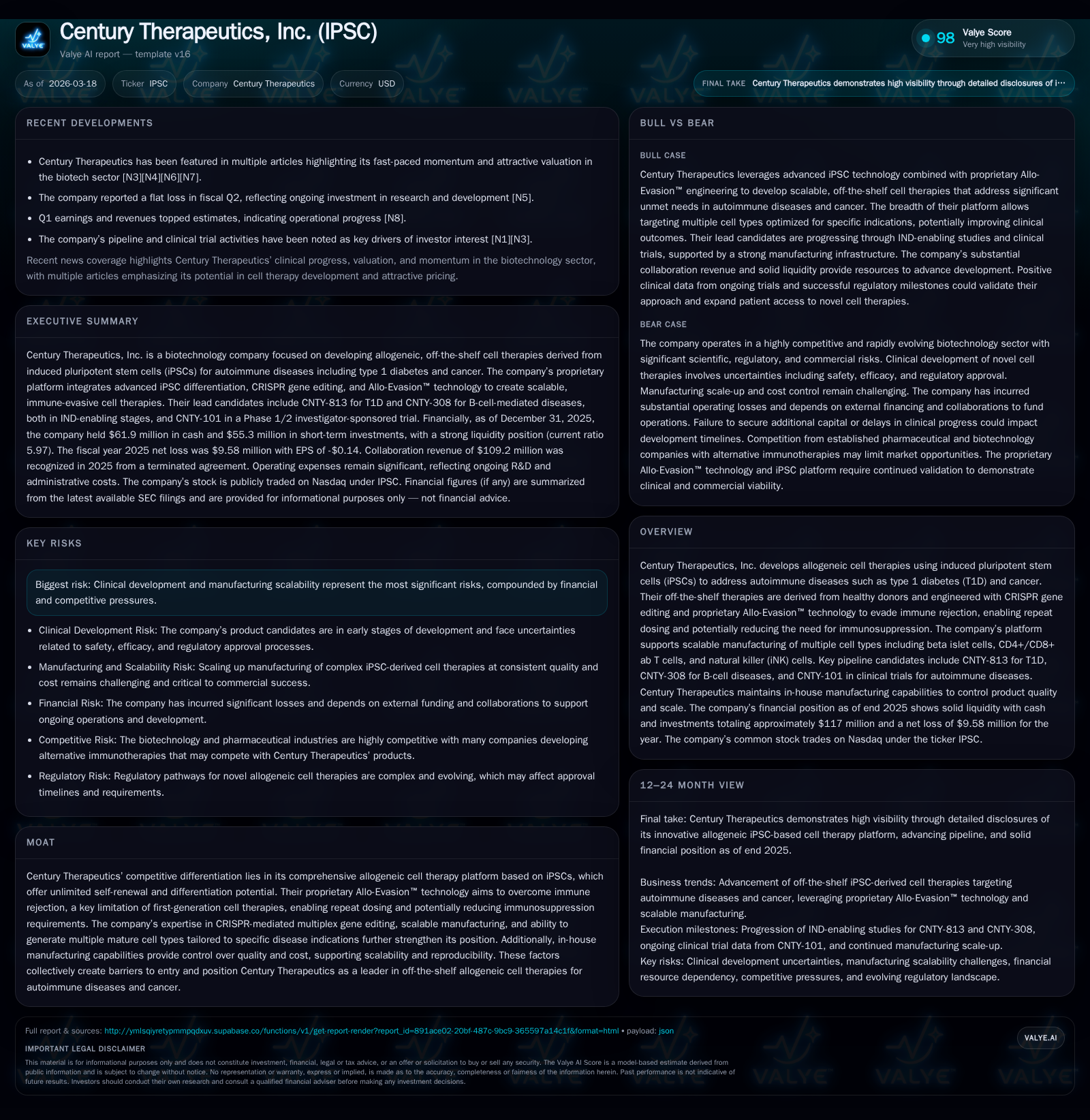
Century Therapeutics employs induced pluripotent stem cells combined with their Allo-Evasion™ gene editing platform to develop off-the-shelf allogeneic therapies targeting autoimmune diseases and cancer. The company has notably reduced its operating losses by over 80% year-over-year while advancing its lead candidate CNTY-813 for type 1 diabetes into IND-enabling studies. Despite robust liquidity and integrated manufacturing capabilities, Century faces clinical, manufacturing, and regulatory execution risks typical of emerging cell therapy developers. Upcoming clinical milestones and manufacturing scale validation represent critical inflection points for the firm’s transition toward commercialization readiness.
Transforming Cell Therapy: Century’s iPSC and Allo-Evasion™ Platform
Century Therapeutics is pioneering a next-generation allogeneic cell therapy paradigm anchored on induced pluripotent stem cells (iPSCs). Unlike traditional autologous approaches that derive cells from individual patients, Century’s platform derives therapeutics from healthy donor iPSCs exhibiting unlimited self-renewal and differentiation capabilities. This foundational plasticity enables the generation of multiple mature cell types—specifically beta islet cells for diabetes, CD4+ and CD8+ ab T cells for immune modulation, and natural killer (iNK) cells for oncology applications.
Central to their technological differentiation is the proprietary Allo-Evasion™ platform employing multiplex CRISPR gene editing to simultaneously disrupt several host-versus-graft immune recognition pathways. This inventive strategy aims to circumvent allorejection—a critical limitation stalling many first-generation allogeneic therapies—by creating "immune stealth" cell products that persist longer in vivo while enabling potential repeat dosing without aggressive immunosuppression. Such an approach also potentially reduces treatment-associated toxicities.
Complemented by cutting-edge scalable manufacturing operated internally to assure reproducibility and quality control over biologically complex product profiles, Century’s integrated system addresses key bottlenecks in production cost and supply risk that have traditionally restricted the broader utility of cell therapies. By aligning iPSC biology with precision genetic engineering and rational manufacture, Century aspires to serve patient populations across autoimmunity and oncology with off-the-shelf options classic autologous platforms cannot efficiently address [S1].
Financial Progress and Historical Loss Reduction Analysis
Financially, Century Therapeutics has illustrated tangible strategic progress by sharply reducing its sizeable fiscal losses whilst sustaining operation-heavy R&D expenditures essential for pipeline development. The company recorded an operating loss of approximately $17.3 million in fiscal year 2025, representing an improvement of about 87.5% compared to the $138.1 million deficit posted in 2024 [F1]. Similarly, net income losses narrowed markedly by over 92%, settling at roughly -$9.6 million for FY2025.
Despite this pronounced narrowing of losses reflecting operational efficiencies or expense control measures, the company’s operating cash flow remained negative at approximately -$103.9 million in FY2025—closely aligned with prior year levels—indicating ongoing substantial investments particularly within research and manufacturing domains [F1]. Capital expenditures increased year-over-year but remain modest relative to total cash outflows.
Historical performance (annual)
| FY | Net ($mm) | CFO ($mm) | OpInc ($mm) | Capex ($mm) | Net YoY |
|---|---|---|---|---|---|
| 2025 | -10 | -104 | -17 | 1 | +92.4% |
| 2024 | -127 | -110 | -138 | 0 | +7.4% |
| 2023 | -137 | -88 | -147 | 14 | -4.4% |
| 2022 | -131 | 14 | -134 | 31 |
Source: SEC companyfacts cache [F1].
Capital returns and efficiency (annual)
| FY | FCF ($mm) | ROE% |
|---|---|---|
| 2025 | -105 | -6.0 |
| 2024 | -110 | -78.4 |
| 2023 | -102 | -74.0 |
| 2022 | -17 | -43.2 |
Source: SEC companyfacts cache [F1].
Table: Century Therapeutics Historical Financial Summary FY2022-FY2025 [F1]
These figures underscore a transition phase where capital intensity remains high but loss trends are moving positively—a signal of strategic recalibration aimed at sustainability as pipelines advance toward value-inflecting clinical milestones.
Development Pipeline Overview and Lead Candidate Progress
Century's therapeutic portfolio centers around genetically engineered iPSC derivatives tailored for distinct indications:
CNTY-813: A beta islet cell therapy engineered with Allo-Evasion™ technology targeting type 1 diabetes (T1D). This program has progressed into IND-enabling studies with plans for submission following regulatory clearance [S1].
CNTY-101: An iPSC-derived T cell product candidate currently conducting clinical trials focused on autoimmune diseases.
CNTY-308: Designed for B-cell malignancies applying the same allogeneic engineered immune cell frameworks.
Leveraging the ability to generate different functional immune subsets (CD4+/CD8+ ab T cells and natural killer cells) from iPSCs positions Century well in terms of disease-specific tailored immunotherapies—critical since immune effector function nuances dictate therapeutic efficacy across oncology and autoimmunity [S1].
However, this pipeline remains early stage; none of the candidates besides CNTY-101 have reached full clinical benchmarks yet, emphasizing developmental risk inherent in pioneering populations using novel mechanisms involving gene-edited pluripotent stem cells [S1].
Operational Challenges in Manufacturing and Supply Chain Control
Manufacturing genetically engineered iPSC-derived cellular therapies on a scalable basis presents formidable hurdles that Century addresses via internal control over production processes—a less common approach among biotech firms reliant on contract manufacturers [S1][S4].
This vertical integration helps ensure consistency in cell quality, vector transduction efficiency, gene editing precision, and product release criteria compliance—parameters challenging to standardize externally due to biological variability intrinsic to living cells.
Nevertheless, reliance on specialized reagents, raw materials compliant with stringent FDA quality standards, and high-grade equipment sourced partly through third-party suppliers injects supply chain fragility [S1]. Unavailability or delays related to these components can cascade downstream causing interruptions in clinical supply fulfillment timelines or escalating costs.
Operational risks also involve maintaining Good Manufacturing Practice (cGMP) certification requirements amidst complex workflows inherent in multiplex CRISPR editing coupled with differentiation protocols that require tight environmental control to preserve genomic stability across cell batches [S1][S4].
Consequently, scaling from bench-scale development to commercial volumes compounds cost variables requiring efficient facility utilization while simultaneously adhering to evolving regulatory expectations for gene-edited biologics [S4].
Regulatory Environment and Risk Assessment
The regulatory landscape surrounding novel gene-edited allogeneic iPSC therapies remains dynamic with multiple overlapping challenges:
- Clinical development entails extensive IND-enabling preclinical studies adhering to GLP standards covering pharmacology/toxicology assays tailored specifically given the immuno-evasive modifications present in Allo-Evasion™ constructs [S1][S9].
- FDA guidance continues evolving particularly concerning multiplex gene-editing off-target assessments which add layers of complexity both scientifically and procedurally influencing trial design decisions.
- Approval depends not only on product safety/efficacy but increasingly on satisfactory manufacturing controls aligned with cGMP regulations—a significant component given live cell product variability [S9][S12].
- Legal compliance requires attention to a myriad of healthcare laws—covering anti-kickback statutes impacting marketing collaboration structures; HIPAA addressing patient data confidentiality; False Claims Act guarding against fraudulent reimbursement claims—as well as international regulations governing privacy such as GDPR [S4][S5][S6][S7][S11].
- Reimbursement uncertainty looms due to lack of precedents for pricing cellular immunotherapies within public/private payor frameworks affecting commercial viability [S21].
Overall, these factors heighten risk vis-à-vis timing unpredictability for achieving pivotal readouts or eventual market access notwithstanding technological promise.
Capital Allocation, Liquidity, and Return Metrics
Century’s balance sheet manifests a cautiously stable liquidity position underpinning near-term operational continuity amid heavy R&D cash burn:
- At December 31, 2025, cash & equivalents stood at approximately $61.9 million alongside current assets nearing $121 million against current liabilities around $20 million—yielding a strong current ratio near 6-fold indicating ample short-term solvency [F1].
- Despite these liquidity cushions, recurring negative operating cash flows exceeding $100 million annually yield an approximate free cash flow deficit over $104 million due primarily to continued investment in pipeline development and manufacturing expansion [F1].
- Equity capitalization contracted slightly year-over-year but remains robust relative to operating losses suggesting structured financing adequacy [F1].
- No dividend distributions or share buybacks are reported consistent with standard clinical-stage biotech practice prioritizing capital deployment toward advancing investigational assets rather than shareholder returns [F1][S8][S10].
Approximate return metrics illustrate negative ROE near -6%, typical given absence of revenue streams at this stage but highlighting sensitivity of financial performance tied directly to successful commercialization outcomes.
Key Clinical and Commercial Milestones to Monitor
Though explicit forward guidance is not available from recent reporting, an astute observer should track these critical upcoming inflection points:
- Submission timing and regulatory clearance of IND application supporting initiation of first-in-human dosing for CNTY-813 targeting type 1 diabetes.
- Initial safety and preliminary efficacy data from ongoing or forthcoming clinical evaluations of CNTY-101 addressing autoimmune indications which could validate platform applicability beyond oncology.
- Advancement milestones for CNTY-308 involving B-cell malignancies including preclinical toxicology findings or early-phase trial initiation.
- Demonstrations of scaled manufacturing processes meeting cGMP release criteria sustaining batch consistency essential for commercial supply agreements.
- Management commentary clarifying pathway dependencies including collaboration negotiations or potential licensing arrangements enhancing capital flexibility.
Achievement or delay relative to these events will materially influence Century’s valuation narrative given the novelty and complexity of its therapeutic approach.
Conclusion: Balancing Innovation with Execution Risk
Century Therapeutics embodies a compelling convergence of cutting-edge biotechnologies: harnessing pluripotent stem cell self-renewal capacities fused with precision CRISPR-mediated multiplexed gene editing framed within a proprietary immune evasion framework alongside committed internal manufacturing capability.
These attributes cumulatively create substantive barriers limiting peer replication while enabling potentially transformative therapeutic solutions targeting underserved autoimmune conditions such as type 1 diabetes as well as B-cell malignancies—a diversification uncommon among many single-agent focused peers [S1][F1].
However, this advanced innovation frontier is concomitant with formidable challenges: technical complexity translating into operational risk navigating regulatory scrutiny poised by evolving guidelines around gene-editing safety; dependency on securing robust third-party supply chains; absence of historical revenue generation coupled with persistent high cash burn necessitating diligent capital stewardship; plus broader sector competition intensifying across immunotherapy innovation hubs [S4][S9][F1].
Financial indicators reveal promising tactical expense management evidenced through meaningful loss reductions yet emphasize the necessity for additional funding rounds hinging upon positive clinical milestone acceleration [F1].
Ultimately, Century’s trajectory hinges critically on navigating this multipronged regime successfully—leveraging its unique Cell Platform moat while cautiously mitigating executional risks inherent within biopharmaceutical innovation cycles.
This analysis reflects information available as of March 18, 2026, derived exclusively from company filings without speculative forecasting or investment advice.
Disclaimer: This is research-only, informational analysis and not investment advice. It may include AI-generated interpretation and general industry context. Always verify important details using primary sources.

Comments