
FedEx Stakes $2.6B on InPost Consortium and Spins Off Freight Division
FedEx reports improving profitability while navigating strategic restructuring and capital discipline.
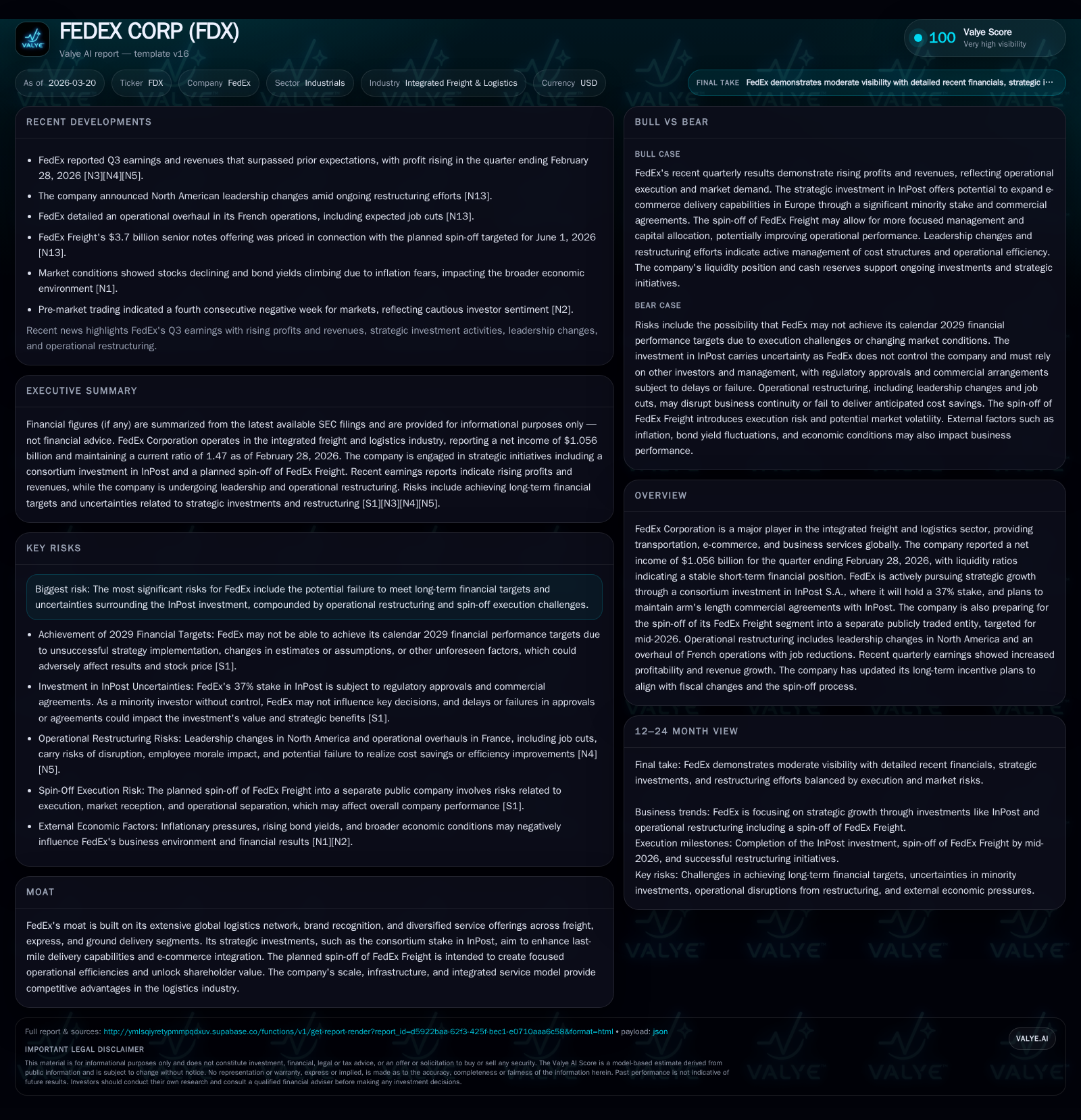
FedEx Corporation concluded fiscal 2025 with solid though slightly declining earnings and cash flow, offset by revenue growth and sustained capital returns. The recent quarter showed a net income of over $1 billion amidst preparations for a mid-2026 spin-off of its Freight segment, intended to sharpen focus and unlock value. Strategic investment in the InPost consortium positions FedEx to expand last-mile delivery capabilities, although execution risks and regulatory approvals remain as key challenges. Liquidity remains robust with a current ratio near 1.5 and cash reserves above $8 billion, underpinning strategic flexibility.
Historical Financial Performance
Reviewing FedEx's financial profile through fiscal years leading up to FY25 shows steady revenue growth alongside fluctuating profits largely influenced by operational costs and strategic investments within the integrated freight and logistics industry.
Historical performance (annual)
| FY | Net ($bn) | CFO ($bn) | OpInc ($bn) | Capex ($bn) | Net YoY |
|---|---|---|---|---|---|
| 2025 | 4.1 | 7.0 | 5.2 | 4.1 | -5.5% |
| 2024 | 4.3 | 8.3 | 5.6 | 5.2 | +9.0% |
| 2023 | 4.0 | 8.8 | 4.9 | 6.2 | +3.8% |
| 2022 | 3.8 | 9.8 | 6.2 | 6.8 |
Source: SEC companyfacts cache [F1].
Capital returns and efficiency (annual)
| FY | Div ($mm) | Buybacks ($bn) | FCF ($bn) |
|---|---|---|---|
| 2025 | 1339 | 3.0 | 3.0 |
| 2024 | 1259 | 2.5 | 3.1 |
| 2023 | 1177 | 1.5 | 2.7 |
| 2022 | 793 | 2.2 | 3.1 |
Source: SEC companyfacts cache [F1].
FY18 revenue reached $17.3B, evidencing organic growth momentum since that time [F1].
Operating income and net income reflected cyclical pressures tied to rising costs and the impact of restructuring efforts including the freight spin-off process underway.
Strategic Growth Initiatives
FedEx is actively enhancing its e-commerce logistics capabilities through a consortium acquisition of InPost S.A., acquiring a substantial minority position (37%). This €15.60 per share all-cash offer values FedEx’s stake around $2.6 billion [S16]. The move aims at strengthening FedEx’s presence in European last-mile delivery—a segment experiencing robust secular growth fueled by heightened online shopping trends.
However, InPost continues as an independent entity post-transaction without FedEx control, requiring arm's length commercial agreements between parties [S4]. Consequently, FedEx's influence on operational decisions remains limited, creating uncertainty regarding the full realization of expected synergies or strategic benefits [S4]. Regulatory approval timelines introduce additional timing risk.
In parallel, FedEx plans to spin off its FedEx Freight business—specializing in less-than-truckload shipping—into a separate publicly traded company mid-2026 [N1][N3]. This unlocking of shareholder value through focused operational units reflects a growing sector trend where pure-play companies can achieve tailored cost structures and market positioning.
Restructuring extends beyond transactions; leadership shifts in North America alongside job reductions in French operations highlight management’s commitment to streamline costs and boost efficiency ahead of the spin-off event [N11].
Forecasts and Milestones
While explicit forward guidance numbers were not disclosed aside from long-term calendar year targets for FY29 released earlier this year, which include growth and profitability benchmarks, the company flagged potential risks to achieving these due to implementation complexities and market uncertainties [S2][S4]. Notably, actual Q3 FY26 quarterly earnings beat consensus expectations with increased profitability reinforcing positive near-term momentum [N11]. Close monitoring of regulatory approval progress on the InPost deal, integration outcomes post-spin-off, and macroeconomic conditions will be critical.
Capital Allocation and Returns
FedEx’s financial discipline is reflected in continued shareholder returns alongside sizable investments:
- Dividend payments climbed to nearly $1.34 billion in FY25 from $0.79 billion in FY22, illustrating steady dividend policy expansion.
- Share repurchases accelerated substantially to over $3 billion in FY25 from approximately $2 billion previously.
- Operating cash flow receded by roughly fifteen percent year-over-year while capex dropped more steeply by about twenty-two percent signaling cautious capital expenditure amidst transitional phases [F1].
Liquidity remains strong heading into calendar Q1 FY26 with $8 billion plus in cash equivalents supported by a favorable current ratio (~1.47), indicating short-term obligations are well covered by liquid assets [F1][S23]. The issuance of senior notes by FedEx Freight Holding Company ahead of the spin-off also suggests active debt management geared towards optimizing capital structure between parent and new entity [S6][S7][S11].
Approximate return on equity stands around mid-teens (about 14.6%) based on latest annual net income against equity base—indicative of respectable profitability leveraging shareholder capital amidst ongoing restructuring [F1].
Industry Context Analysis
Within integrated freight & logistics, heightened demand from persistent e-commerce acceleration collides with inflationary cost pressures on fuel and labor costs across developed markets—factors that challenge margin expansion yet validate investments into automation, network optimization, and technology adoption such as route optimization AI or autonomous delivery trials increasingly prevalent at scale among peers.
FedEx’s large-scale network advantages continue to shield it competitively but require continual capex balancing with near-term profitability demands given infrastructure-heavy operations.
Risks Highlighted in Filings
- The possibility that FedEx fails to meet its multi-year financial targets presented for calendar year 2029 remains material if strategic executions falter or assumptions shift negatively [S2][S4].
- Uncertainty surrounds whether the consortium investment in InPost will yield anticipated benefits given limited control over governance decisions coupled with dependencies on other investors’ cooperation [S4][S5].
- Execution risk linked to spinning off FedEx Freight presents operational challenges entailing legal compliance, stakeholder alignment, and maintaining service continuity during transition periods.
Additional generic sector risks such as global trade disruptions—evidenced by market volatility related recently to geopolitical tensions—and inflationary pressures persist as external variables affecting performance [N6][N7][N8].
Conclusion
FedEx is steering through significant transformation marked by strategic portfolio shifts toward sharper business segments while bolstering last-mile presence through asset-light investment partnerships like InPost consortium participation. Strong liquidity buffers alongside disciplined capital return practices support this navigation but caution remains warranted considering execution risks inherent in large-scale corporate restructuring combined with industry-wide cost challenges. Continued vigilance over regulatory progress on transactions alongside quarterly operational metrics will provide clearer indicators of whether evolving strategies fully crystallize into sustained value accretion beyond current quarter improvements.
This analysis synthesizes publicly filed data and recent news disclosures without offering investment advice or price forecasts; it aims solely to elucidate factors shaping FedEx Corporation's current financial state and strategic direction within integrated freight and logistics.
Disclaimer: This is research-only, informational analysis and not investment advice. It may include AI-generated interpretation and general industry context. Always verify important details using primary sources.

Comments