
First Seacoast Bancorp’s Financial Turnaround and Portfolio Evolution
A review of First Seacoast Bancorp’s improved profitability, strategic portfolio shifts, and capital management in a competitive regional banking market.
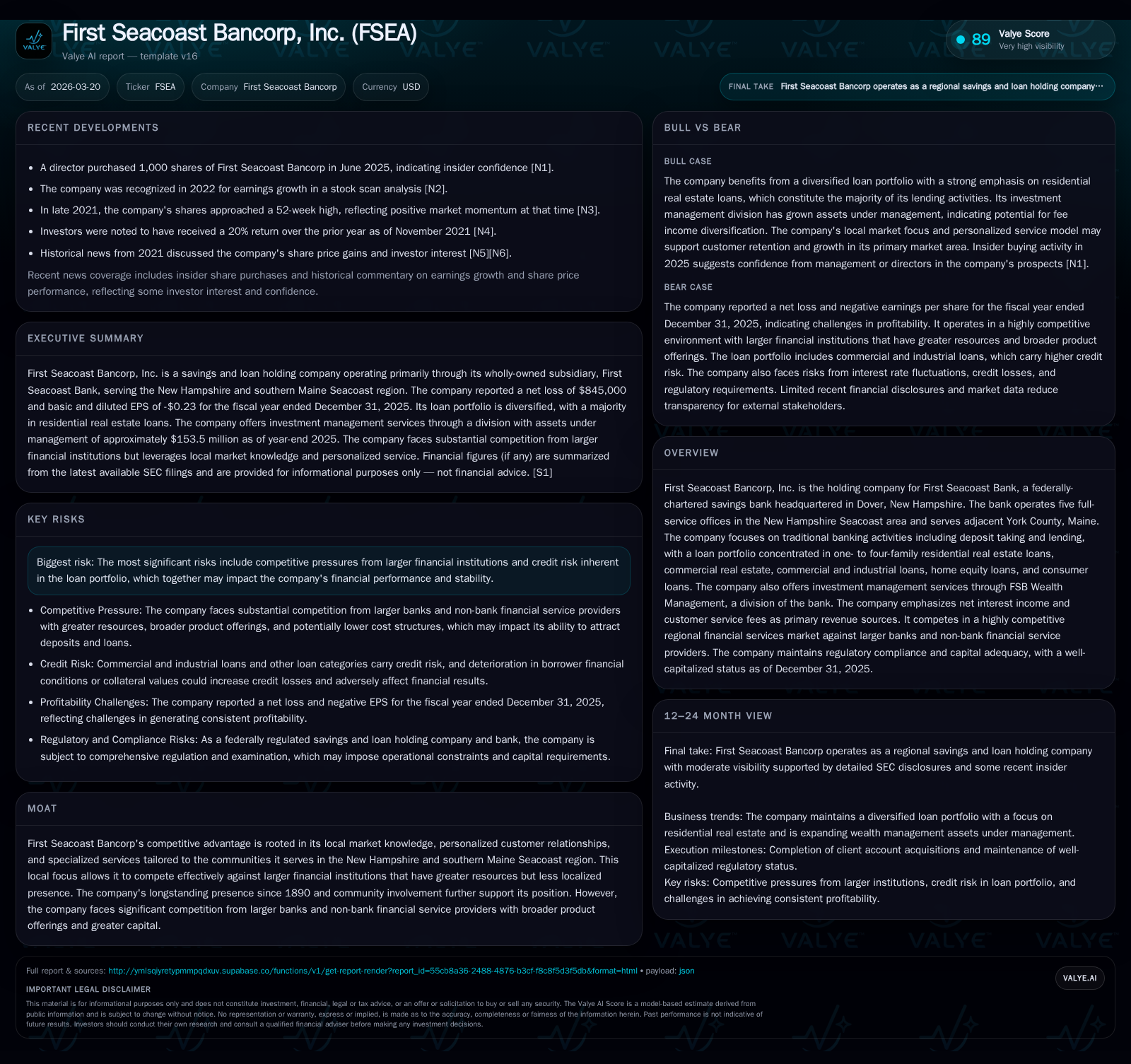
First Seacoast Bancorp has progressively reduced net losses from 2023 through 2025, supported by improving operating cash flows and controlled capital expenditures. The company strategically diversified its loan portfolio by increasing focus on commercial real estate and commercial & industrial loans to enhance yields while maintaining conservative underwriting standards. Despite persistent challenges from larger competitors, the bank leverages localized market knowledge and maintains regulatory capital compliance. Capital allocation remains conservative with no dividends or share repurchases during the period, while employee ownership initiatives underpin workforce stability. Key areas to monitor include credit quality amid portfolio shifts and evolving competitive dynamics.
Historic Financial Performance: Losses Narrowing but Challenges Persist
First Seacoast Bancorp demonstrated a marked improvement in financial results over recent years. Net losses decreased from approximately -$10.7 million in FY2023 to about -$845,000 in FY2025 [F1], with the most significant reduction occurring between FY2023 and FY2024 (-$10.7M to -$513K). Operating cash flow similarly rebounded from negative values in FY2023 (-$1.9M) and FY2024 (-$2.95M) to positive $449,000 in FY2025 [F1]. Capital expenditures were reduced to $120,000 in 2025 compared to prior years, resulting in an estimated free cash flow of $329,000 (operating cash flow less capex) for that year [F1].
Equity increased from $49.3 million at end-FY2022 to $63.5 million at end-FY2025 [F1], though return on equity remained negative at approximately -1.3% for 2025 due to ongoing net losses.
Historical performance (annual)
| FY | Net ($mm) | CFO ($mm) | Capex ($) | Net YoY |
|---|---|---|---|---|
| 2025 | -1 | 0 | 120000 | -64.7% |
| 2024 | -1 | -3 | 368000 | +95.2% |
| 2023 | -11 | -2 | 349000 | -1786.0% |
| 2022 | -1 | 1 | 103000 |
Source: SEC companyfacts cache [F1].
Capital returns and efficiency (annual)
| FY | FCF ($mm) | ROE% |
|---|---|---|
| 2025 | 0 | -1.3 |
| 2024 | -3 | -0.8 |
| 2023 | -2 | -16.0 |
| 2022 | 1 | -1.1 |
Source: SEC companyfacts cache [F1].
Table: Key financial metrics highlighting loss recovery and operating cash flow improvement [F1]
Loan Portfolio Dynamics: Maintaining Residential Core While Expanding Commercial Exposure
At December 31, 2025, total loans amounted to approximately $419.5 million with one- to four-family residential real estate loans comprising roughly 63%, the largest segment of its loan portfolio [S1][S18]. Concurrently, First Seacoast has increased emphasis on commercial real estate loans—including multi-family properties—which together represent about 20.4% of total loans [S12], as well as commercial and industrial loans accounting for approximately 5.4% [S17]. Acquisition, development, and land loans make up around 3%, while home equity loans total about $20.7 million or just under 5% of the portfolio [S9][S26].
The bank applies conservative underwriting standards characterized by thorough analysis of borrower cash flows, collateral appraisals, debt-service coverage ratios generally above 1.2x for commercial loans, personal guarantees when applicable, and ongoing monitoring through updated financial statements [S13][S17]. Participation interests in commercial loans have grown modestly from $17.4 million previously to $19.4 million at year-end 2025, aiding diversification efforts [S7]. Residential construction loans are closely managed via third-party oversight limiting project risk exposure [S17]. Consumer loans represent about $12.7 million (~3%), including growth in externally purchased manufactured housing secured loans that perform per original terms [S9][S7].
Revenue Composition: Predominance of Net Interest Income Supported by Fee-Based Services
Net interest income remains the primary driver of First Seacoast’s revenues, generated by the spread between interest earned on loans and securities versus interest paid on deposits and borrowings [S14]. This margin is sensitive to interest rate fluctuations impacting asset yields and funding costs.
Non-interest income derives mainly from customer service fees such as deposit maintenance charges plus investment advisory fees via FSB Wealth Management—a division offering advisory products through third-party broker-dealers—with assets under management around $153 million off-balance-sheet at year-end 2025 [S14]. This dual focus reflects a community bank model centered on stable customer relationships rather than wholesale trading.
Competitive Positioning: Localized Expertise Versus Larger Regional Competitors
First Seacoast’s competitive strength lies in its deep roots within New Hampshire’s Seacoast region dating back over a century combined with personalized customer service and local decision-making authority enabling responsiveness unmatched by larger banks with broader networks [S3].
Despite intense competition from regional banks with greater resources and non-bank financial entities offering overlapping products under lighter regulation, First Seacoast leverages its established relationships and community knowledge to maintain relevance within its focused markets [S21].
Capital Allocation: Conservative Approach Amid Profitability Recovery
The company maintained a conservative capital allocation stance throughout this period marked by ongoing losses but improving trends.
Equity rose from about $49 million in earlier years to approximately $63 million at end-2025 despite recurring net losses dampening ROE near -1.3% for fiscal year 2025 [F1]. No dividends or share repurchases were declared or executed during this timeframe consistent with Federal Reserve Board guidelines emphasizing dividend payments only out of current earnings aligned with capital needs and supervisory conditions [S11][S23]. Although stock repurchase authorizations were filed without objection, management prioritized capital preservation given transitional profitability conditions.
Positive free cash flow generation as of FY25 offers some flexibility for future capital deployment depending on earnings progress.
Liquidity and Regulatory Capital Compliance
First Seacoast Bank meets all relevant regulatory capital requirements including common equity Tier 1 ratios above mandated minimums and total risk-based capital ratios exceeding required floors under federal banking regulations [S22][S25]. The bank did not opt into the Community Bank Leverage Ratio framework but maintains leverage ratios consistent with Prompt Corrective Action thresholds ensuring sound solvency margins.
The liability base primarily consists of locally sourced deposits supplemented by Federal Home Loan Bank advances providing liquidity flexibility; borrowings totaled approximately $52 million at year-end 2025 with substantial unused capacity available [S15][S19][S26]. Deposit pricing balances competitiveness against cost pressures amid regional competition without engaging in high-rate wars [S19]. The securities portfolio is concentrated in government-sponsored mortgage-backed securities supporting liquidity and credit quality stability [S6][S16].
Outlook Considerations: Monitoring Credit Quality Amid Portfolio Shift and Competitive Environment
While explicit future guidance is not provided, key focus areas include:
- Monitoring credit quality developments within expanded commercial real estate and industrial loan segments given inherent elevated risks relative to residential exposures.
- Tracking deposit growth trends against competitive pressures affecting liquidity costs.
- Assessing local economic factors influencing borrower cash flows across dominant sectors such as healthcare, education, manufacturing.
- Navigating evolving regulatory landscapes impacting capital requirements or distribution constraints.
- Advancing consumer relationship depth through growing manufactured housing loan portfolios.
- Progressing profitability improvements toward sustainable net positive earnings. These factors will be critical as First Seacoast seeks cautious growth amid pressures typical for mid-sized community banks competing against larger institutions.
Risk Factors: Credit Concentration, Competition, Regulatory Complexity
Credit risk concentration remains a principal concern given increased commercial exposure requiring rigorous underwriting due to dependence on property operation for debt service payment capacity [S24][S12][S13]. Although non-performing assets remain low currently, volatility may arise from macroeconomic shifts affecting vacancies or collateral values leading to potential write-downs.
Competitive headwinds persist as large banks with broader product offerings alongside fintech entrants pressure pricing and technological expectations potentially constraining market share gains if unaddressed tactically [S21]. Regulatory compliance demands coupled with capital maintenance obligations create an environment where missteps could have outsized impacts on community banks lacking megabank scale resources [S24][S22].
Workforce Strategy: Employee Ownership as Retention Catalyst
Human capital is emphasized through an Employee Stock Ownership Plan granting eligible employees tax-deferred stock ownership aligning their interests with shareholders’ outcomes at no cost—supporting retention objectives vital for operational continuity given the bank's scale constraints typical among community banks [S5]. Internal promotion pathways further reinforce workforce stability underpinning relationship-driven service models crucial for local competitiveness.
Disclaimer: This report is prepared solely for informational purposes based on publicly available company filings and does not constitute investment advice or recommendations.
Disclaimer: This is research-only, informational analysis and not investment advice. It may include AI-generated interpretation and general industry context. Always verify important details using primary sources.

Comments