
SentinelOne Inc’s Pursuit of Profitability Amid Expanding AI Cybersecurity Platform
SentinelOne balances strong revenue growth driven by AI innovation and channel expansion against persistent net losses and intensifying competitive pressures.
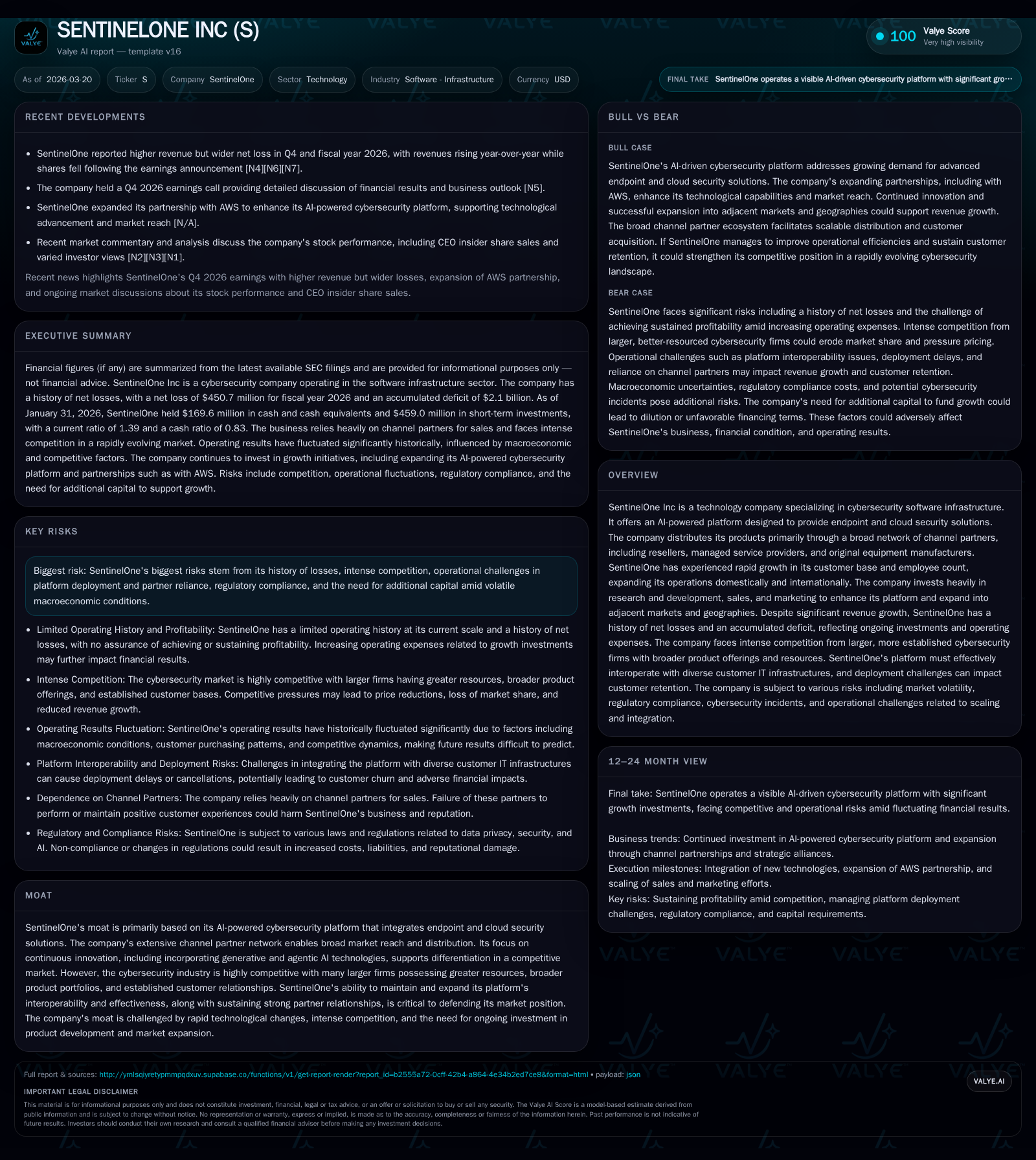
SentinelOne has demonstrated rapid expansion in revenues fueled by an extensive global channel partner ecosystem and continuous enhancements to its AI-powered cybersecurity platform. Despite improving operating income trends and significant operating cash flow growth, net losses deepened notably due to aggressive investments in R&D and sales. The company confronts challenges from larger competitors with broader portfolios and faces regulatory, litigation, and interoperability risks. SentinelOne’s recently authorized share repurchase program signals an evolving capital allocation strategy amid a complex macroeconomic backdrop. Key milestones to monitor include annual recurring revenue growth, platform adoption, and margin improvements.
Strong Revenue Expansion Fueled by Channel-Led Growth and AI Innovation
SentinelOne’s top-line growth is supported by a robust global channel partner ecosystem including resellers, managed service providers, and original equipment manufacturers that extend its market reach [S1]. The company continues to integrate advanced generative and agentic AI technologies into its endpoint and cloud security platform to differentiate itself in a highly competitive cybersecurity landscape [S8].
Strategic acquisitions such as Prompt, specializing in generative AI security, and Observo, focused on AI-ready data pipelines, aim to broaden SentinelOne’s autonomous platform capabilities [S16]. These moves complement efforts to integrate cloud workload security with cloud-native application protection platforms, targeting adjacent market segments [N1]. This multi-faceted approach sustains customer acquisition momentum despite macroeconomic headwinds affecting IT spending.
Profitability Trends: Operating Income and Net Losses
Operating income showed a slight improvement of approximately 2.4% year-over-year but remains significantly negative at a loss of $321 million for FY2026 according to SEC filings [F1]. Persistent margin pressure reflects heavy investments in research and development alongside sales and marketing expenses necessary for scaling the business [N3][S1].
Net losses widened sharply by 56.3% year-over-year to $451 million [F1], indicating that costs beyond operating expenses—potentially financing or one-time charges—contributed to the deeper bottom-line deficit. Competitive pricing pressures also continue to weigh on gross margins [S8][N3]. Balancing growth investments with profitability remains a key challenge.
Operational Cash Flow Strengthening during Low Capital Expenditures
SentinelOne generated approximately $77 million in positive cash flow from operations for FY2026, more than doubling the prior year’s performance with a 127% increase [F1]. This improvement underscores enhanced billing efficiencies aligned with its subscription-based revenue model.
Capital expenditures were modest at around $0.7 million for FY2026, down over 60% year-over-year [F1], consistent with the company’s software-centric business model focused on platform development rather than fixed asset investment. Resulting free cash flow stood near $76 million after deducting capex from operating cash flow [F1], providing liquidity support for ongoing R&D while maintaining financial flexibility.
Competitive Landscape and Platform Differentiation
SentinelOne operates amid intense competition from larger incumbents possessing greater financial resources, broader product suites, and established customer relationships [S8][S12]. Competitors may leverage bundling strategies or aggressive pricing tactics that challenge SentinelOne’s market penetration.
The company’s competitive edge centers on its AI-powered combined endpoint-cloud security platform emphasizing interoperability within diverse IT environments—a crucial factor given complex multi-vendor deployments [S26]. However, rapid technological advancements require ongoing innovation especially in generative AI integration where rivals are also actively investing [S8][S12][N14][N13]. Reliance on channel partners introduces execution risks related to sales commitments and integration coordination that could affect customer retention or acquisition rates [S2][S26]. Additionally, compliance with evolving regulations such as the EU's DORA framework adds operational complexity [S19][S24].
Capital Allocation: Share Repurchases Amid Growth Investments
In May 2025, SentinelOne’s board authorized a share repurchase program allowing up to $200 million in buybacks as part of its capital allocation strategy [S4][F1]. The timing and extent of repurchases remain discretionary based on market conditions.
With cash & equivalents totaling approximately $170 million as of January 2026 [F1] and improving free cash flow generation, management appears to be balancing shareholder returns with substantial reinvestment in R&D crucial for advancing its AI-driven platform [F1][S4]. No dividends have been declared historically nor are expected given the ongoing investment needs alongside operating losses documented through FY2026 [F1][S4].
Regulatory Risks and Litigation Exposure
The company faces ongoing securities class actions and commercial litigation which may divert management attention and impose potential financial burdens [S5][S6][S7][S14]. These legal risks compound operational uncertainties amid an evolving cybersecurity regulatory environment marked by stringent data privacy laws globally.
Export controls related to encryption technology subject SentinelOne to U.S. Department of Commerce licensing requirements along with sanctions regimes restricting certain markets [S17][S21][S29]. Compliance demands are heightened by requirements such as those under EU DORA impacting ICT risk management for financial sector clients [S19][S24]. Additionally, use of open-source software components exposes SentinelOne to potential indemnity claims or costly remediation efforts if vulnerabilities arise [S9][S15]. These factors underscore ongoing risk mitigation challenges.
Historical Financial Performance Summary (USD millions)
Historical performance (annual)
| FY | Net ($mm) | CFO ($mm) | OpInc ($mm) | Capex ($mm) | Net YoY |
|---|---|---|---|---|---|
| 2026 | -451 | 77 | -321 | 1 | -56.3% |
| 2025 | -288 | 34 | -329 | 2 | +14.8% |
| 2024 | -339 | -68 | -378 | 1 | +10.6% |
| 2023 | -379 | -193 | -403 | 5 |
Source: SEC companyfacts cache [F1].
Capital returns and efficiency (annual)
| FY | FCF ($mm) | ROE% |
|---|---|---|
| 2026 | 76 | -31.4 |
| 2025 | 32 | -17.3 |
| 2024 | -70 | -21.2 |
| 2023 | -198 | -22.9 |
Source: SEC companyfacts cache [F1].
Source: SEC filings via companyfacts cache [F1]
Outlook: Key Milestones To Monitor
Investors should track annual recurring revenue (ARR) growth as a key indicator of subscription base expansion alongside geographic diversification outside North America [N1][N2][S16]. Progress in integrating generative AI features across the platform may drive upselling opportunities but carries execution risk.
Margin improvements will depend on controlling sales efficiency costs while managing R&D inflation pressures currently sustaining operating losses despite revenue gains [N3][N11]. Analyst views suggest upside potential exceeding 30% if key metrics outperform consensus though macroeconomic uncertainties including IT budget pressures remain headwinds [N6][N7][N11].
The pace of share repurchases under the authorized program will also influence stock price dynamics alongside developments related to regulatory compliance or litigation outcomes potentially impacting financial results or reputation.
This analysis is based exclusively on publicly available information from SEC filings, verified financial data extracts, and recent market news articles as dated through March 2026. It does not constitute investment advice or recommendations.
Disclaimer: This is research-only, informational analysis and not investment advice. It may include AI-generated interpretation and general industry context. Always verify important details using primary sources.

Comments