
Leapfrog Acquisition's Early Stage Focus on Energy Supply Chain Assets and Critical Minerals
Leapfrog Acquisition Corp, a Cayman Islands SPAC launched in 2025, is pursuing an international energy and critical minerals business combination.
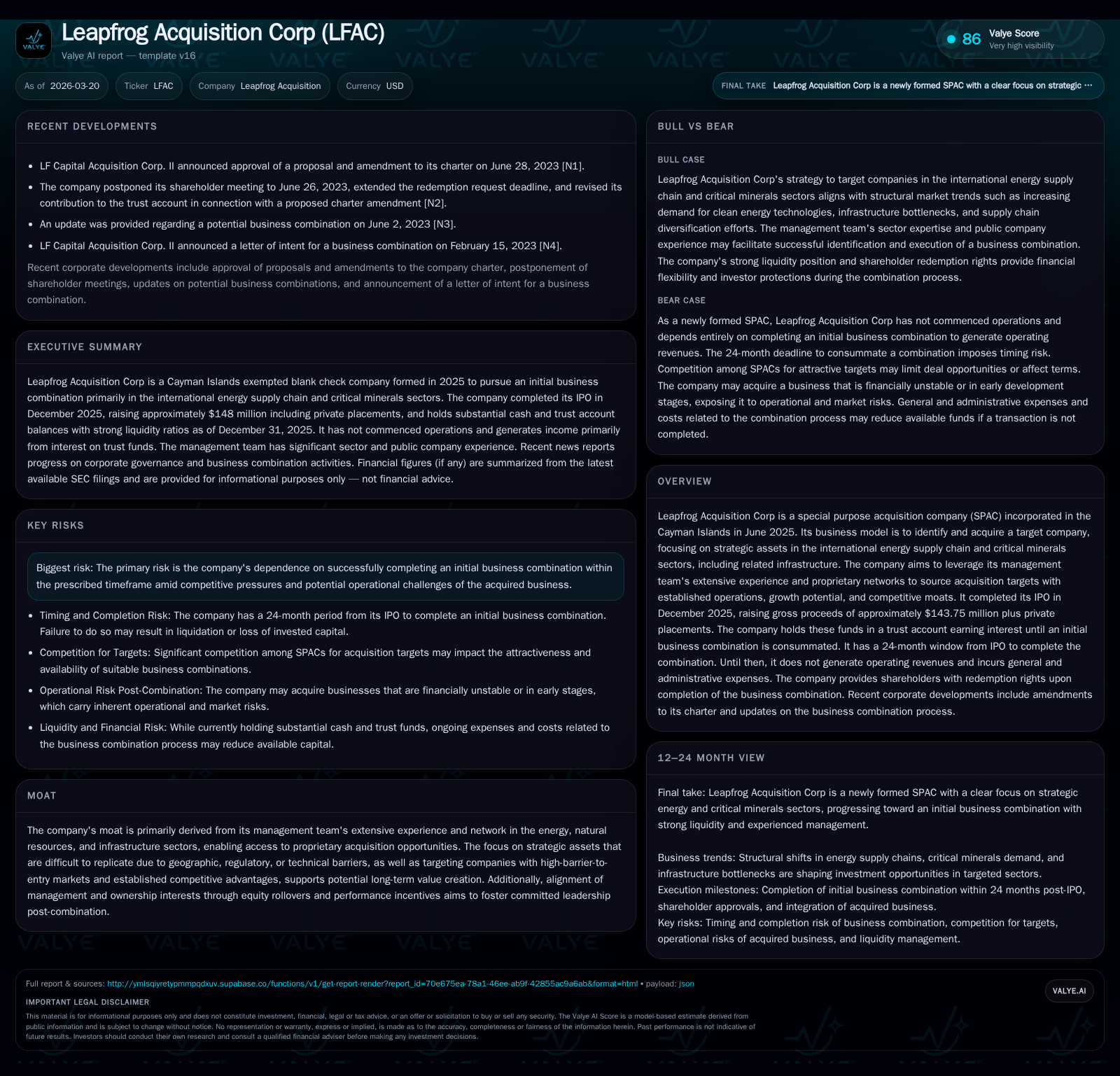
Leapfrog Acquisition Corp (LFAC) conducted its IPO in December 2025, raising over $143 million to effect a business combination targeting strategic assets in the international energy supply chain and critical minerals sectors. The company has yet to identify a target and has no operating revenues, generating only interest income on trust account proceeds so far. Its management team’s sector expertise and proprietary networks represent key competitive advantages. The company faces key risks inherent to SPACs, including successfully completing a business combination within the two-year window and competing among numerous other acquirers targeting similar assets.
Company Overview
Leapfrog Acquisition Corp (LFAC) was incorporated on June 20, 2025, as a Cayman Islands exempted company formed specifically to pursue a business combination within the energy supply chain and critical minerals sectors across international markets. As a special purpose acquisition company (SPAC), it completed an initial public offering (IPO) on December 8, 2025, issuing 14.375 million units at $10 each, raising gross proceeds of approximately $143.75 million alongside private placement units totaling nearly $4.72 million [S1][F1].
The company's core strategy is to leverage the management team's extensive experience in energy, infrastructure, and natural resources sectors to identify acquisition targets that possess durable competitive advantages or "moats." These moats stem from factors such as control over geographically embedded strategic assets, regulatory licenses, proprietary infrastructure, or logistical networks that are challenging for competitors to replicate [S1][S10].
Historical Financial Performance
As is standard for pre-acquisition SPACs, Leapfrog Acquisition has not engaged in any operating activities or generated revenues through December 31, 2025. The financial results since inception primarily reflect organizational costs necessary to prepare for the IPO coupled with minimal non-operating income from interest earned on the trust account funds where IPO proceeds are held.
According to the company's financial statements filed in March 2026:
- General and administrative expenses through December 31, 2025 totaled approximately $132,317.
- Interest income earned was roughly $337,613.
- Resulting net income came in at about $205,296.
- Cash balance was approximately $1.4 million.
- Working capital was healthy at around $1.27 million [F1].
Historical performance (annual)
| FY |
|---|
| 2025 |
Source: SEC companyfacts cache [F1].
*Period from inception June 20 to Dec 31, 2025
The negative operating income reflects ongoing costs unrelated to operations since no target has been acquired yet; the net income mainly captures accrued interest income exceeding administrative expenses.
Growth Prospects and Strategic Focus
The company's future growth hinges entirely on completing an initial business combination within its prescribed two-year timeframe post-IPO — currently by December 8, 2027 — focusing on acquisitions that align with its sector focus [S1][S19].
Leapfrog seeks businesses controlling important links in international energy production chains or firms tied to critical mineral extraction and processing whose products are essential for emerging technologies such as data center infrastructure powered by AI or advanced computing [S13]. This aligns with IEA projections signaling significant growth in electricity demand centers requiring robust baseload power sources like advanced nuclear or geothermal as well as stable supplies of copper, rare earth elements, and specialized metals.
Moreover, global geopolitical shifts have fostered reconfiguration of natural resource supply chains favoring companies embedded in regions with regulatory protection or technological barriers [S10][S13]. Leapfrog's management aims to uncover such target companies offering organic growth potential via operational improvements or consolidation opportunities within fragmented market segments.
However, these prospects come with caveats: intense competition from numerous other SPACs, private equity groups, strategic buyers, and established players seeking similar acquisitions could limit Leapfrog's ability to negotiate favorable deals or acquire larger enterprises restricted by its trust funds [S20]. Also, any requirement for significant cash consideration beyond available IPO proceeds would necessitate raising additional capital via debt or equity — financing that is uncommitted at this stage [S25].
Forecasts and Milestones to Watch
To date, the company has provided no specific guidance or disclosed milestones regarding timing or size of its initial business combination beyond its statutory deadline constraints [N/A]. Thus, investors should monitor disclosures related to:
- Identification of a preliminary target candidate.
- Announcement timelines around due diligence progress.
- Outline of financing plans if purchase price exceeds trust account liquidity.
- Shareholder meeting materials including proxy statements detailing transaction terms.
Completion within the allotted timeframe is critical; failure results in liquidation and distribution of trust funds back to public shareholders with expiration of warrants rendering them worthless [S19].
Returns and Capital Allocation Dynamics
Pre-combination returns metrics such as ROE are not particularly meaningful given Leapfrog's lack of operating earnings or asset base beyond cash holdings from the IPO. Reported approximate ROE stands negative at about -5.6% based largely on startup expenditures against shareholders’ equity without revenue generation [F1]. Free cash flow registered slightly negative driven by general administrative outflows compared to minor interest collections.
There are currently no dividends or share repurchase programs given Leapfrog’s early development stage and SPAC nature [F1][S15]. Capital allocation focuses predominantly on preserving cash for acquisition-related transaction costs while maintaining compliance with trust agreements governing the use of IPO proceeds.
Subsequent financing activities may include private offerings of debt or equity securities concurrent with an acquisition if additional capital proves necessary [S25]. Sponsor loans for working capital needs exist but were unused as of December 31, 2025 [S16]. The sponsor owns founder shares amounting near five million Class B shares which grant voting control prior to business combination completion; these shares carry no redemption rights but may convert into Class A shares post-combination aligning interests [S6][S18].
Risk Considerations
Critical risks revolve around Leapfrog's conditionality on successfully consummating a qualifying business combination before expiration of its two-year clock under Nasdaq rules — failure mandates return of trust fund money minus permitted expenses but destroys shareholder equity value aside from potential warrant expiration worthlessness [S22][S19].
Competition from multiple types of financiers and acquirers chasing scarce strategic energy assets globally could reduce deal flow quality or push prices beyond reach. Also problematic could be operational integration challenges post-merger if acquired businesses suffer inefficiencies or regulatory hurdles restricting anticipated growth.
Finally, the structural nature of SPAC sponsor incentives might induce aggressive deal-making under time pressure potentially affecting transaction discipline unless properly managed via alignment mechanisms like equity rollovers and performance-based incentives intended here by Leapfrog’s management team [S10].
Industry Contextual Analysis (Non-company-specific)
The international energy supply chain sector targeted by Leapfrog includes transmission grids, fuel processing facilities, battery storage manufacturers, and mining operations crucial for rare earth elements supporting energy transition technologies. These industries often feature high regulation complexity combined with long project lead times creating substantial barriers for new entrants—a favorable backdrop for acquiring defensible assets through focused M&A strategies.
Likewise critical minerals’ demand is projected to rise sharply driven by electric vehicles, grid storage solutions, and advanced electronics manufacturing necessitating secure upstream sources able to weather geopolitical uncertainties—hence why investors have intensely pursued consolidation platforms aiming at scalability advantages.
Summary Table: Key Financial Snapshot as of FY End December 31, 2025[F1]
| Metric | Amount (USD) |
|---|---|
| Cash & Equivalents | 1,395,995 |
| Current Assets | 1,493,005 |
| Current Liabilities | 224,800 |
| Working Capital | ~1,268,205 |
| Operating Income | -132,317 |
| Net Income | +205,296 |
| Approx ROE % | -5.6% |
| Free Cash Flow | -140,505 |
This table reflects the stand-alone pre-combination financial position highlighting substantial liquidity reserved mainly for an acquisition transaction alongside modest operating expense consumption balanced by interest earned on invested proceeds.
Conclusion
Leapfrog Acquisition Corp entered public markets very recently with a funds-backed mandate focused tightly on strategic segments influenced heavily by global energy transitions and mineral supply chain realignment. Its success fundamentally hinges on executing a timely initial business combination capturing firms with defensible market positions linked to these macro trends amid stiff competitive forces for quality assets. Until that occurs, financial performance remains limited mostly to managing organizational overhead against modest interest accruals on IPO proceeds held securely in trust.
This report is prepared solely for informational purposes based on current publicly available filings through March 20th, 2026. It does not constitute investment advice nor an offer or solicitation to buy or sell securities.
Disclaimer: This is research-only, informational analysis and not investment advice. It may include AI-generated interpretation and general industry context. Always verify important details using primary sources.

Comments