
Lithium Argentina AG Faces Substantial Capex and Liquidity Constraints While Advancing Lithium Production in Argentina
The company is advancing its phased lithium carbonate production amid significant capital expenditures and liquidity challenges.
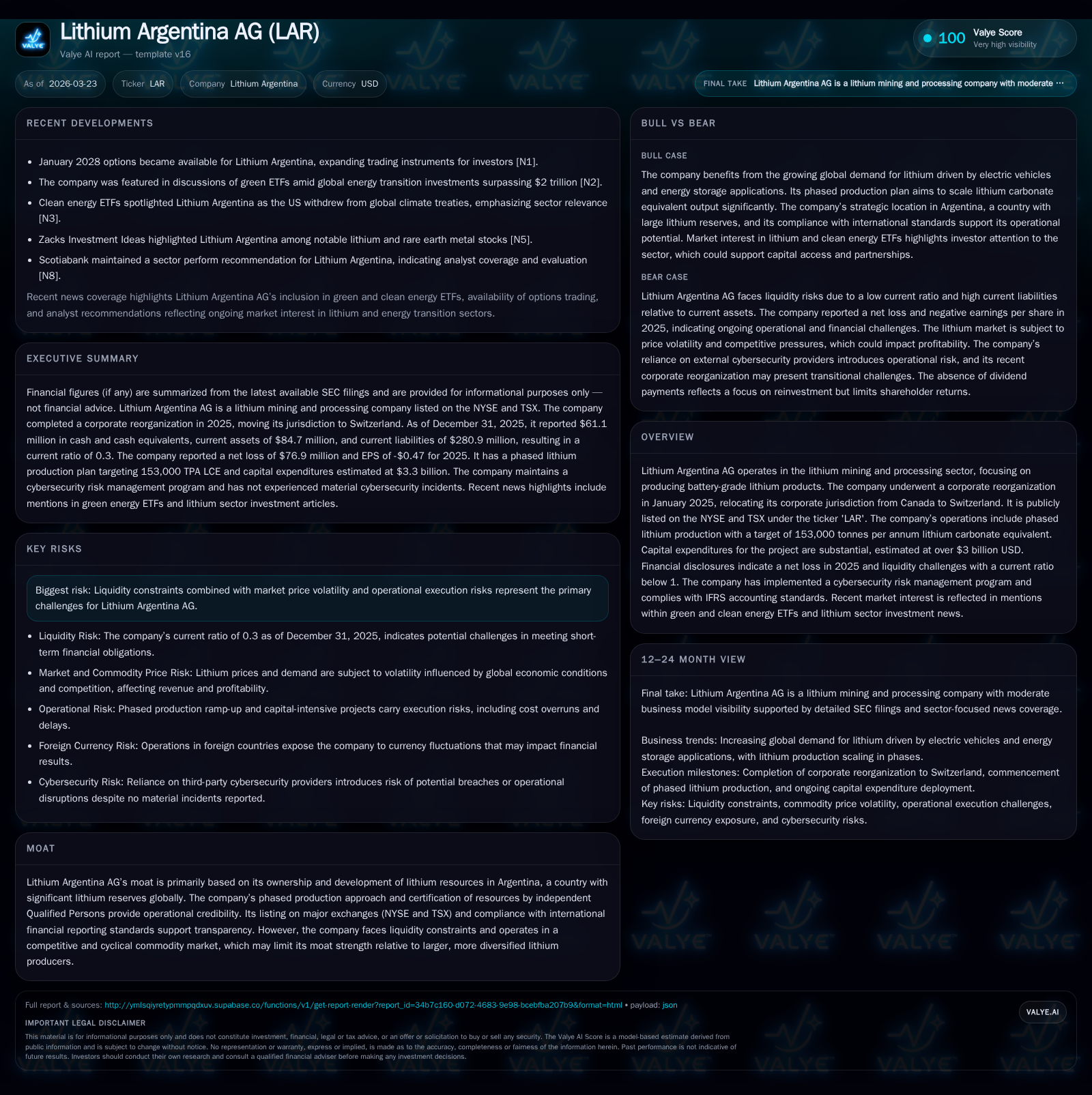
Lithium Argentina AG, having relocated its corporate base to Switzerland in early 2025, focuses on developing lithium extraction projects in Argentina's prolific 'lithium triangle'. The firm aims for a phased ramp-up to 153,000 tonnes per annum of lithium carbonate equivalent (LCE), backed by substantial capital expenditures exceeding $3 billion. Despite ambitious growth targets and validated resource ownership, the company reported a net loss in 2025 and faces liquidity pressures with a current ratio around 0.3. Its capital allocation strategies emphasize equity financing with no dividend payout plans given current operational focus. Monitoring operational execution and market dynamics will be critical for future growth prospects.
Company Overview and Corporate Structure
Lithium Argentina AG specializes in lithium mining and processing, particularly producing battery-grade lithium compounds. The company underwent a significant corporate transformation in January 2025 by relocating its jurisdiction from Canada to Switzerland, establishing its principal executive office in Zug while maintaining a North American mailing address in Vancouver [S1][S2][S3]. It is publicly traded on both the New York Stock Exchange and Toronto Stock Exchange under the ticker symbol "LAR."
The strategic repositioning aligns with efforts to enhance governance transparency through compliance with Swiss law alongside Canadian regulations [S4][S7]. Lithium Argentina operates primarily within Argentina's lithium triangle—a globally recognized region for lithium brine deposits—focusing on projects situated within Salta Province.
Historical Growth and Performance Drivers
Historically, Lithium Argentina's revenue remains modest relative to its operational scale due to the nature of development-stage mining operations. The last reported revenue figure was approximately $4.8 million USD in fiscal year 2018 [F1]. More recently, the company experienced significant financial volatility indicated by a net loss of approximately $76.9 million USD for fiscal year 2025 compared to prior years showing fluctuating earnings including a one-time net income peak in FY2023 [F1]. This volatility reflects ongoing high capital investments coupled with limited commercial output during staged ramp-up phases.
Financial Summary Table
Historical performance (annual)
| FY | Net ($mm) | Net YoY |
|---|---|---|
| 2025 | -77 | -404.5% |
| 2024 | -15 | -101.2% |
| 2023 | 1288 | +1476.9% |
| 2022 | -94 |
Source: SEC companyfacts cache [F1].
Capital returns and efficiency (annual)
| FY | ROE% |
|---|---|
| 2025 | -9.4 |
| 2024 | -1.7 |
| 2023 | 155.4 |
| 2022 | -11.9 |
Source: SEC companyfacts cache [F1].
Revenue figures are limited; net income reflects comprehensive operational investment impacts; current ratio indicates liquidity stress [F1].
Asset Ownership and Project Details
Lithium Argentina’s core asset is the Pozuelos-Pastos Grandes (PPG) Project located strategically within Argentina’s renowned lithium triangle near other major salars including Salar de Pocitos and Salar de Rincon [S1]. The total PPG project area spans approximately 66,261 hectares incorporating:
- The Lithea Project (Pozuelos), fully owned by Ganfeng Lithium.
- Pastos Grandes SA (PGCo), where Lithium Argentina holds an 85% stake.
- Sal de la Puna Project (SdlP), under majority ownership by Lithium Argentina (65%) alongside Ganfeng at 35% [S1].
In August 2025, both companies formalized a joint venture consolidating these assets into PPG JV whereby Ganfeng owns 67% and Lithium Argentina retains a valuable minority share at 33%. This structure recognizes contributions of resources, capital input, and technology sharing essential to advancing operations [S1].
Capex Commitments and Production Phases
Capital expenditures represent a defining feature of Lithium Argentina’s business model due to extensive infrastructure requirements inherent to brine extraction and chemical processing plants. Total invested CapEx exceeds $3.3 billion USD as detailed below:
- Wellfields: Approximate outlay $501 million.
- Evaporation ponds: Around $817 million.
- Process Plants including solvent extraction, purification, electrodialysis: Combined totaling over $684 million.
- Utilities & Infrastructure: Significant additional investment exceeding $300 million [S9][S14][S26].
Development follows a phased strategy targeting incremental lithium carbonate equivalent (LCE) production:
| Phase | Target LCE Production (TPA) |
|---|---|
| Phase 1 | ~51,000 |
| Phase 2 | ~102,000 |
| Phase 3 | ~153,000 |
Estimated full capacity is projected nine years after commencement of initial production stage [N2][S19]. Operating costs reflect typical sectoral inputs such as labor, power consumption—often deriving from renewable sources—and reagents critical to efficient brine processing [S10]. Estimated operating costs carry ±15% accuracy based on technical studies.
Financial Outlook and Operational Risks
Despite promising resource ownership and validated technical feasibility reports filed under NI43-101 standards [S2][S3], Lithium Argentina grapples with liquidity concerns evidenced by a current ratio hovering at roughly 0.3 at end-2025 [F1]. This underscores an imbalance between short-term liabilities ($281 million USD) versus current assets ($85 million USD).
The company's net losses have widened sharply year-over-year reflecting intensified spending on construction activities ahead of revenue generation capabilities scaling commensurately [F1]. No dividends were declared historically or planned according to the latest filings; all surplus cash flows are being allocated towards sustaining exploratory and developmental expenditure commitments [S11][S15].
Key risks include fluctuating lithium market prices which impact revenue prospects directly alongside operational execution challenges tied to building complex evaporative extraction systems in remote geographies [S12][N1]. Additionally, foreign currency exposure from cross-border transactions introduces added volatility affecting financial results due to exchange rate fluctuations [S1].
Capital Allocation Policies
Lithium Argentina has adopted an equity financing preference embedded within its Articles of Association provisioned under Swiss corporate law to facilitate flexible capital increases through ordinary or conditional share issuance via shareholder-approved mechanisms such as capital bands capped until at least January 2030 [S6][S7][S13][S17]. This framework supports raising funds expeditiously though dilutive effects require stakeholder considerations.
During fiscal year ended December 31, 2025, approximately 1.9 million new shares were issued under incentive plans fulfilling equity compensation obligations tied to performance share units (PSUs) and restricted share units (RSUs) granted under board-approved schemes aiming at long-term management retention aligned with shareholder interests [S6][S8].
No repurchase programs or dividends currently exist due to reinvestment needs but future policy shifts contingent upon profitability metrics could modify this stance.
Industry Contextual Analysis
Argentina's position within the global lithium supply chain benefits from expansive salars offering high-grade brine deposits often characterized by lower impurity levels amenable to solvent-extraction technologies typical of Argentine operations versus hard-rock mining dominant elsewhere—such as Australia. This technological advantage potentially affords efficiency gains though competition remains fierce among producers striving for scale and cost leadership.
Phased ramp-up reflects a common industry approach mitigating upfront risk while banking on anticipated surges in electric vehicle demand intensifying lithium oxide feedstock requirements over the next decade.
What To Watch Forward (Analysis)
Ongoing developments surrounding construction milestones particularly relating to pond liner installations, wellfield drilling completion rates, plant commissioning schedules will signal tangible progress towards commercial production phases assumed pivotal for transitioning from net loss status toward positive cash flows.
Market price fluctuations remain critical — lithium pricing negotiation outcomes tied to long-term contracts with battery manufacturers or intermediaries will directly influence project economics highlighted by earlier discounted cash flow models using conservative price assumptions around $18,000/ton lithium carbonate equivalent [S19].
Liquidity amelioration paths might involve further equity raises leveraging capital band authorities or entering strategic partnerships beyond existing joint venture agreements that could defray expenditure burdens.
Cybersecurity efforts underway also indicate emerging governance emphasis reflective of broader industry trends recognizing digital risk as integral operational consideration especially given multinational operational footprint.
Conclusion
Lithium Argentina AG presents an ambitious development trajectory anchored by substantial resource holdings in one of Earth's prime lithium provinces combined with high capital intensity projects designed for multi-phase expansion targeting over 150K TPA LCE capacity. Yet investors should remain cognizant of the challenging liquidity profile compounded by operating losses during project buildout as well as dependence on volatile commodity markets.
Successful milestone attainment overseeing execution timeliness coupled with potential cost optimizations could materially reshape fundamental prospects toward sustainable profitability horizons.
This analysis is based solely on publicly available information up to March 23, 2026. It does not constitute investment advice or an endorsement of any securities mentioned herein.
Disclaimer: This is research-only, informational analysis and not investment advice. It may include AI-generated interpretation and general industry context. Always verify important details using primary sources.

Comments