
Talphera's Strategic Shifts Amid Clinical Trials and Manufacturing Challenges
Assessment of Talphera’s nafamostat-based anticoagulant pipeline against a backdrop of financial strain and supply-chain dependencies.
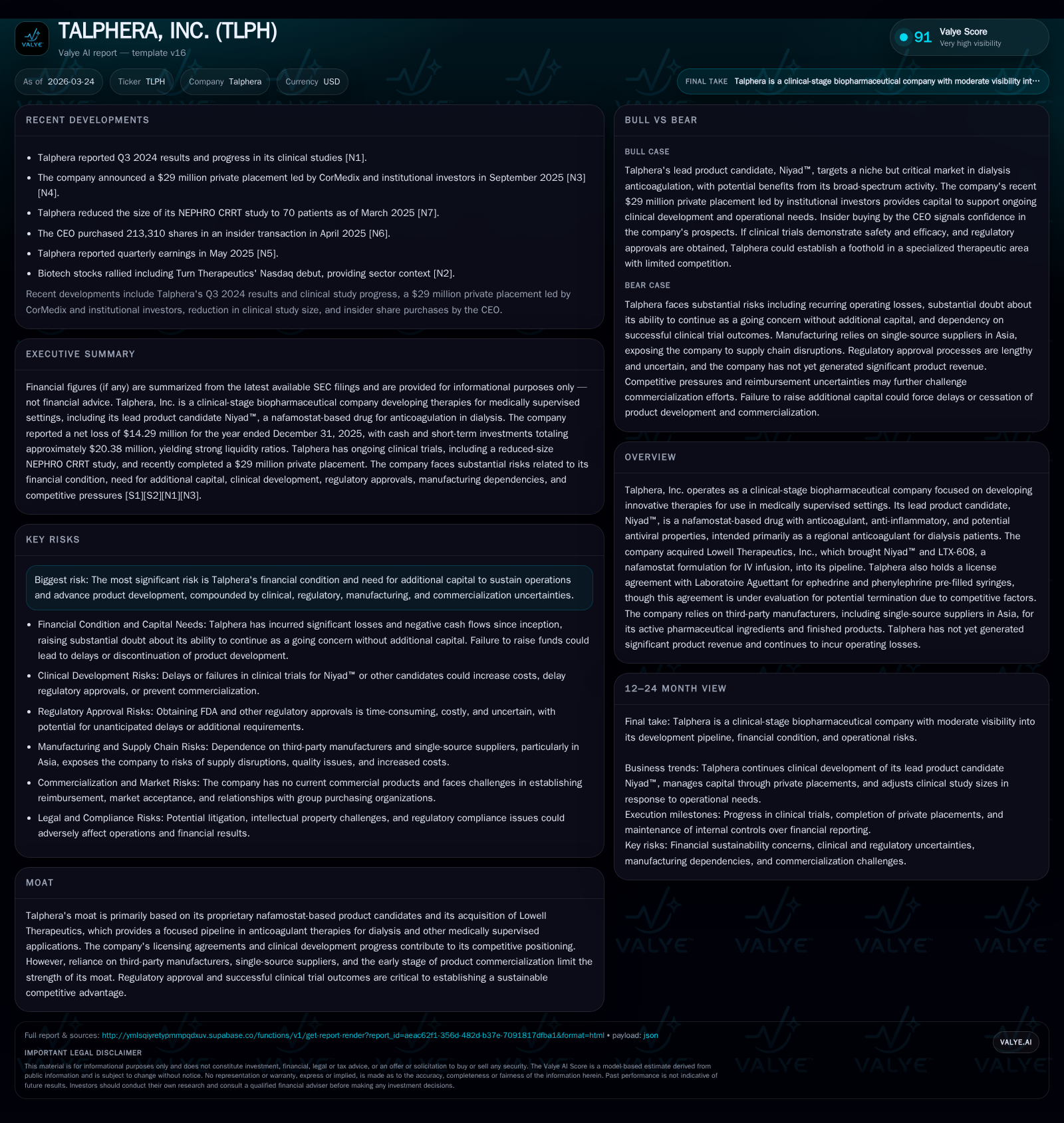
Talphera, Inc. is a clinical-stage biopharmaceutical company focused on nafamostat-based therapies tailored for medically supervised use, notably dialysis. Its growth depends on the development progress of Niyad™ and LTX-608 following its acquisition of Lowell Therapeutics, though ongoing operating losses and cash burn reflect challenges typical for early-stage biotech firms. The company's manufacturing reliance on Asian suppliers and a licensing agreement under review introduce operational risks that could affect scalability. Key milestones include clinical trial outcomes and regulatory feedback, which remain primary catalysts amid capital constraints and regulatory uncertainties.
Evolution of Talphera's Clinical Pipeline and Growth Drivers
Talphera, Inc. focuses on developing novel biopharmaceutical agents intended for medically supervised settings requiring controlled anticoagulation. Its lead clinical candidate Niyad™, based on nafamostat mesylate chemistry, functions as a regional anticoagulant targeting dialysis patients who require blood fluid management without systemic anticoagulation risks. This application leverages nafamostat's rapid onset and short half-life beneficial in extracorporeal circuits.
Niyad's advancement remains the company's principal route toward commercial viability as reported in Q3 2024 results [N1]. The acquisition of Lowell Therapeutics broadened the pipeline by adding LTX-608—another intravenous nafamostat formulation—supporting diversification within the anticoagulant niche . This strategic move consolidates Talphera’s position in a complex clinical area with limited therapeutic innovation.
Given the early stage of these assets' clinical programs, significant uncertainty remains regarding regulatory approvals. The portfolio expansion via acquisition over internal discovery reflects a pragmatic approach prioritizing near-term developmental acceleration.
Financial Performance Trends: Revenue, Losses, and Cash Flow Dynamics
From FY2019 through FY2025, Talphera showed limited revenue generation alongside sustained operating deficits consistent with its early-stage profile [F1]. Revenue decreased from approximately $613K in FY2018 to $475K in FY2019.
Operating income improved from -$25.3 million in FY2022 to -$13.48 million in FY2025 while net losses narrowed (Table 1). Operating cash flow remained negative at -$11.36 million in FY2025 reflecting ongoing R&D investments without offsetting revenues.
Capital expenditures have largely ceased (zero capex reported in FY2024), indicating cost-conscious resource allocation typical among clinical-stage companies prioritizing operational expenditure over asset expansion [F1].
Historical performance (annual)
| FY | Net ($mm) | CFO ($mm) | OpInc ($mm) | Capex ($) | Net YoY |
|---|---|---|---|---|---|
| 2025 | -14 | -11 | -13 | -9.9% | |
| 2024 | -13 | -13 | -15 | 0 | +29.3% |
| 2023 | -18 | -17 | -17 | 100000 | -138.5% |
| 2022 | 48 | -28 | -25 | 364000 |
Source: SEC companyfacts cache [F1].
Capital returns and efficiency (annual)
| FY | FCF ($mm) | ROE% |
|---|---|---|
| 2025 | -83.9 | |
| 2024 | -13 | -162.5 |
| 2023 | -18 | -130.4 |
| 2022 | -29 | 218.9 |
Source: SEC companyfacts cache [F1].
Table 1: Talphera Historical Financial Overview FY2019-FY2025 [F1]
Capital Structure and Liquidity Position: Navigating Cash Burn
As of December 31, 2025, Talphera held approximately $5.89 million in cash and equivalents against current liabilities of about $3.81 million, yielding a robust current ratio near 5.49 [F1]. This suggests adequate short-term liquidity despite recurring operating losses.
Negative operating cash flows of $11.36 million annually highlight ongoing capital consumption driven by R&D activities [F1]. The company has neither issued dividends nor repurchased shares, focusing instead on conserving capital for clinical advancement.
Management acknowledges ongoing capital requirements with plans for potential equity raises or collaborations; however, such funding events remain uncertain per SEC disclosures [S10][S15]. The firm balances sustaining operations amid cash burn against potential dilutive financing common to pre-revenue biotechs.
Strategic Licensing and Manufacturing Partnerships: Opportunities & Risks
Talphera relies on third-party manufacturers primarily located in Asia—active pharmaceutical ingredient sourcing from Japan and product manufacturing in China—which introduces supply chain vulnerabilities amid geopolitical uncertainties [S19].
A licensing agreement with Laboratoire Aguettant involving ephedrine/phenylephrine syringes is under review for possible termination due to competitive market pressures impacting commercial viability . These factors highlight exposure to supplier disruptions and portfolio concentration risks.
Regulatory and Litigation Background: Implications for Stability
Talphera faced securities class action lawsuits related to alleged misstatements about product marketing; these were dismissed at multiple judicial levels including affirmation by the Ninth Circuit Court in mid-2025 [S4][S8]. Related shareholder derivative complaints were consolidated and terminated following the securities case resolution.
Despite favorable legal outcomes reducing distraction risk, ongoing regulatory compliance remains critical given FDA promotional rules, healthcare fraud statutes, data privacy laws including HIPAA/HITECH and GDPR [S5][S6][S7]. Non-compliance could result in penalties or operational impacts common among clinical-stage biopharma firms.
Outlook: Milestones to Monitor and Potential Growth Catalysts
No explicit forward guidance was disclosed [N1][S3]. Key upcoming catalysts likely include:
- Clinical trial readouts for Niyad™ pivotal phases,
- Regulatory interactions around submissions or approvals,
- Licensing agreement decisions impacting portfolio composition,
- Capital raising efforts essential for development continuity.
These milestones will influence operational momentum and investor sentiment linked to therapeutic adoption prospects.
Investor Considerations: Risk Factors and Return Expectations
Talphera exemplifies early-stage biopharma risk/reward dynamics marked by substantial net losses resulting in an approximate ROE of -83.9% based on FY2025 data [F1]. Profitability is absent while dependence on external funding persists.
Intellectual property centered on proprietary nafamostat derivatives offers differentiation but is tempered by Asian manufacturing dependencies and licensing uncertainties [S19]. Management must also maintain regulatory compliance post-litigation while advancing operations amidst capital constraints.
In summary, Talphera’s competitive edge lies in selective biochemical innovation supported by acquired assets but requires successful navigation through multifaceted risks including capital sufficiency, clinical validation, manufacturing robustness, and evolving reimbursement landscapes typical for specialty regional anticoagulants.
Disclaimer: This is research-only, informational analysis and not investment advice. It may include AI-generated interpretation and general industry context. Always verify important details using primary sources.

Comments