
SUPA Consolidated’s Strategic Pivot From Autonomous Tech to Food Vending Amid Liquidity Constraints
The company transitions from ridesharing patents to food tech vending assets while facing significant financing challenges.
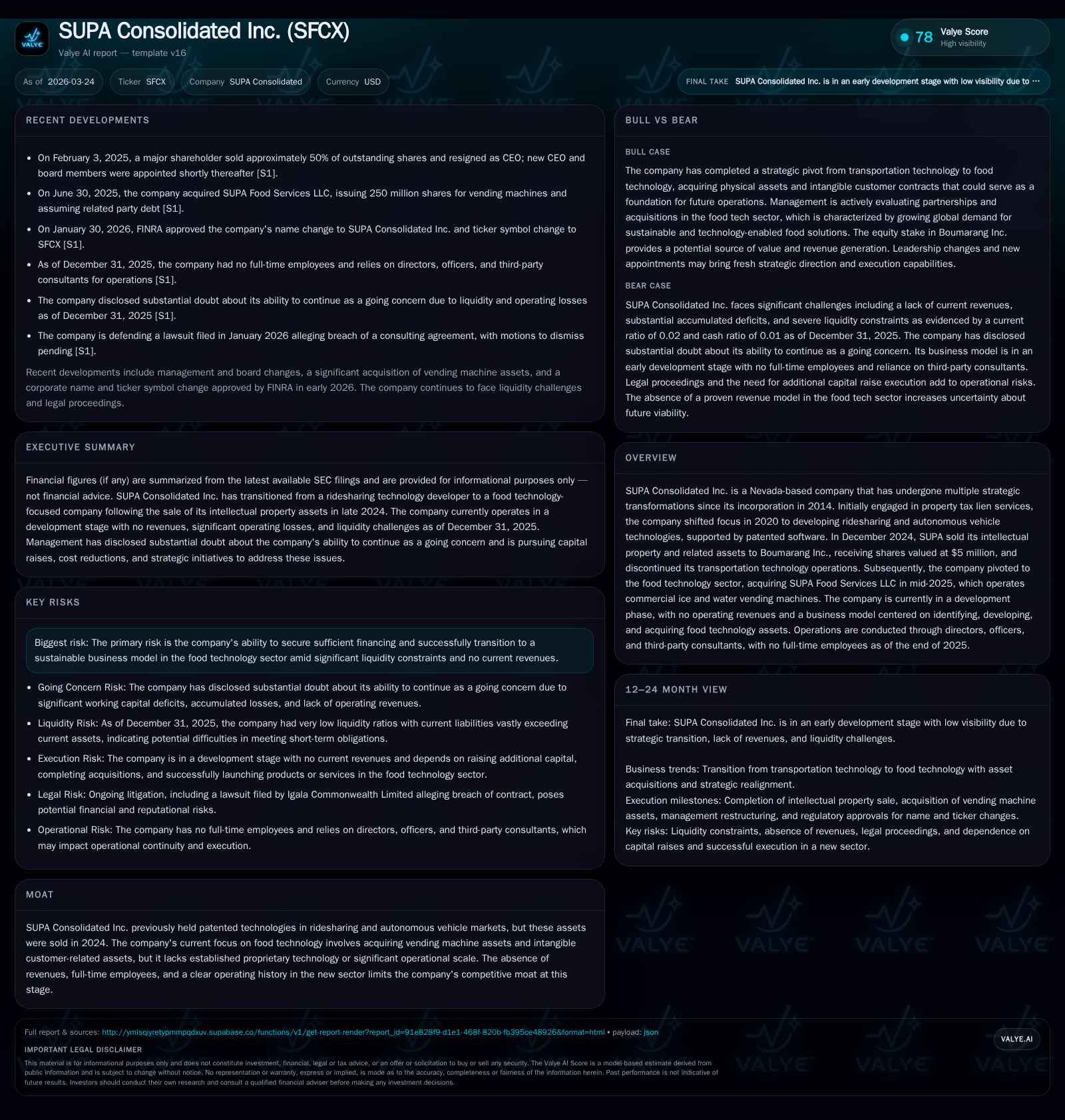
SUPA Consolidated Inc. has undergone substantial business transformations since its inception in 2014. Initially focused on property tax lien services, then transitioning to ridesharing and autonomous vehicle technologies through patented software, SUPA divested these assets in late 2024 for $5 million in Boumarang stock and exited transportation tech. The firm pivoted to food technology by acquiring vending machine assets via SUPA Food Services LLC in mid-2025 but remains in the development stage with no revenues and persistent liquidity shortfalls. The company’s future depends critically on securing capital, operationalizing its new business model, and navigating legal risks.
Company Evolution and Historical Performance
SUPA Consolidated Inc.’s trajectory reveals a series of strategic reorientations since its incorporation as Trimax Consulting, Inc. in May 2014. Initially engaged in property tax lien auction and advisory services until early 2020 [S2], the company undertook a significant pivot into proprietary software development for ridesharing and autonomous vehicle markets between January 2020 and December 2024. This phase was underpinned by U.S. Patents Nos. 9,984,574 and 11,217,101 focusing on AI-powered demand anticipation and optimization algorithms designed to improve vehicle dispatch efficiency [S1][S11].
Operating results during this period reflected continued investment without revenue generation: annual operating losses persisted alongside negative cash flows from operations [F1]. The company recorded no revenue throughout its documented history up to FY2020 [F1].
Financial Snapshot: Selected Annual Metrics
Historical performance (annual)
| FY | Net ($) | CFO ($) | OpInc ($) | Capex ($mm) | Net YoY |
|---|---|---|---|---|---|
| 2025 | -293069 | 17675 | -406982 | -654.6% | |
| 2024 | 52842 | 66305 | -88196 | 5 | +106.5% |
| 2023 | -810840 | -19826 | -137843 | 0 | +45.6% |
| 2022 | -1491513 | -154504 | -1098690 | 0 |
Source: SEC companyfacts cache [F1].
Capital returns and efficiency (annual)
| FY | FCF ($mm) | ROE% |
|---|---|---|
| 2025 | -7.3 | |
| 2024 | -5 | 1.3 |
| 2023 | 0 | 115.1 |
| 2022 | 0 | 348.2 |
Source: SEC companyfacts cache [F1].
Note: Revenue consistently at zero illustrates reliance on non-operational financial maneuvers.
Divestiture of Transportation Assets and Pivot to Food Technology
On December 31, 2024, SUPA executed a pivotal sale of substantially all ridesharing-related intellectual property—including patents and proprietary software—to Boumarang Inc., receiving approximately $5 million in Boumarang common stock valued at nearly three million shares [S1][S26]. This transaction terminated the company's historical transport technology business.
Following the divestiture, SUPA redirected efforts toward the food technology sector with the acquisition of SUPA Food Services LLC in June 2025 [S12][S13]. This acquisition included ownership of over one thousand commercial ice/water vending machines (valued close to $41k), plus intangible assets such as customer contracts and operational infrastructure [S8][S26]. The company issued an aggregate of 250 million shares for this transaction valued nominally at $125k [S8][S13].
Despite these steps towards establishing a base in the food vending domain, SUPA remains lagging on commercialization fronts with no recorded revenues through fiscal year-end December 31, 2025 [F1], underscoring its development-stage status.
Liquidity Profile and Capital Structure Dynamics
Financial statements reveal acute liquidity constraints threatening operational continuity. As of the fiscal year ended December 31, 2025:
- Cash equivalents stood at an estimated $25.8k.
- Current liabilities exceeded current assets by approximately $1.09 million resulting in a current ratio near 0.02 [F1][S3].
- Accumulated deficits expanded beyond $3 million reflecting continual operational losses without offsetting gains [F1][S3].
Management acknowledges these metrics raise "substantial doubt" concerning going concern viability over the following year absent corrective actions [S3][S6][S7]. Strategies include pursuing additional equity or debt financing rounds; monetizing equity stakes such as Boumarang shares; cost reductions; and leveraging related-party support from SUPA Food Services LLC [S3][S12]. However, explicit agreements for new funding sources are not currently established [S6][S8], exposing execution risk.
Operating Expenses and Capital Investments
Operating expenses have fluctuated notably amidst strategic shifts. For instance:
- General & administrative expenses increased sharply post-acquisition reflecting legal fees and rental costs tied to vending machine operations [S12][S17].
- Capital expenditures experienced erratic surges peaking notably at $5 million in FY2024 coinciding with asset sales and restructuring activities rather than organic R&D or growth CAPEX [F1].
This pattern indicates financial outlays concentrated on transactional events rather than steady operational build-up.
Governance Changes and Operational Structure
Key leadership turnover occurred early in Q1 2025: CEO Joseph Grimes divested a large share portion (~50%) followed by resignations among multiple executives including CTO—with new executives named shortly after February 6 [S1][S13].
Importantly, the company lacks full-time employees as of December 31, 2025; all functions are undertaken via directors or contracted third parties highlighting limited internal operational capacity [S1].
Legal Proceedings Impact Potential Uncertainty
Litigation emerged prominently in early '26 when Igala Commonwealth Limited filed claims seeking issuance of approximately an additional 12.8 million shares beyond initial contract terms linked to consulting arrangements dating back to March 2023 [S18][S19].
SUPA denies merit asserting Illinois law penalties apply due to disproportionate damages sought relative to contract value—a dispute ongoing with hearings scheduled mid- 2026. Additionally, an unrelated but potentially material pre-litigation demand from Forza 2 LLC concerning transactions involving prior vending machine dealings suggests further contingent liabilities or reputational risks [S18].
Forward-Looking Considerations
The company explicitly states that future operations hinge on successfully raising capital and integrating acquisitions into viable commercial offerings within food tech spaces [S12][S13]. Currently no formal revenue milestones or product launch timelines are disclosed. Investors should monitor:
- Success in capital raises given historically tight liquidity.
- Progress in scaling vending operations beyond existing machines acquired.
- Legal outcomes from ongoing disputes which could materially affect equity balances.
- Management’s ability to build internal capabilities beyond director-driven engagements.
- Market acceptance dynamics within highly fragmented food vending spaces.
Returns and Capital Allocation Review
There is no dividend history nor share buyback activity reported across recent years indicating a focus on reinvestment or survival over capital returns [F1]. The latest annual return on equity appears negative at approximately -7.3% given ongoing net losses relative to shareholders’ equity base [F1]. Operating cash flow remains insufficient against capex outlays resulting in negative free cash flow estimated above -$4.9 million for FY2025 alone [F1]. This reflects structural challenges balancing growth ambitions against financial endurance.
Disclaimer: This report is intended solely for informational purposes reflecting facts available as of March 24, 2026. It does not constitute investment advice or solicit any action regarding securities of SUPA Consolidated Inc. Readers should conduct independent due diligence before making financial decisions.
Disclaimer: This is research-only, informational analysis and not investment advice. It may include AI-generated interpretation and general industry context. Always verify important details using primary sources.

Comments