
Curis Inc’s Path Forward: Innovation, Financing, and Market Uncertainty
Curis transitions from royalty reliance to clinical-stage development with emavusertib central amid capital and regulatory challenges.
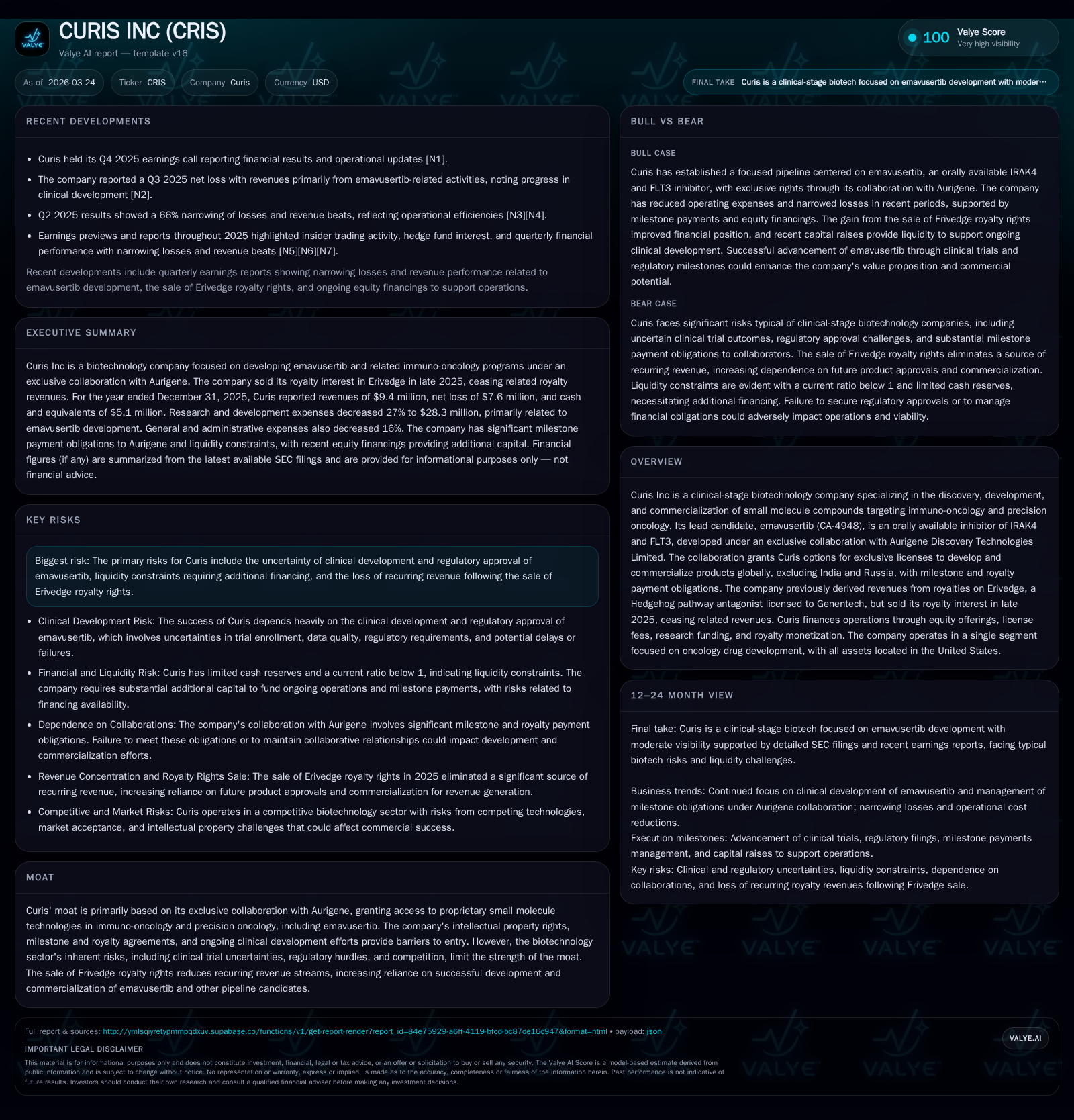
Curis Inc has evolved from a royalty-dependent biotech into a clinical-stage company focused on its lead IRAK4/FLT3 inhibitor, emavusertib. The recent sale of its Erivedge royalties removed a once steady revenue source, increasing reliance on milestone-driven cash flows and equity financing, highlighted by a $18.6 million PIPE in early 2026. Despite narrowing operating losses in 2025, Curis faces significant liquidity stress with a current ratio below one and substantial continuing cash burn. Regulatory approval hurdles, including FDA trial requirements and heightened legal scrutiny post-2024 Supreme Court decisions, compound commercial risks. Upcoming clinical readouts, regulatory submissions, and collaboration milestones are key watchpoints shaping the company’s near-term outlook as it attempts to balance innovation with constrained financial resources.
From Royalties to R&D: Curis’ Historical Revenue Evolution
Historically, Curis Inc’s financial foundation rested significantly on royalty income derived from Erivedge (vismodegib), a pioneering Hedgehog pathway antagonist licensed to Genentech. This royalty stream provided relatively steady revenues through at least 2017, with recorded top-line revenue reaching approximately $3.26 million that year [F1]. Post-2017 revenue figures have not been updated publicly; the company pivoted towards pipeline-centric investments.
A major inflection occurred by late 2025 when Curis sold its remaining royalty interests in Erivedge, effectively eliminating this source of recurring revenue [S1]. This divestment marked a definitive transition away from legacy income toward reliance on clinical-stage progress and milestone-driven payments.
This shift is reflected starkly in the company's financial statements with operating losses becoming the norm due to elevated R&D spending on pipeline candidates. The withdrawal of Erivedge royalties removed a buffer against volatility inherent to biotech development phases.
Historical performance (annual)
| FY | Net ($mm) | CFO ($mm) | OpInc ($mm) | Capex ($) | Net YoY |
|---|---|---|---|---|---|
| 2025 | -8 | -27 | -6 | +82.5% | |
| 2024 | -43 | -40 | -45 | +8.5% | |
| 2023 | -47 | -38 | -48 | 0 | +16.3% |
| 2022 | -57 | -54 | -53 | 416000 |
Source: SEC companyfacts cache [F1].
Capital returns and efficiency (annual)
| FY | FCF ($mm) | ROE% |
|---|---|---|
| 2025 | -138.8 | |
| 2024 | 723.4 | |
| 2023 | -38 | -241.0 |
| 2022 | -55 | -121.7 |
Source: SEC companyfacts cache [F1].
The table highlights years of sustained losses widening until mid-2020s before notable improvement in operating income in FY2025 [F1]. However the cessation of royalties implies continued top-line vulnerability.
Exclusive Collaboration with Aurigene: Access to Small-Molecule Immuno-Oncology Assets
Central to Curis’ pipeline evolution is its amended exclusive collaboration agreement with Aurigene Discovery Technologies Limited [S1]. This deal grants Curis option rights for exclusive royalty-bearing licenses worldwide excluding India and Russia—territories reserved for Aurigene—to develop small molecule compounds targeting immuno-oncology pathways including IRAK4 and PD1/TIM3.
Under this collaboration structure:
- Curis owes Aurigene tiered royalties ranging from high single digits up to about 10% of annual net sales on partnered products.
- Regulatory approval and commercial sales milestones payable per licensed program remain materially significant at approximately $42.5 million each.
- Payments upon sublicense agreements are also contractually defined.
This arrangement establishes Curis’ control over advanced therapeutic innovations inaccessible without similar licenses while embedding substantial contingent liabilities tied to regulatory success.
Emavusertib: Lead Clinical Asset Driving Strategic Outlook
Emavusertib (CA-4948) represents Curis’ lead compound under development — an oral inhibitor selectively targeting IRAK4 and FLT3 kinases crucial in immuno-oncology and precision oncology contexts [S1][N1]. The dual inhibition aims at modulating innate immune signaling pathways with potential applicability across hematologic malignancies and solid tumors.
Currently in clinical-stage trials globally excluding India/Russia territories reserved for Aurigene:
- Emavusertib’s advancement encapsulates weighted risk given its pivotal role but unproven market entry.
- Its oral bioavailability supports patient compliance vital for systemic targeted therapies.
- The mechanistic approach aligns well with trends favoring immunomodulatory agents capable of overcoming tumor microenvironment resistance.
Reliance on this single asset concentrates risk given lack of diversified revenue streams post-Erivedge royalties .
Financial Performance: Narrowing Losses Amid Liquidity Stress
Financial disclosures portray a progressively narrowing loss trajectory culminating in FY2025 operating income at approximately -$5.7 million compared to massive losses above -$44 million annually from FY2022 through FY2024 [F1]. Net losses remain negative at about $7.6 million in FY2025 [F1].
Operational cash flow remains deeply negative at approximately -$27.2 million as of year-end 2025 despite cost improvements [F1]. Cash and equivalents totaled roughly $5.1 million as of December 31st last year juxtaposed against current liabilities of approximately $14.1 million – yielding a precarious current ratio near 0.49 indicating pronounced liquidity stress [F1].
Equity stands positive yet thin at about $5.46 million by year-end despite prior years characterized by significant negative equity balances [F1]. These figures indicate ongoing challenges sustaining operations without continued external funding amid absence of steady product-generated cash flow.
Capital Allocation: Funding Clinical Development Without Recurring Revenues
Lacking recurring royalty income post-Erivedge sale sharply raised capital intensity around supporting imminent clinical milestones for emavusertib [S1][S19]. To mitigate acute funding gaps:
- Curis completed an $18.6 million private investment in public equity (PIPE) financing as early as January 2026 underscoring capital necessity amidst constrained cash runway [S1].
- There are no dividends or share repurchases as all free cash flow remains negative reflecting reinvestment into pipeline progression rather than shareholder returns [F1][S19].
- Milestone payment obligations exceeding tens of millions per program remain contingent liabilities adding financial burden alongside capital raises.
This dynamic typifies clinical stage biotechs shifting from legacy revenue models toward capital markets dependency fueled by investor appetite for innovative therapeutics yet burdened by volatility intrinsic to drug development cycles .
Regulatory Environment: FDA Approval Hurdles and Emerging Legal Uncertainties
Despite potentially expedited pathways offering accelerated approval based on one robust clinical trial plus confirmatory evidence requirements put forth by FDA for oncology drugs, emavusertib faces critical procedural uncertainties [S4]:
- The FDA may mandate additional trials beyond initial pivotal studies if data is deemed insufficient jeopardizing approval timelines.
- Recent landmark U.S Supreme Court rulings dismantling decades-old presumptive deference frameworks for federal agencies could expose approval processes to judicial reinterpretation delaying agency decisions or opening procedural litigation avenues.
- Combined with evolving Medicaid drug pricing reforms under the Inflation Reduction Act and emerging price negotiation programs starting late 2026 further cloud pricing environments impacting commercial feasibility assumptions .
- Healthcare laws including Anti-Kickback Statutes and privacy regulations like HIPAA impose compliance costs adding complexity pre-and post-marketing authorization .
Thus regulatory navigation necessitates extensive legal expertise alongside traditional scientific rigor increasing time-to-market risks inherent to small-cap biopharma entities reliant on singular assets.
Projected Milestones and Investor Watchpoints
Explicit guidance remains limited regarding precise timing yet several material events merit close observation:
- Clinical trial progress updates particularly Phase II/III data readouts informing efficacy/safety profiles relevant for NDA submission considerations [N1][S1].
- Completion or initiation of confirmatory trials mandated by regulators shaping approval likelihoods.
- Achievement of collaboration milestones triggering payments or license fee negotiations impacting near-term liquidity positions.
- Additional equity raises or strategic partnerships as potential recourse if operating losses continue exceeding internal funding capacity.
- Any shifts in FDA policies following ongoing federal agency-related litigation outcomes possibly affecting accelerated approval standards or post-market requirements.
Monitoring these developments will clarify Curis’ trajectory transitioning from developmental expenditures toward potential market entry preparation.
Risk Factors Impacting Future Prospects and Capital Strategy
Key risks include:
- Substantial doubt about continuing as a going concern given insufficient secured capital beyond next twelve months absent further financings raising existential uncertainty [S1].
- Clinical failure risk tied especially to emavusertib’s single asset dependency – failure here could precipitate operational shutdown absent diversification options.
- Heightened legislative scrutiny including new Medicare drug pricing rules introducing downward pricing pressures limiting future revenue scalability .
- Broad healthcare fraud/abuse compliance costs tied to anti-kickback laws plus privacy/data protection enforcement creating persistent overhead burdens [S21].
- Intellectual property enforcement complexity intensified partly via Aurigene-originating patents vulnerable especially within Indian jurisdiction limiting effective global exclusivity protections [S17][S25].
- Potential increases in legal challenges arising from recent Supreme Court APA interpretations weakening standard agency rule deference elevating administrative risk profile [S4].
These factors delineate a challenging environment requiring astute financial stewardship alongside successful scientific translation — crucial for survival beyond early clinical stages.
This analysis incorporates explicitly disclosed company facts up through early 2026 filings and earnings commentary without speculative extrapolation or forward-looking statements absent documented guidance sources. Details reflect the unique challenges facing small cap biopharmaceutical companies undergoing fundamental business model transformation amid complex regulatory landscapes and volatile capital market conditions common in clinical-stage drug developers today.
Disclaimer: This is research-only, informational analysis and not investment advice. It may include AI-generated interpretation and general industry context. Always verify important details using primary sources.

Comments