
AEVA Technologies' 4D LiDAR Drives Strong Revenue Growth Amid Continued Investment Phase
AEVA’s proprietary FMCW 4D LiDAR technology nearly doubles revenue in 2025 while operating losses persist as the company invests heavily in R&D and commercialization.
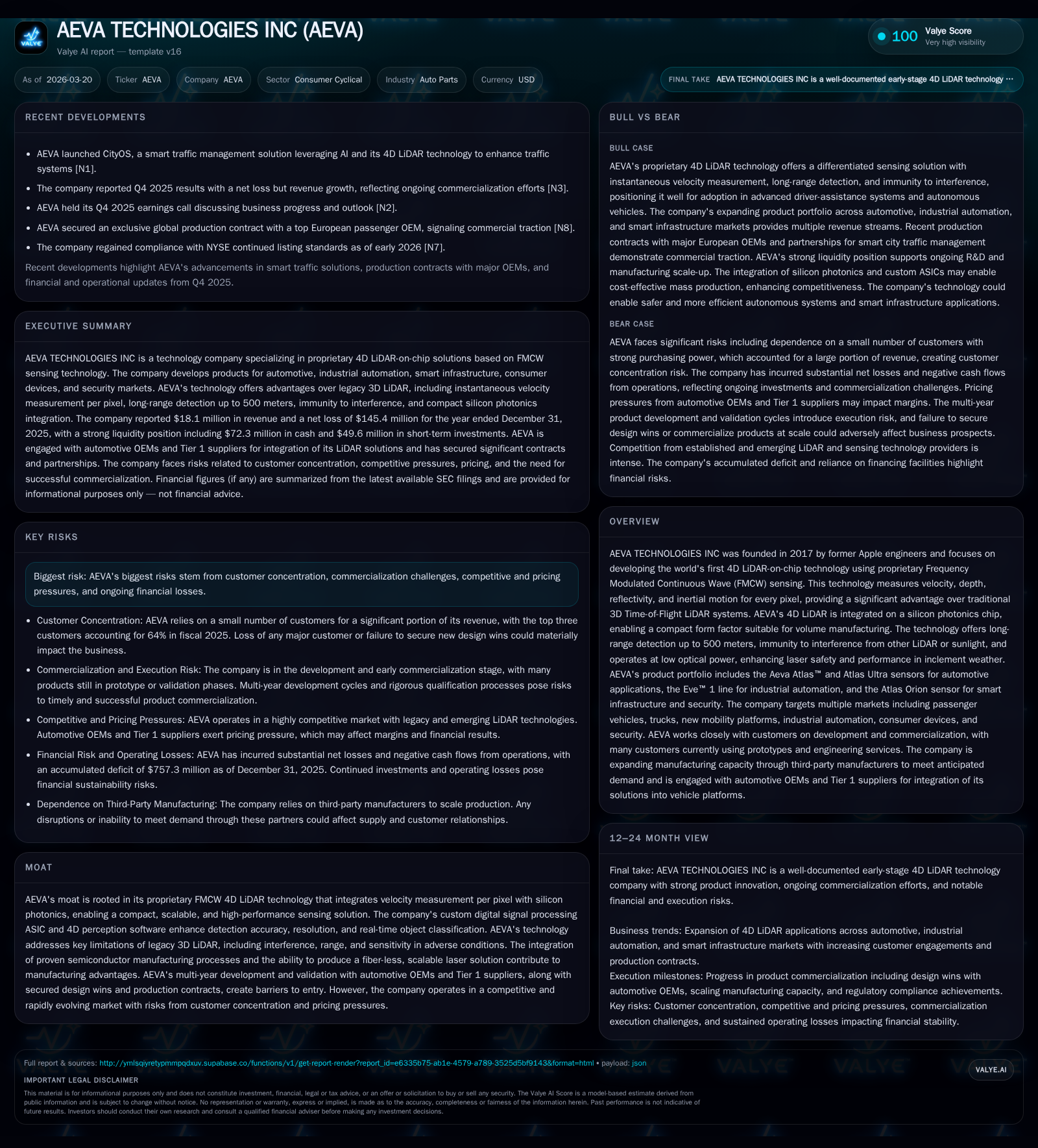
Founded in 2017 by former Apple engineers, AEVA Technologies develops a unique Frequency Modulated Continuous Wave (FMCW) 4D LiDAR-on-chip that measures velocity, depth, reflectivity, and inertial motion per pixel. The company reported revenues of $18.1 million in 2025, up 99% year-over-year, driven by increased unit sales and engineering services. Operating losses narrowed to $127.6 million from $158.4 million in 2024 amid ongoing investment in product development. Customer concentration remains high with three customers accounting for roughly two-thirds of revenue. AEVA’s growth depends on scaling production, securing design wins, and expanding into new markets such as industrial automation and smart infrastructure. Liquidity is supported by cash balances of $72.3 million and access to additional capital through convertible notes and equity facilities.
Company Overview and Technology Innovation
AEVA Technologies Inc., founded in 2017 by former Apple engineers Soroush Salehian and Mina Rezk, has developed the world’s first integrated Frequency Modulated Continuous Wave (FMCW) 4D LiDAR-on-chip technology [S1]. Unlike traditional Time-of-Flight (ToF) LiDAR systems that measure only depth and reflectivity, AEVA's solution simultaneously measures velocity, depth, reflectivity, and inertial motion per pixel. This proprietary approach provides key advantages including immunity to interference from sunlight or other LiDAR signals, low optical power consumption enhancing laser safety compliance, and long-range detection capabilities up to 500 meters [S1]. By leveraging silicon photonics technology—proven in telecommunications—on a compact chip module integrated with custom digital signal processing ASICs and proprietary perception software, AEVA aims for scalable volume manufacturing primarily targeting automotive advanced driver-assistance systems (ADAS), autonomous driving (AD), industrial automation, smart infrastructure, robotics, and consumer devices.
Historical Financial Performance
AEVA’s fiscal year results through December 31, 2025 illustrate substantial revenue growth during ongoing negative profitability typical of early-stage technology companies:
Historical performance (annual)
| FY | Net ($mm) | CFO ($mm) | OpInc ($mm) | Capex ($mm) | Net YoY |
|---|---|---|---|---|---|
| 2025 | -145 | -115 | -128 | 5 | +4.5% |
| 2024 | -152 | -107 | -158 | 5 | -2.0% |
| 2023 | -149 | -119 | -148 | 6 | -1.4% |
| 2022 | -147 | -110 | -152 | 7 |
Source: SEC companyfacts cache [F1].
Capital returns and efficiency (annual)
| FY | FCF ($mm) | ROE% |
|---|---|---|
| 2025 | -120 | -1100.5 |
| 2024 | -112 | -153.3 |
| 2023 | -125 | -65.4 |
| 2022 | -117 | -44.6 |
Source: SEC companyfacts cache [F1].
Revenue nearly doubled in fiscal year 2025 primarily due to increased unit sales combined with more non-recurring engineering service engagements relative to prior years [F1][S13]. Operating income showed improvement but remained deeply negative amid sizeable research and development expenses focused on product innovation [F1][S22]. Net losses narrowed modestly while operating cash flow deteriorated slightly year-over-year reflecting continuing investment needs [F1].
The company’s customer base is concentrated: as of December 31, 2025 the top three customers accounted for approximately two-thirds of total revenue—a pattern consistent with prior periods—which introduces risks if any key customer reduces orders or encounters financial difficulties [S8].
Growth Drivers and Outlook
AEVA’s growth prospects depend on several critical factors aligned with market adoption of ADAS/AD systems incorporating advanced perception technologies:
Scaling Production: Transitioning from prototype deliveries largely used for research and pilot programs toward high-volume production is essential for improving gross margins over time [S6].
Technological Differentiation: The ability to measure instantaneous velocity per pixel sets AEVA apart from legacy ToF LiDAR solutions that only capture depth and reflectivity; this advantage supports integration into more advanced ADAS/AD applications [S1][S14].
Strategic Partnerships: The August 2025 private placement and joint development agreement with LG Innotek, which included a $32.5 million equity investment by LG Innotek, aim to broaden AEVA’s reach beyond automotive into industrial automation and consumer sectors using its proprietary FMCW platform [S19].
Expanding End Markets: Growing interest in smart infrastructure applications such as AI-driven traffic management solutions combining LiDAR sensing with artificial intelligence presents incremental opportunities beyond automotive safety [N3][S17].
However, these opportunities come with challenges including customer concentration risk which could impact revenue stability if major customers reduce commitments or delay adoption [S8], intense competition from established Tier-1 suppliers offering legacy ToF or alternative sensing technologies putting pricing pressure on margins [S14], regulatory complexities related to evolving automotive safety standards as well as FDA laser safety regulations and environmental compliance requirements [S5][S7][S16], and the need for successful execution of commercialization plans including design wins at OEMs and Tier-1 suppliers under tight cost targets [S6][S12].
Capital Allocation and Returns Profile
As an early-stage innovator focused on long-term commercialization rather than near-term profitability:
Return on equity remains deeply negative at approximately -1100% for fiscal year 2025 due to net losses against a shrinking equity base after cumulative deficits over prior years [F1].
Operating cash flow was negative $115 million in FY2025; combined with capital expenditures totaling roughly $4.6 million resulted in free cash flow near negative $119.7 million reflecting continued heavy investment needs [F1].
Liquidity is supported by cash balances of approximately $72 million at year-end plus access to additional capital through convertible notes issuance completed November 2025 totaling $100 million alongside a standby preferred stock purchase facility providing up to $125 million available through November 2026 [F1][S12][S23].
No dividends or share repurchases have been declared or executed given the focus on reinvestment.
What To Watch Next
Absent explicit forward guidance recently, investors should monitor:
- Progression of current design wins into production ramps impacting revenue visibility.
- Gross margin improvements reflecting operational scale-up.
- Expansion of partnerships broadening market penetration beyond automotive.
- Reduction of customer concentration risk through diversification.
- Regulatory developments influencing adoption timelines globally.
- Cash burn trajectories relative to planned capital raises.
Conclusion
AEVA Technologies offers compelling technological innovation via its proprietary FMCW-based integrated LiDAR chip solution capable of measuring velocity per pixel alongside depth at long range—a capability setting it apart from incumbent ToF systems widespread today. This has fueled rapid revenue growth nearing doubling annually as the company advances commercial deployments primarily within automotive safety systems while expanding into industrial automation and smart infrastructure domains.
Nonetheless, sustained operating losses exceeding $127 million annually underscore typical challenges for early-stage deep tech ventures involving substantial upfront R&D costs alongside commercialization execution risks accentuated by concentrated customer bases and competitive pressures threatening pricing power.
Strong liquidity buffers provide runway near term; however, execution effectiveness across manufacturing scale-up, program wins at OEMs/Tier-1 vendors, regulatory compliance navigation, and market expansion will determine sustainability of AEVA’s growth trajectory going forward.
This analysis is based exclusively on publicly available information including SEC filings [F1]–[S29] and recent news transcripts [N1]–[N3], without any confidential insights or speculative forecasts.
Disclaimer: This is research-only, informational analysis and not investment advice. It may include AI-generated interpretation and general industry context. Always verify important details using primary sources.

Comments