
Ollie’s Bargain Outlet: Poised for Continued Growth with Strategic Expansion and Operational Leverage
Ollie’s leverages a flexible closeout inventory model and contiguous expansion strategy to drive strong financial performance while managing emerging operational complexities.
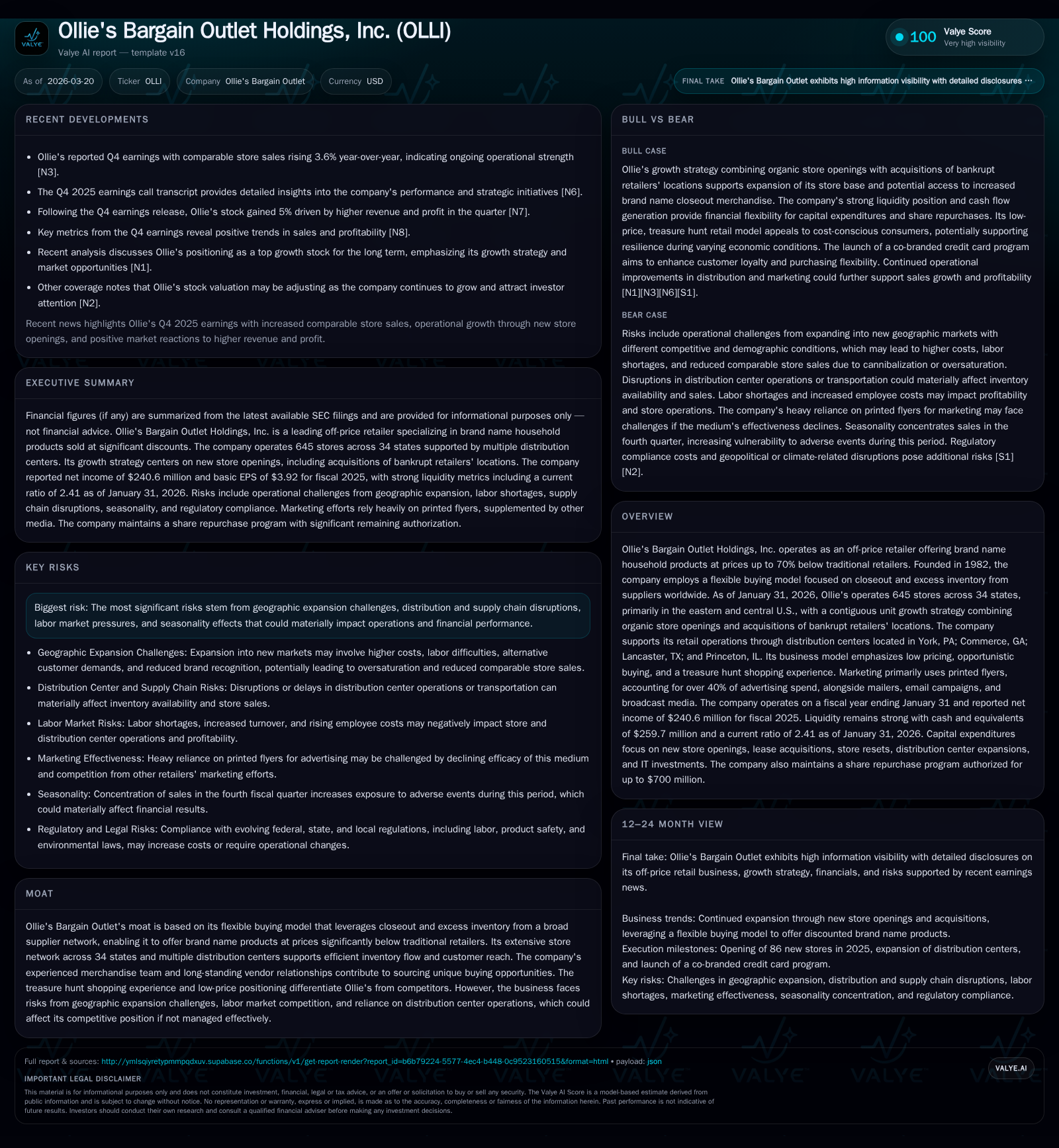
Ollie’s Bargain Outlet has demonstrated significant growth in revenue and profitability through its off-price retail business model focused on opportunistic sourcing of excess inventory and brand-name goods. In fiscal 2025, operating income surged over 30% year-over-year, supported by the opening of 86 new stores across 34 states and a 3.6% gain in comparable store sales. The contiguous unit growth strategy emphasizes geographic expansion primarily through organic openings and selective acquisition of bankrupt retailers’ locations, underpinned by multiple distribution centers. However, this expansion introduces risks including distribution center capacity constraints, increasing transportation costs, and market adaptation hurdles. Capital allocation remains balanced between efficient capex investment for new stores and attractive share repurchases, delivering solid cash flow and a roughly 12.7% return on equity. Key metrics to monitor include comparable store sales trends, inventory management efficiency, and labor cost pressures against the backdrop of broader economic uncertainties.
Distinctive Business Model Driving Past Performance
Ollie’s Bargain Outlet Holdings distinguishes itself within brick-and-mortar retail through a highly flexible buying model centered on closeout and excess inventory procurement from a broad supplier network worldwide [S1]. This approach enables it to offer brand-name household products at prices often up to 70% below traditional retailers — a clear competitive advantage that fuels repeat customer traffic seeking bargain opportunities reminiscent of a "treasure hunt shopping" experience.
The company operates an extensive network of distribution centers strategically located in York, PA; Commerce, GA; Lancaster, TX; and Princeton, IL to support its retail footprint encompassing 645 stores as of January 31, 2026 [S1]. Each distribution hub plays a critical role in processing incoming shipments from suppliers before routing merchandise efficiently to local stores.
Financially, Ollie’s has capitalized on this model with steady margin expansion evidenced by operating income rising from $130.9 million in FY2022 to nearly $298 million in FY2025 — a compounded growth trajectory reflecting both operational leverage and enhanced purchasing power [F1]. This substantial increase (30.7% YoY between FY2024 and FY2025) underscores how deep vendor relationships allow the company to capitalize on disparate surplus inventories quickly while maintaining cost discipline [F1].
Simultaneously, the company's operating income growth is significantly driven by leveraging its merchandise team’s expertise to identify unconventional buying opportunities that keep product assortments fresh without sustaining inventory inflation risks typical for standard retailers [S1]. Overall, Ollie’s business model anchors its financial results through disciplined closeout sourcing coupled with a differentiated consumer value proposition.
2025 Growth Surge Anchored in Inventory Flexibility and Store Network Expansion
Ollie’s Fiscal Year 2025 marked a notable milestone with accelerating growth fueled by both expanding store count and improving sales productivity. During this period, the company opened 86 new stores contributing materially to top-line expansion [S20],[N1]. This increased footprint reached across contiguous territories following their strategic approach targeting eastern and central U.S. markets primarily [S22].
Complementing square footage growth was impressive same-store sales momentum recording a +3.6% increase in Q4 year-over-year results — highlighting sustained customer demand amid broader retail headwinds [N1]. Such comp gains reinforce the efficacy of Ollie’s offering as well as marketing efforts heavily weighted towards printed flyers (over 40% of ad spend) driving local traffic effectively [S1].
Financially for FY2025: Operating income advanced strongly by approximately 31%, reaching $297.7 million; net income similarly jumped by about 33%, totaling roughly $240.6 million; while operating cash flow improved nearly 16.5% year-over-year to $296.5 million [F1]. These figures illustrate both profitability scaling and enhanced cash generation from core operations.
Capital expenditure allocations moderated versus prior years with spending declining roughly 18% to $101.9 million amid tighter project execution controls focused on optimizing new store openings combined with upgrades at existing locations and distribution hubs [F1],[S20]. The mix signals prioritization of both physical footprint growth alongside incremental operational efficiency enhancements.
Operational Challenges Tied to Distribution Center Capacity and New Geography Risks
Despite robust top-line progress, Ollie’s faces pronounced risks inherent in scaling both geographically and logistically [S1]. The company’s relatively limited number of key distribution centers creates potential bottlenecks; these hubs must maintain high throughput levels amidst expanding store delivery requirements over larger geographic areas spanning multiple states [S21].
Transportation costs — heavily influenced by fuel price volatility — amplify logistical complexity given longer shipping distances for newer stores further from established DCs [S1]. Moreover, labor shortages within warehouse operations or trucking lanes add uncertainty that could disrupt timely merchandise flow.
New geographic markets also bring hurdles around adapting merchandising mix aligned with distinct customer preferences, establishing brand recognition among consumers unfamiliar with Ollie’s format, higher entry costs including leases or local labor premiums—and sensitivity toward cannibalization effects where new outlets may erode sales at proximate existing stores [S1]. The risk mosaic here includes oversight failures that could compress comps or slow unit productivity gains.
Broader supply chain interruptions related to pandemics or geopolitical tensions likewise threaten stability given dependence on supplier shipping schedules which underpin the orderly receipt-to-store inventory pipeline critical for turnaround times demanded by rapid closeout purchasing strategies [S1].
Forward-Looking Growth Strategy Coupled with Execution Risks
Looking ahead into fiscal year 2026, Ollie's management plans continued aggressive expansion targeting approximately 75 new store openings complemented by capital investments in enlarging two current distribution centers plus corporate infrastructure updates including IT systems improvements [F1],[S4]. Such an approach seeks to alleviate identified network capacity constraints while sustaining growth velocity.
Nonetheless, management acknowledges execution risks linked to construction delays caused by factors including skilled labor shortages or permitting bottlenecks—threatening timely rollouts that underpin revenue forecasts [S4],[S20]. Oversaturation concerns remain pertinent with measured sensitivity required when opening stores near established locations to mitigate adverse cannibalization impacts on overall comp store trends [S23].
Maintaining tight inventory alignment with shifting consumer discretionary budgets will be essential as macroeconomic uncertainties persist—especially if inflationary pressures curtail spending or introduce more frequent markdown requirements damaging margin performance [S1],[N2]. Observers should thus closely watch indications around incremental margin sustainability as well as new unit productivity metrics moving forward.
Capital Allocation Balances Store Expansion, Capex, and Attractive Share Repurchases
Ollie's capital deployment reflects an intentional balance: investing nearly $102 million into new stores and infrastructure during FY2025 while simultaneously executing shareholder-friendly buybacks totaling approximately $73.8 million during the same period [F1],[S15],[S16].
This capital discipline is mirrored in improving returns metrics—FY2025 implied return on equity stands near 12.7%, benefiting from both profit gains ($240.6 million net income) and equity growth nearing $1.89 billion as the balance sheet expands alongside operations [F1]. Free cash flow generation also remains strong at almost $195 million (operating cash flow minus capex), reinforcing internal funding sufficiency for growth initiatives without excessive reliance on external capital markets [F1].
However, restrictions embedded within Ollie’s revolving credit facility place covenants curbing unrestricted dividend payouts or additional indebtedness beyond prudent levels—a structural safeguard preserving liquidity but potentially constraining aggressive financial maneuvers should conditions deteriorate unexpectedly [S4],[S6],[S8],[S10].
Substantial available borrowing capacity ($86.5 million undrawn as of January 31, 2026) enhances optionality nonetheless should opportunistic needs arise or market conditions dictate flexibility [S10]. Overall capital strategy thus exemplifies measured execution facilitating sustainable expansion balanced with shareholder return considerations.
Financial Health: Solid Cash Flow Generation and Resilient Profit Margins
Ollie's balance sheet displays notable strength entering fiscal year-end January 2026: holding roughly $260 million in cash and equivalents coupled with robust working capital ($964 million current assets vs $400 million current liabilities yielding a current ratio of approximately 2.41) signals ample liquidity buffers for ongoing operational needs and planned investments [F1].
Operating margins have improved concomitantly due to scale effects from expanded store count combined with disciplined expense management despite inflationary headwinds including transportation costs rising markedly across the industry sector recently [F1],[S10]. The company emphasizes productivity enhancements at both the retail store level and distribution centers offsetting incremental cost pressure inherent in closeout inventory sourcing strategies which often demand expedited handling.
Nevertheless, margin contraction risks linked to unanticipated markdowns or elevated shrinkage remain perennial concerns requiring vigilant oversight given Ollie's heavy reliance on variable closeout product assortments that may not always match evolving consumer tastes perfectly [S1],[S23]. To date however, consistent margin resilience evidences effective operational controls supporting profitability amid challenging retail dynamics.
Key Metrics to Monitor in Upcoming Quarters
Given the sensitive interplay between aggressive growth initiatives and operational challenges described above, several key performance indicators warrant monitoring:
- Comparable store sales trajectory remains crucial as it captures organic demand strength separate from unit count increases; recent +3.6% Q4 comp result sets positive benchmark but sustainability is key amid macro uncertainties [N1],[N2];
- Distribution center throughput metrics including average processing time per shipment will indicate if logistical bottlenecks emerge threatening stock availability;
- Incremental margin sustainability per new unit as higher penetration may dilute profitability if inefficiencies arise from geographic shifts;
- Inventory turnover ratios reflecting efficient buying tied tightly to consumer demand versus aging stock markdown risk;
- Labor cost impacts particularly wage inflation or turnover rates within warehouse/distribution centers affecting operating expense control;
- Short-term sensitivity testing around adverse weather events or geopolitical disruptions impacting supply chains given Ollie's predominantly physical retail presence without online backup options limiting channel diversification [N2],[S1];
- Capital expenditure pacing versus budget will highlight execution ability amid reported construction/permitting delays.
Close observation of these metrics will be essential for assessing whether Ollie's can seamlessly translate its proven business model into accelerated scale while mitigating emergent risk exposures inherent in its strategic path.
Historical Financial Summary: Key Consolidated Measures (FY2021–FY2025)
Historical performance (annual)
| FY | Net ($mm) | CFO ($mm) | OpInc ($mm) | Capex ($mm) | Net YoY |
|---|---|---|---|---|---|
| 2025 | 241 | 297 | 298 | 102 | +32.6% |
| 2024 | 181 | 254 | 228 | 124 | |
| 2022 | 103 | 114 | 131 | 52 | +129.8% |
| 2021 | 45 | 45 | 205 | 35 |
Source: SEC companyfacts cache [F1].
Capital returns and efficiency (annual)
| FY | Buybacks ($mm) | FCF ($mm) | ROE% |
|---|---|---|---|
| 2025 | 74 | 195 | 12.7 |
| 2024 | 53 | 130 | 12.0 |
| 2022 | 42 | 63 | 7.5 |
| 2021 | 220 | 10 | 3.5 |
Source: SEC companyfacts cache [F1]. Note: Equity shown in millions; YoY percentages calculated where data available.
This analysis relies exclusively on disclosed financials from latest SEC filings ([F1], [S#]) and corroborates recent earnings commentary ([N#]). It does not offer investment recommendations but provides detailed insights into Ollie’s operational drivers, financial health, risk factors, and strategic considerations relevant for sector professionals monitoring off-price retail dynamics.
Disclaimer: This is research-only, informational analysis and not investment advice. It may include AI-generated interpretation and general industry context. Always verify important details using primary sources.

Comments