
Coffee Holding Co. Inc.'s Growth Challenges and Strategic Shifts in a Volatile Coffee Market
Coffee Holding Co. balances diverse product offerings and strategic acquisitions with commodity price risks and operational transitions.
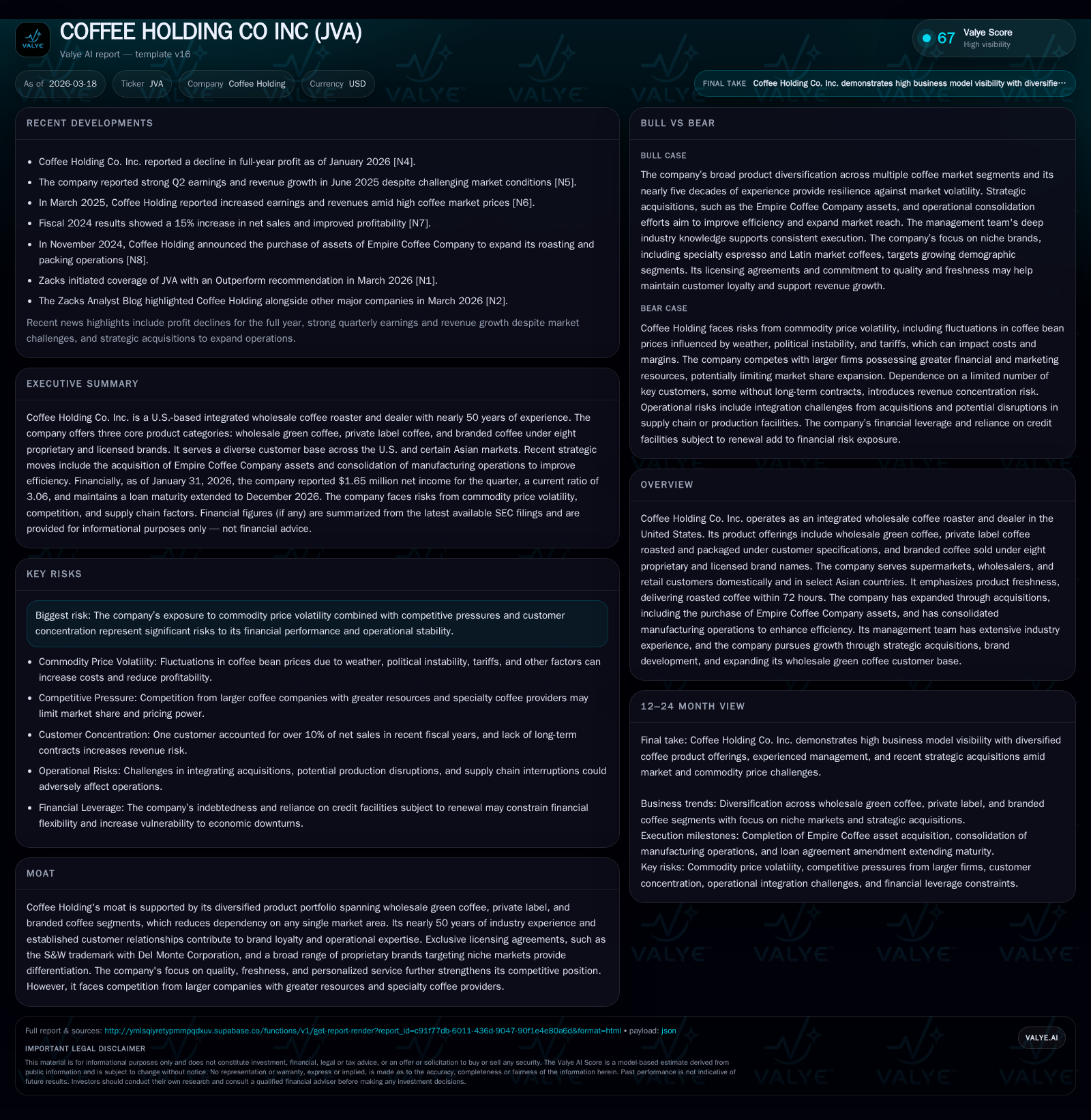
Coffee Holding Co. Inc. (JVA) operates as an integrated wholesale coffee roaster and dealer focusing on wholesale green coffee, private label, and branded products in the U.S. and select Asian markets. The company has faced significant volatility in profitability over recent years, driven by commodity price fluctuations and competitive pressures, but aims to grow through brand development and acquisitions like Empire Coffee Company. While the firm shows operational resilience with strategic consolidation of manufacturing, recent financials reveal a sharp decline in operating cash flow and free cash flow deficits. Key risks include reliance on coffee as a single commodity, customer concentration, and supply chain uncertainties.
Overview and Business Model
Coffee Holding Co., Inc. (JVA) is an established player in the U.S. coffee roasting and wholesaling sector with nearly half a century of industry experience [S15]. Its integrated model encompasses three core segments: wholesale green coffee (unroasted beans sold primarily to roasters), private label roasted coffee customized for retailers' branding needs, and proprietary branded roasted coffee sold under eight distinct labels including licensed brands like S&W via Del Monte Corporation [S15][S16]. The company serves diverse retail channels such as supermarkets, wholesalers, independent stores, multi-unit retail customers domestically, along with selective Asian markets.
Historical Financial Performance
JVA's revenue trajectory demonstrates considerable contraction during recent measured periods. Revenue stood at approximately $90.7 million in FY2018 before sliding to roughly $63.9 million by FY2021 — a near 30% decrease over three years [F1]. Operating income has proved volatile amidst this backdrop: after enduring losses amounting to -$5.3 million in FY2022 the company recovered to a modest operating profit of $2.15 million by FY2025 [F1]. Net income followed a similar pattern moving from losses deeper than $3.7 million in FY2022 back up to $1.4 million net earnings in FY2025 showing an uneven but improving bottom-line picture [F1].
Historical performance (annual)
| FY | Net ($mm) | CFO ($mm) | OpInc ($mm) | Capex ($) | Net YoY |
|---|---|---|---|---|---|
| 2025 | 1 | -5 | 2 | 191592 | -36.7% |
| 2024 | 2 | 5 | 3 | 306931 | +365.4% |
| 2023 | -1 | 1 | -1 | 857760 | +77.7% |
| 2022 | -4 | -5 | -5 | 1059205 |
Source: SEC companyfacts cache [F1].
Capital returns and efficiency (annual)
| FY | Div ($) | FCF ($mm) | ROE% |
|---|---|---|---|
| 2025 | -5 | ||
| 2024 | 5 | 8.5 | |
| 2023 | 399000 | 0 | -3.5 |
| 2022 | 399000 | -6 | -15.1 |
Source: SEC companyfacts cache [F1].
*FY2025 operating income and net income compared with prior year show signs of margin contraction; operating cash flow fell sharply into negative territory while capital expenditures moderated [F1].
Operating cash flow turned negative again in FY2025 by approximately $5 million following a strong recovery the year prior; combined with capex outlays this resulted in negative free cash flow for the latest reported period highlighting potential liquidity pressures despite positive earnings results [F1].
Industry Positioning and Moat
Coffee Holding's competitive moat is anchored by its diversified product mix spanning wholesale green beans sold internationally to specialty roasters, customized private label roasts servicing supermarket clients competing against national brands on value pricing, plus proprietary branded coffees targeting multiple niches including Latin espresso enthusiasts through Cafe Caribe and premium Colombian blends under Don Manuel [S16][S26]. The company's exclusive licensing deals like S&W allow access to established brand equity that differentiates it within crowded retail aisles.
The company's almost five decades of cumulative roasting expertise manifests in quality control processes ensuring fresh roasted coffee delivered within seventy-two hours — a significant service differentiator given coffee's sensitivity to freshness for premium taste profiles [S15][S16]. Additionally, Coffee Holding supports its green bean customers with technical training on blends contributing to stickiness among specialty roasters aiming for differentiated end products.
Strategic Developments and Future Growth Prospects
Recent strategy articulates growth through three levers: (i) selectively pursuing accretive acquisitions and alliances demonstrated by the late-2024 acquisition of Empire Coffee Company's assets which added capacity and customer relationships; (ii) expanding penetration of their branded lines particularly among Latin demographics where brands like Cafe Caribe benefit from demographic tailwinds; (iii) growing wholesale green coffee sales leveraging trend growth among smaller gourmet roasters who purchase micro-batches as little as one bag at a time rather than committing to large volumes—a nimble inventory approach enabling competitive participation without significant capital expenditure or distribution expansion [S9][S16][S18].
The company's October 2025 closure of its Comfort Foods facility represents a tactical consolidation endeavor channeling production into the East Coast hub Second Empire LLC located in Port Chester NY; this move aims to reduce overhead duplications while allowing focus on more profitable lines amid contraction of certain regional brands originally produced at Comfort Foods [S22].
Nonetheless, broadening geographic reach beyond existing U.S./Asian presence remains challenging due to intense competition with larger food conglomerates (Smucker’s; Kraft Heinz), elevated advertising spend required for national branding campaigns, and distribution channel hurdles typical of mid-sized manufacturers attempting scale without sacrificing margins or customer service [S27][S6].
Risks and Challenges
As underscored in SEC disclosures, Coffee Holding faces multiple systemic risks:
- Singular dependence on coffee as an agricultural commodity exposes it heavily to market price swings driven by weather-induced crop variability, geopolitical tensions affecting origin countries (Brazil, Colombia), tariffs impacting import costs or supply chain interruptions [S6][S8][S25];
- Competitive pressures arise both from well-resourced multinational branded competitors leveraging brand recognition plus increasingly popular specialty coffee producers carving out niche premium segments making value or volume propositions less consistent across customer bases [S6];
- Customer concentration risk exists since one buyer accounted for more than 10% of sales for consecutive years without long-term contracts limiting predictability or retention guarantees [S7];
- Operational risks include supply chain dependency on common carriers vulnerable to labor disruptions or cost hikes that could pinch margins or delay deliveries harming retailer relationships; likewise capacity constraints following facility consolidations could strain timely order fulfilment under demand surges or equipment failure scenarios [S13];
- Regulatory scrutiny over caffeine health perceptions could impact consumer demand negatively if public opinion sours leading toward litigation or reduced consumption patterns [S12];
- Hedge strategies deployed using futures/options partially mitigate raw material price volatility but cannot eliminate exposure entirely especially if rapid market declines occur causing margin compression or inventory valuation losses [S16];
- Internal control limitations present ongoing monitoring requirements given risks around financial reporting accuracy exposing reputational or compliance risks should failures emerge impeding investor confidence or operational transparency [S19];
- Governance concentration whereby Gordon family ownership (~23%) exerts influence potentially creating conflicts between minority shareholders’ interests versus controlling family objectives especially regarding strategic transactions or dividend policies [S20].
Capital Allocation & Returns Profile
JVA’s capital allocation decisions have been modestly conservative aligning with its size profile yet revealing some inconsistencies tied to fluctuating operational performance:
- Notably no recent share repurchases disclosed post-2018 levels where buybacks were material ($6 million range)
- Dividends have been maintained primarily at low levels around $400k annually post-FY2022 indicating restrained payout capacity amid earnings volatility
- Capex spending declined from over $1 million range during mid-decade down toward sub-$200k recently reflecting reduced expansion investment coinciding with restructuring moves such as plant closure/consolidation [F1][S22]
- Operating cash flows’ sharp reversal into negative territory most recently resulted in negative free cash flow estimated near $5 million suggests ongoing working capital or cost management challenges undermining capital return generation despite slight profitability recovery;
- Equity base remains robust above $24 million albeit down versus historical peak providing financial buffer but tempered ROE (~5% approx based on latest data) signals relatively low capital efficiency at scale compared with higher margin peers relying on brand premiumization or direct-to-consumer models absent here currently.
Outlook & Monitoring Points (Analysis)
While explicit forward-looking guidance is absent, key focus areas warrant tracking:
- Impact realization from second-tier manufacturing consolidation on operating costs and fulfillment agility;
- Success metrics around brand penetration efforts particularly targeting Latin American consumer segments where demographic leverage is cited but competitive intensity remains high;
- Expansion dynamics within wholesale green bean sales particularly capturing small specialty roaster growth without diluting gross margins through excessive discounting;
- Response strategies toward commodity price swings including efficacy of hedging programs given recent pronounced market volatility;
- Cash flow stabilization through inventory management improvement essential given recent operational cash burn trends;
- Customer diversification progress reducing dependency risks alongside maintenance of quality standards supporting long-term client partnerships;
- Any further M&A activities expanding product licensing portfolios or geographic footprints that complement current capabilities without overstretching integration resources.
Conclusion
Coffee Holding Co., Inc.’s footprint as an integrated U.S.-based wholesale coffee roaster/dealer is supported by long-standing industry know-how, differentiated proprietary brands, exclusive licensing arrangements, and commitment to freshness that collectively underpin its market relevance within a fiercely competitive segment dominated by both large players and emerging specialty brands.
However, volatile financial performance marked by large swings between losses and modest profits underlines inherent challenges tied chiefly to raw material price volatility compounded by competitive pressures limiting pricing power at scale.
Strategic initiatives emphasizing selective acquisition-driven expansion along with operational consolidation aim at driving synergies cost-effectively while tapping demographic-driven brand growth opportunities.
Risks remain high around supply chain robustness, customer concentration exposure, regulatory landscape shifts related to caffeine perception, and ensuring internal controls adequacy amidst complexity growth.
Investors should watch developments around cash flow trends closely as negative free cash flow despite profitability improvements poses short-term liquidity considerations that must be addressed for sustainable returns enhancement.
This assessment does not constitute investment advice but provides an integrated view synthesizing historical data points with known corporate developments based on public filings through early 2026.
This report synthesizes information available up to March 18, 2026, including SEC filings (10-K/10-Q), press releases, Nasdaq analyst notes ([F1], [N#], [S#]). It is intended for informational purposes only without any recommendation regarding securities transactions.
Disclaimer: This is research-only, informational analysis and not investment advice. It may include AI-generated interpretation and general industry context. Always verify important details using primary sources.

Comments