
Odyssey Health's Transformative Pursuit of Breakthrough Medical Devices
Odyssey Health is transitioning from a prolonged development phase marked by operating losses to a repositioned business model focused on advancing two medical device candidates amid financing and regulatory challenges.
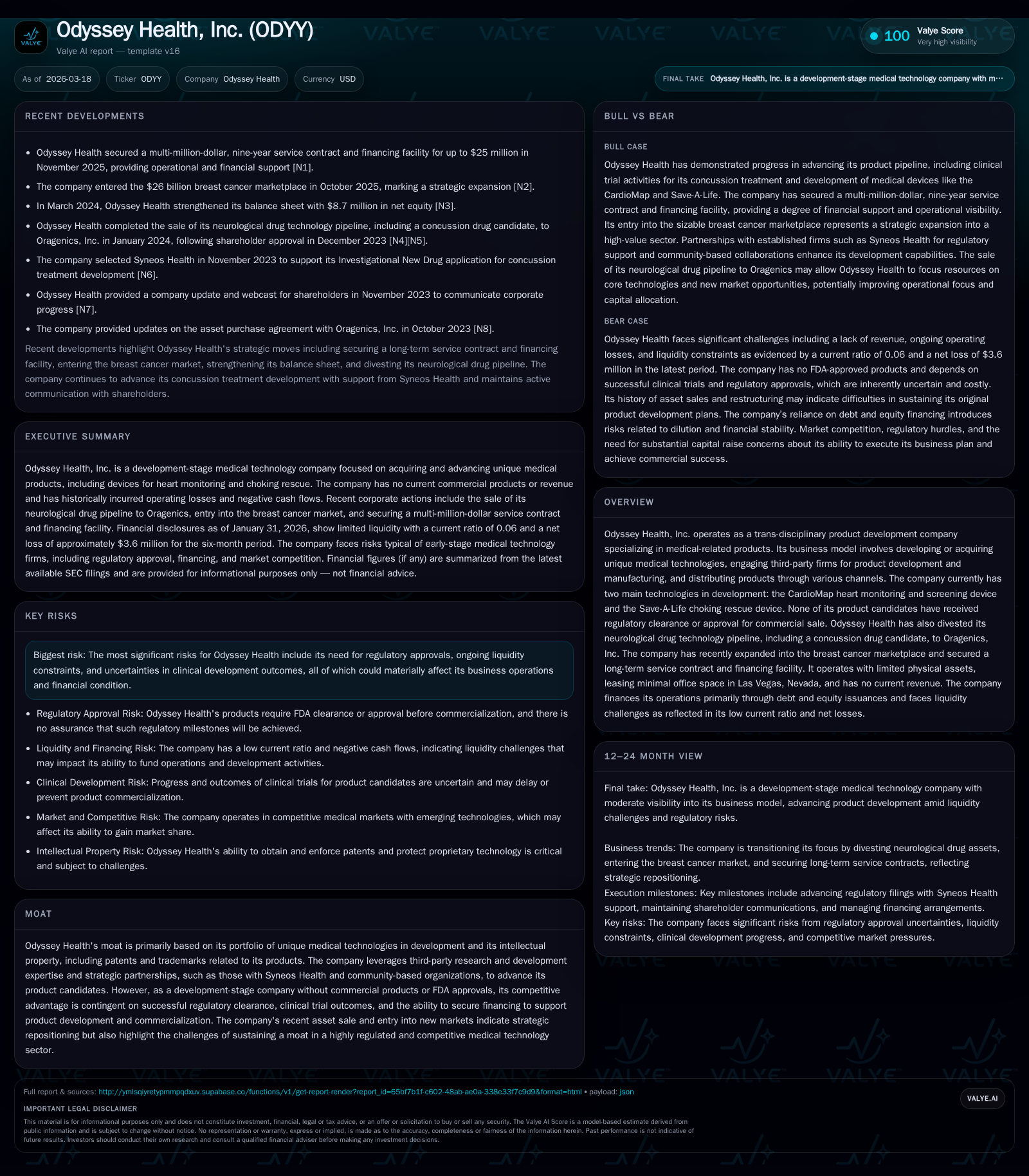
Odyssey Health, Inc. remains a development-stage medical technology company without revenue to date, driven historically by its unique product candidates: the CardioMap heart monitoring device and the Save-A-Life choking rescue device. Persistent operating losses, negative cash flow, and substantial current liabilities have pressured liquidity and raised going concern doubts. The company’s strategic divestiture of its neurological drug assets to Oragenics and recent market expansion efforts point to a transitional phase toward commercialization. Critical upcoming milestones hinge on securing FDA regulatory clearances and successful clinical outcomes, while continued capital raises remain essential to sustain operations.
Historical Trajectory: From Development Losses to Strategic Restructuring
Odyssey Health’s financial performance over recent years illustrates the steep challenges typical of early-stage medical technology developers focused on innovation absent commercial sales. Over fiscal years 2018 through 2025, Odyssey Health reported zero revenues consistently, reflecting its pre-commercial status and ongoing R&D focus rather than market engagement [F1]. Net losses have been regular and significant, increasing sharply from approximately -$0.8 million in FY2024 to around -$1.7 million in FY2025 representing a roughly 107% year-over-year deterioration in bottom-line performance [F1].
Operating income figures expose similar volatility with FY2024 exhibiting an anomalous $14.3 million operating income spike, primarily driven by a one-time gain on sale of neurological assets including a concussion drug pipeline divested to Oragenics (the gain was $16.4 million before impairments) [F1], [S6]. The core operations remain unprofitable as exemplified by the FY2025 operating loss of about -$1.0 million (a dramatic negative reversion), underscoring the continuing burden of R&D investments without offsetting revenues.
This significant asset sale delineates a strategic pivot away from pharmaceutical pipelines toward focusing resources on its medical device portfolio — specifically CardioMap and Save-A-Life products under active development but still far from commercialization.
Historical Financial Performance Overview
Historical performance (annual)
| FY | Net ($mm) | CFO ($mm) | OpInc ($mm) | Net YoY |
|---|---|---|---|---|
| 2025 | -2 | 0 | -1 | -106.9% |
| 2024 | -1 | -1 | 14 | +85.8% |
| 2023 | -6 | -1 | -5 | +29.9% |
| 2022 | -8 | -3 | -8 |
Source: SEC companyfacts cache [F1].
Capital returns and efficiency (annual)
| FY | Buybacks ($) | ROE% |
|---|---|---|
| 2025 | 25.1 | |
| 2024 | 15.8 | |
| 2023 | 0 | 96.2 |
| 2022 | 20 | 181.8 |
Source: SEC companyfacts cache [F1].
Note: Capex data is unavailable post-2017; revenue remained zero throughout.
Medical Technology Portfolio and Innovation Edge
Odyssey Health operates as a trans-disciplinary product development firm centering efforts on two medical devices: the CardioMap heart monitor/screening device and the Save-A-Life choking rescue apparatus [S6]. Neither has obtained FDA clearance or approval—a prerequisite for U.S. commercialization—placing Odyssey firmly in the clinical R&D stage with heavy reliance on third-party research organizations for device design refinement, regulatory submission preparation, manufacturing scale-up, and distribution strategy.
The company's business model involves licensing or acquiring promising technologies followed by outsourcing development phases to specialized firms—Syneos Health notably being one partner—and aiming for eventual regulatory approvals that would unlock market potential while licensing or distributing through established channels including community-based organizations [S6],. Intellectual property protections form part of its competitive moat via patents and trademarks associated with control over innovative technologies.
However, FDA regulatory clearance pathways require robust clinical trial data demonstrating safety and efficacy which has yet to be achieved for either primary technology suite—common bottlenecks include lengthy trial periods, compliance demands with Good Manufacturing Practices (GMP), and costly validation steps typical in Class II/III medical device submissions.
Financial Footprints: Operating Losses, Cash Flow, and Liquidity Stress
Financial statements detail persistent liquidity strain accentuated by accelerated cash burn rates without offsetting inflows. At fiscal year-end July 31, 2025, Odyssey's current liabilities exceeded $7 million while current assets barely covered $50 thousand resulting in an acute working capital deficit of ~$7 million and a critically low current ratio (approximate 0.06 reported at January 31, 2026), highlighting near-term survival risks without immediate capital infusion [F1],[S11],[S13].
Operating cash flows remain negative albeit improved sequentially from previous years—from nearly $-3.2 million outflow in FY2022 down to roughly $-0.35 million in FY2025—nonetheless signaling continuing operational reliance on external capital given no reported commercial cash generation [F1],[S4],[S7]. Capital expenditures have been negligible or absent since at least FY2017 aligning with the company's asset-light strategy focused more on intellectual property development than fixed asset investment.
Furthermore, accumulated deficit stands near $63 million as of mid-2025 evidencing cumulative investment losses overwhelming equity resulting in significant stockholders' deficit (around -$7 million) causing persistent balance sheet weakness challenging lender confidence during fundraising efforts [F1],[S12],[S17].
Capital Architecture and Allocation Decisions
Odyssey funds operations largely through convertible debt instruments complemented by periodic equity sales resulting in sizeable dilution pressures on shareholders. The company has no history of dividend payments or share buybacks affirming reinvestment priority amidst constrained capital resources [F1],[S15],[S19].[S26]
Convertible promissory notes have been amended several times (notably the $1.05 million LGH note) extending maturity into early calendar year 2027 with interest rates around 8-10%, often converted into shares at discounted prices (~$0.072-$0.12 per share) supporting immediate liquidity needs though dilutive for existing investors [S23],[S24],[S27]. Officer and director loans also feature convertible provisions further intertwining management incentives with long-term company viability.
Equity compensation plans remain active with sizable granted stock options/warrants (totalling over 38 million securities outstanding including those not yet vested) sustaining incentive alignment albeit adding complexity to future capital structure management [S20],[S15].
Regulatory Landscape and Approval Bottlenecks
Central to Odyssey’s commercial trajectory is navigating complex regulatory frameworks mostly governed by FDA requirements within the United States alongside anticipated EU equivalents for international market entry [S6],[S9]. Device candidates like CardioMap fall likely into Class II medical device category demanding premarket notification (510(k)) or potentially Class III requiring premarket approval (PMA) depending on risk profiles.
Risks outlined include timing uncertainties for clinical trials’ progress, costs related to comprehensive safety/efficacy testing programs, patent enforcement challenges amid growing competitor innovation clusters, plus procedural delays inherent within medical device review pipelines—all directly impacting time-to-market estimations and financial runway valuations [S6],[S9].
Additionally, contingent liabilities tied to milestone payments exist: e.g., a contractual $250k payment upon receiving FDA clearance for the anti-choking device which currently has zero fair value recognition pending probability assessments reflecting delayed filing prospects or technical setbacks [S14].
Forward-Looking Growth Signals and Challenges
Latest filings indicate Odyssey’s intention to aggressively pursue product licensing/development efforts alongside identifying new acquisition targets complementing their portfolio potentially extending beyond cardio-pulmonary applications into oncology-adjacent domains like breast cancer screening technologies which could open alternative revenue streams once commercialized ,[S6],[S3].
Furthermore, entering into long-term service contracts combined with securing associated financing facilities signal attempts at stabilizing operational cash flow foundations ahead of generating sales throughput—yet still no explicit near-term revenue forecasts prevail leaving considerable uncertainty about scaling timelines and sustainability beyond grant/debt-supported phases.
Operational constraints persist including managing limited physical assets (minimal office leasing only), dependence on third-parties for manufacturing quality adherence under GMP norms plus maintaining sufficient liquidity amidst ongoing innovation cost burdens without proven commercial traction.[S13],
Investment Watchpoints: Milestones and Market Catalysts
Key events that could materially influence Odyssey’s outlook encompass positive clearing decisions from FDA regarding their lead device candidates enabling market launch eligibility; completion announcements of critical clinical trial phases validating product claims; potential partnerships or licensing deals unlocking marketing pathways; as well as further successful capital raises ensuring solvency continuity past upcoming debt maturities especially related to convertible notes extended annually until early 2027 ,[S6].
Without these milestones materializing timely—particularly regulatory approvals—the pathway toward revenue realization remains speculative complicating valuation assessments despite intellectual property portfolio strengths combined with ongoing technological innovation.
Conclusion: Evaluating the Risk-Reward Equation
Odyssey Health presents a high-risk profile characteristic of early-stage medtech ventures engaged deeply within research phases coupled with pressing liquidity challenges reflected in working capital deficits below $7 million coupled with less than two months average liquidity coverage ratios approximately between April–January periods signaling short operating runway absent external capital access [F1],[S4]. While approximate ROE derived (~25%) might superficially reflect return ratios due to accounting nuances around negative equity bases rather than genuine profitability achievements it does highlight magnitude relative to shareholder deficits needing remedial action if sustainable returns are sought.[F1]
Overall prospects hinge decisively upon successful proprietary development execution translating intellectual property moats into FDA-approved commercial products supplemented by consistent funding strategies minimizing dilution while fostering investor confidence through milestone transparency coupled with execution discipline within tight regulatory-compliant frameworks typical across this sector.
This analysis is based solely on publicly available documents as referenced without providing investment advice.
Disclaimer: This is research-only, informational analysis and not investment advice. It may include AI-generated interpretation and general industry context. Always verify important details using primary sources.

Comments