
Victoria's Secret & Co.: Steering Growth Through Brand Leadership and Digital Innovation
Victoria's Secret & Co. leverages strong brands and digital initiatives to sustain growth amid tariff-related cost pressures and a resolved cybersecurity incident in fiscal 2025.
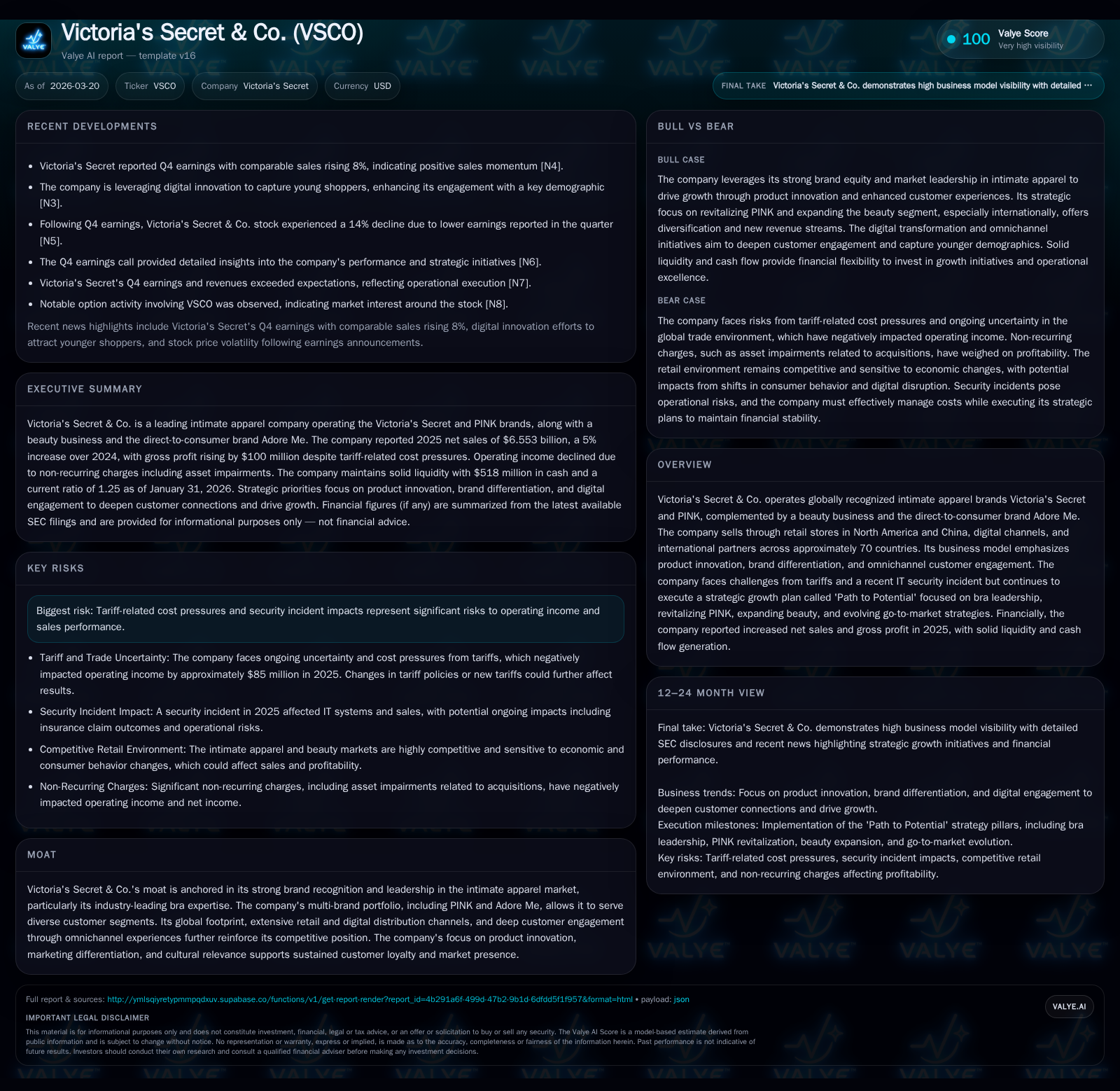
Victoria's Secret & Co. sustains its market leadership in intimate apparel through brand strength, product innovation, and omnichannel engagement. Fiscal 2025 saw operating income decline due to tariff costs, while net sales and gross profit improved supported by digital expansion and revitalization of PINK and Adore Me. The company maintains robust liquidity, disciplined capital management without recent share repurchases, and strategic investments aligned with its Path to Potential plan emphasizing bra leadership, beauty expansion, and retail modernization. Key risks include tariff uncertainties and cybersecurity vigilance following a 2025 incident.
Track Record of Performance: Growth Drivers and Shifts Since 2023
Victoria's Secret & Co.'s financials over recent years reveal steady top-line growth tempered by margin pressures. Net sales increased from approximately $6.18 billion in FY2022 to $6.55 billion in FY2025 driven by international expansion including China joint ventures, wholesale royalties abroad, and evolving channel mix [S1][S13]. However, operating income declined significantly from $478 million in FY2022 to $271 million in FY2025 [F1], reflecting cost headwinds notably from tariffs.
In FY2025 (year ended January 31, 2026), operating income was $271 million, down about 12.6% compared to $310 million in FY2024 (Table below) [F1]. The decrease aligns closely with an estimated $85 million tariff-related expense despite mitigation efforts [S1]. Gross profit dollars increased nearly $100 million aided by less promotional activity and stronger regular-priced selling [S13]. Net income was resilient at $161 million versus $165 million prior year, down approximately 2.4%, underscoring earnings stability amid margin compression.
Operating cash flow improved robustly by 17.4% year-over-year to $499 million due to higher net income adjusted for non-cash items plus working capital management involving inventory buildup partially linked to tariffs [F1][S16]. Capital expenditures rose modestly to $187 million from $178 million as investments focused on store enhancements and technology/logistics supporting omnichannel fulfillment [F1][S18]. Equity increased significantly to $856 million from $640 million reflecting earnings retention and share retirements related to prior repurchases [F1][S26].
Historical performance (annual)
| FY | Net ($mm) | CFO ($mm) | OpInc ($mm) | Capex ($mm) | Net YoY |
|---|---|---|---|---|---|
| 2025 | 161 | 499 | 271 | 187 | -2.4% |
| 2024 | 165 | 425 | 310 | 178 | +51.4% |
| 2023 | 109 | 389 | 246 | 256 | -68.7% |
| 2022 | 348 | 437 | 478 | 164 |
Source: SEC companyfacts cache [F1].
Capital returns and efficiency (annual)
| FY | Buybacks ($mm) | FCF ($mm) | ROE% |
|---|---|---|---|
| 2025 | 0 | 312 | 18.8 |
| 2024 | 0 | 247 | 25.8 |
| 2023 | 125 | 133 | 26.1 |
| 2022 | 250 | 273 | 90.9 |
Source: SEC companyfacts cache [F1].
Table illustrates operating income contraction despite revenue gains; net income remains broadly stable.
Brand Power and Innovation: Pillars of Sustainable Growth
Victoria's Secret & Co.'s strength stems from its globally recognized Victoria's Secret brand renowned for fashion-forward intimates—especially bras where it holds leadership—and the youthful PINK brand catering to younger consumers seeking bold lifestyle intimates [S1]. The acquisition of Adore Me adds a direct-to-consumer digital platform complementing diverse consumer segments across price points.
Unit economics indicate robust customer engagement with elevated units per transaction and average transaction values sustained through innovative assortments including inclusive sizing, fabric technologies enhancing comfort/functionality, and culturally resonant collections [S13]. PINK’s revitalization leverages social media influencer partnerships boosting conversion rates both online and in strategically located stores where sales per square foot exceed many specialty apparel peers [N10][S13].
The beauty segment expansion enhances cross-selling opportunities within stores and direct channels with fragrances and skincare anchored in Victoria’s Secret glamorous positioning, strengthening customer loyalty while mitigating commoditization risks common in intimate apparel [S1].
Tariff Impacts and IT Security Incident: Managing External Headwinds
Tariffs imposed under the International Emergency Economic Powers Act (IEEPA) negatively impacted operating income by an estimated $85 million during FY2025 despite mitigation via supply chain adjustments and pricing strategies [S1]. Following the U.S. Supreme Court’s invalidation of certain IEEPA tariffs, a new flat global tariff was introduced creating regulatory uncertainty including potential refunds for prior payments—requiring ongoing trade policy vigilance [S1].
Separately, an IT security incident detected May 24, 2025 triggered swift response protocols restoring full system operation by Q2 FY2025 without material disruption or financial impact [S1][S15]. Subsequent comprehensive investigations led to enhanced cyber risk frameworks—a critical focus given e-commerce’s growing contribution particularly through Adore Me targeting younger demographics [N10][S15].
These external challenges underscore material risk factors that have so far been managed effectively; however, tariff changes or cybersecurity issues remain key contingencies.
Omnichannel and Digital Strategy: Capturing the Young Consumer Segment
Digital innovation is central as Victoria’s Secret adapts to consumer shifts favoring online discovery combined with integrated multichannel shopping experiences [N10]. Adore Me’s subscription-based lingerie model leverages algorithmic personalization driving lifetime customer value beyond traditional retail limits [S1][N10].
Revitalization efforts focus on improving digital conversion rates using data analytics for personalized marketing while optimizing inventory allocation across channels—boosting sales per square foot at physical stores where experiential retail complements online engagement [N10][S13]. For PINK especially, omnichannel strategies align with mobile commerce preferences offering agile fulfillment options such as buy-online-pick-up-in-store.
Rising units per transaction alongside growing average transaction values reflect success in accessory bundling promotions and beauty cross-selling executed seamlessly both digitally and instore—enabled by technology investments evident from capex toward logistics automation [F1][S18].
Financial Overview: Profitability, Liquidity, and Capital Structure Focus
Victoria’s Secret & Co.’s approximate return on equity stands near 18.8%, calculated as FY2025 net income divided by year-end shareholders’ equity ($161M / $856M), indicating effective earnings generation despite margin pressures [F1]. Liquidity is strong with a current ratio around 1.25 derived from current assets of roughly $1.88 billion versus liabilities near $1.51 billion at January-end FY2025 providing flexibility for seasonal inventory builds typical of retail [F1][S4][S16].
Debt comprises primarily a fixed-rate senior unsecured note of $600 million maturing July 2029 at 4.625%, plus a senior secured term loan facility of approximately $383 million maturing August 2028 with floating rates lowered after December 2025 refinancing amendments (2.75% base rate plus margin), improving cash interest costs going forward [F1]. An undrawn asset-based revolving credit facility capped at $750 million offers additional liquidity support during peak seasons.
Financial covenants including leverage ratios are currently met affording capital strategy flexibility; cash flow coverage remains robust supported by rising operating cash flow (+17.4%) despite increased capex targeting store modernization plus systems upgrades [F1]. Interest payments decreased consistent with improved borrowing terms.
Capital Allocation Review: Share Repurchases, Dividends, and Investment Trends
Capital deployment has been disciplined following significant buybacks totaling approximately $125 million completed during FY2023 under the January program; no repurchases occurred during FY2024 or FY2025 though a March 2024 share repurchase program remains authorized but unused [F1][S18]. Shares acquired were retired immediately enhancing per-share metrics.
No dividends have been declared or paid since becoming publicly independent; future policy remains discretionary based on cash flows consistent with retail capital allocation norms prioritizing reinvestment over distributions presently [S10].
Capital expenditures have trended upward reflecting strategic priorities involving physical store enhancements supporting experiential retail alongside backend logistics infrastructure upgrades needed for expanding digital fulfillment—signaling investment-led growth rather than financial engineering [F1][S18].
What Comes Next: Key Milestones and Risks to Monitor
Looking ahead into calendar year 2026 and beyond, key milestones include executing the Path to Potential strategic plan focusing on bra leadership via product innovation; revitalizing PINK brand vitality through targeted omnichannel activation; expanding beauty categories leveraging cross-sell synergies; plus ongoing refinement of go-to-market models enabled by data-driven personalization backed by technology investments ([N9][N10]).
Risks remain around evolving tariff policies nationally/internationally affecting input costs unpredictably requiring supply chain agility ([S15]). Cybersecurity vigilance continues post-incident emphasizing layered defenses protecting intellectual property and customer data critical for sustaining trust ([N10][S15]). Competitive pressure intensifies amid digital-native challengers necessitating ongoing differentiation.
Recent quarterly earnings showed topline momentum with comparable store sales growth near +8%, though bottom-line pressures contributed to stock price pullbacks reflecting investor sensitivity toward margin compression tied chiefly to macroeconomic headwinds ([N3],[N4],[N13]). These market dynamics highlight importance of balancing cost absorption against sustainable revenue growth moving forward.
Overall, Victoria’s Secret & Co.’s profile reflects solid foundational strength anchored by prominent brands harmonized with advancing digital capabilities securing relevance across consumer generations amid complex cost environments.
This analysis is based solely on information available from official SEC filings as well as reputable news reports as cited; no forward-looking guarantees or recommendations are offered herein.
Disclaimer: This is research-only, informational analysis and not investment advice. It may include AI-generated interpretation and general industry context. Always verify important details using primary sources.

Comments