
TIC Solutions' 2025 Transition: Integrating NV5 and Managing Debt Amid Industry Dynamics
TIC Solutions faces operational and financial headwinds following its NV5 acquisition and debt load alongside shifting market demands.
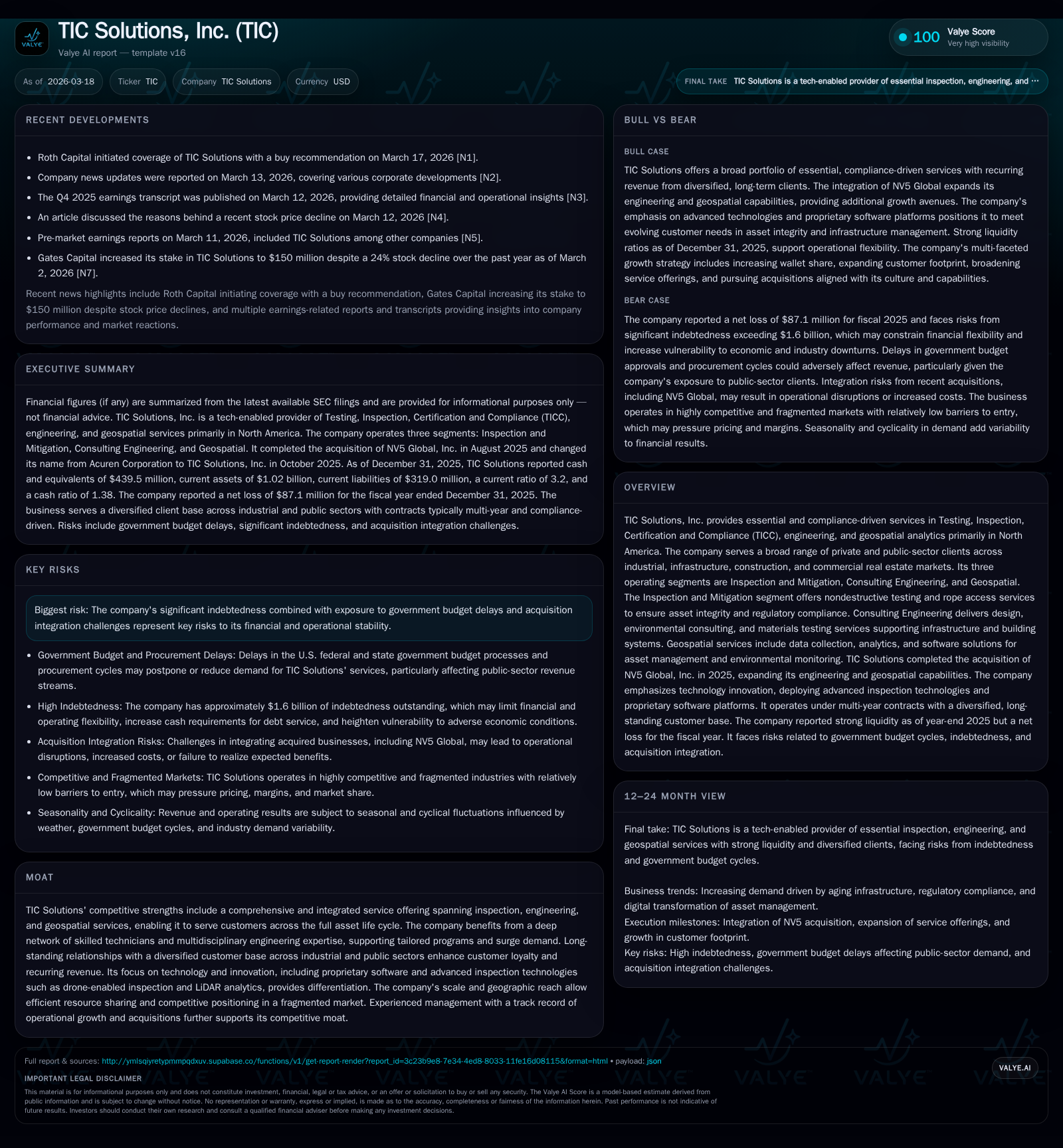
In 2025, TIC Solutions, Inc. completed a transformational acquisition of NV5 Global, expanding its footprint in engineering and geospatial services and rebranding itself from Acuren Corporation. Despite broadening service capabilities across three integrated segments—Inspection and Mitigation, Consulting Engineering, and Geospatial—the company reported significant operating and net losses for the year. Key drivers include tight government budgets impacting public-sector demand and challenges related to acquisition integration. TIC maintains a strong current ratio but grapples with substantial indebtedness that restricts financial flexibility. Technology investments and expanding customer penetration underpin growth prospects; however, competitive pressures and cyclical end markets temper near-term outlooks.
Overview and Historical Context
TIC Solutions, Inc., formerly Acuren Corporation until an October 2025 rebranding, operates at the intersection of Testing, Inspection, Certification and Compliance (TICC), engineering consulting, and geospatial analytics. The transition in 2025 was marked by the acquisition of NV5 Global on August 4th which significantly broadened its service portfolio beyond Inspection and Mitigation into the high-growth Consulting Engineering and Geospatial segments [S1, S23]. This strategic move alters the company's operational scale, service breadth, and market exposure primarily across North America.
Historically focused on highly nondiscretionary regulatory-driven inspection services catering largely to industrial clients such as energy processing facilities and manufacturing plants, the integration of NV5 forms a more diversified entity addressing infrastructure design, environmental consulting, asset management planning with data-driven geospatial intelligence [S8, S9].
Financial Performance in Recent Years
While detailed multi-year data is limited to key metrics for 2025 from the latest SEC-filed financials ([F1]), certain points illustrate performance trends:
Historical performance (annual)
| FY |
|---|
| 2025 |
Source: SEC companyfacts cache [F1].
Key highlights include a significantly negative net income in 2025 despite maintaining substantial liquidity with $440 million in cash equivalents supporting short-term obligations [F1]. The current ratio above 3 indicates strong short-term solvency. The operating loss reflects integration costs related to NV5 as well as softness in market demand influenced by government budget constraints. While revenue figures are not disclosed explicitly in available data sources, filings note cyclicality driven by both private industrial sectors and public infrastructure projects [S4].
Segment Breakdown & Competitive Environment
TIC operates three core business lines: Inspection & Mitigation; Consulting Engineering; Geospatial Services.
- Inspection & Mitigation: Asset integrity services using Nondestructive Testing (NDT) techniques such as ultrasonic testing and radiography combined with Rope Access Technician solutions for difficult-to-access sites. Contracts are mainly time-and-materials or cost-plus supporting compliance-driven maintenance across industrial sectors including energy and manufacturing [S23].
- Consulting Engineering: Infrastructure design, environmental consulting, materials testing labs supporting longevity of built environments. Engagements are typically project-based under fixed-price or unit-rate agreements primarily from government agencies or utilities [S8,S9].
- Geospatial: Spatial data collection and analytics leveraging technologies like LiDAR scanning and drone imagery feeding subscription software platforms that support asset management for utilities, defense agencies, and transportation operators with stable recurring revenue streams [S9].
Technological leadership is emphasized through advanced inspection methods including drone-enabled aerial inspections and proprietary analytics platforms providing integrated lifecycle asset management—critical as aging infrastructure necessitates sophisticated oversight for safety compliance [S11,S14].
Competition is fragmented with low barriers to entry; rival firms range from small regional providers competing on price to large diversified companies with broader resources exerting pricing pressure especially in commoditized inspection segments [S12]. Differentiation through technology adoption remains key to maintaining market share.
Growth Prospects & Strategic Drivers
TIC's growth strategy centers on leveraging the NV5 acquisition synergies:
- Deepening wallet share via cross-selling integrated TICC plus engineering/geospatial offerings within existing customers.
- Expanding geographic footprint by securing new sites leveraging scalable field technician resources.
- Investing in advanced inspection technologies such as enhanced ultrasonics targeting complex materials prevalent in aerospace or renewables sectors [S19].
- Expanding public-sector penetration driven by infrastructure investment linked to regulatory mandates around pipeline integrity and water resource management.
- Continuing tuck-in acquisitions targeting complementary capabilities funded partly through free cash flow generation [S19].
Risks include execution challenges integrating new markets amidst entrenched competitors; government budget delays causing project timing uncertainties; inflationary labor costs compressing margins if pricing adjustments lag cost increases; plus cyclical demand fluctuations tied to weather impacting inspection scheduling predominantly active spring through fall [S2],[S13],[S16].
Financial Health & Capital Allocation Considerations
At year-end 2025 TIC held $1.02 billion in current assets against $319 million current liabilities yielding a current ratio above 3.2 indicative of solid liquidity [F1]. However substantial leverage exists under a secured credit facility encumbering nearly all assets with covenants limiting additional indebtedness unless certain financial ratios are met ([S5],[S7]). Floating interest rates expose cash flows to rate volatility risks amid tightening monetary policy ([S26]). Covenant breaches could trigger defaults accelerating repayment obligations potentially constraining operational flexibility.
Capital allocation currently prioritizes deployment toward acquisition integration and organic growth investments rather than shareholder returns; no dividends or buybacks were disclosed in filings ([F1]). Maintaining cash reserves supports deleveraging efforts while funding technology platform enhancements critical to sustaining competitive advantage.
Risks Summary
Key risks facing TIC Solutions include:
- Integration risk post-NV5 acquisition potentially undermining anticipated synergy benefits ([S1]).
- Dependence on government spending subject to federal/state budget cycles affecting contract timing ([S2]).
- Pricing pressures from fragmented competitive landscape compressing margins ([S12],[S16]).
- Skilled labor shortages impacting capacity during peak demand periods such as plant turnarounds ([S15]).
- Litigation exposure including wage-hour claims adding potential cost volatility ([S15],[S22],[S27]).
- Interest rate increases raising borrowing costs reducing free cash flow available for reinvestment ([S26]).
Outlook & What To Watch Next (Analysis)
Absent explicit forward guidance publicly released ([N1],[N3]), investors should monitor:
- Quarterly earnings updates revealing progress on NV5 integration cost reductions.
- Revenue mix shifts indicating success cross-selling legacy TICC services with newly acquired engineering/geospatial lines.
- Public sector contract awards or delays signaling government spending trends.
- Operating margin trends reflecting labor cost control amid inflationary pressures.
- Balance sheet movements showing deleveraging or refinancing activity affecting interest expense.
Longer term success depends on managing integration complexity while capitalizing on digital transformation trends pushing clients toward consolidated providers offering end-to-end asset lifecycle visibility supported by advanced sensor data analytics platforms.
Conclusion
TIC Solutions stands at a pivotal juncture reshaping its business model toward broader asset integrity solutions augmented by digital innovation spanning inspection through engineering into geospatial domains. Despite near-term losses and significant debt burdens constraining immediate returns potential, the enlarged platform accesses expanding markets driven by regulatory imperatives around infrastructure safety and life extension.
Operational resilience relies on effective integration execution coupled with technological differentiation amid intense competition where price sensitivity prevails. Continued focus on expanding recurring revenue contracts primarily via public sector engagements remains critical given cyclicality observed among private clients. Prudent capital structure management amid evolving macroeconomic conditions will be essential for sustaining investment capacity required to maintain industry relevance moving forward.
This analysis is based solely on information expressly available from cited SEC filings and reputable news transcripts as of March 18, 2026. It is intended solely for informational purposes without any investment advice or recommendation.
Disclaimer: This is research-only, informational analysis and not investment advice. It may include AI-generated interpretation and general industry context. Always verify important details using primary sources.

Comments