
Verano Holdings' Vertical Integration and Multi-State Footprint Confront Profitability and Regulatory Challenges
Verano Holdings’ extensive cultivation capacity and retail presence drive growth but debts, losses, and regulatory complexities temper outlook.
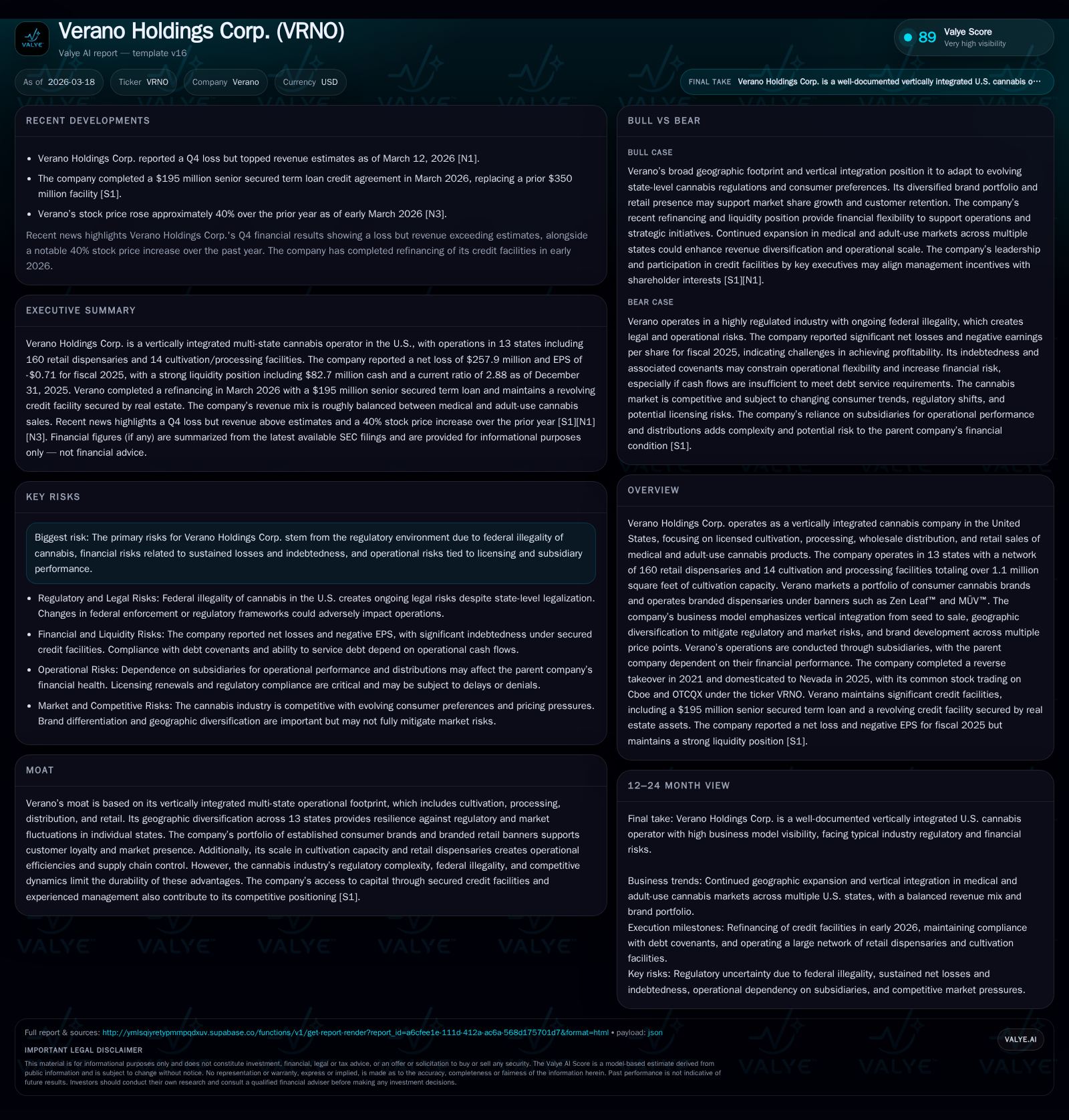
Verano Holdings operates one of the largest vertically integrated cannabis platforms in the U.S., spanning cultivation, processing, wholesale, and retail across 13 states. Its diversified footprint and consumer brand portfolio support resilience amid the fragmented state-by-state legalization landscape. However, recent financials reveal sustained operating losses and net losses despite progress toward narrowing deficits. The company’s liquidity position remains stable with substantial current assets exceeding liabilities, supported by recent refinancing activity. Regulatory risks, federal illegality of cannabis, and cost pressures on margins continue to cap upside potential and cloud growth visibility.
Company Overview and Business Model
Verano Holdings Corp. is a leading vertically integrated cannabis operator in the United States. As of March 2026, the company operates in 13 states where cannabis is legal for medical or adult use, managing approximately 160 retail dispensaries alongside 14 cultivation and processing facilities totaling over 1.1 million square feet of production capacity [S1].
The company’s vertically integrated model spans seed-to-sale operations—from cultivation through manufacturing to retail—allowing control over product quality, inventory management, and brand development. Verano's portfolio includes brands such as Encore™, Avexia™, MÜV™, Savvy™, Essence™, BITS™, HYPHEN™, Swift Lifts™, and Verano™ itself. Retail operations feature branded dispensaries under banners like Zen Leaf™ and MÜV™ among others [S20].
Historical Financial Performance
Verano has faced typical challenges of a growing multi-state cannabis operator amid regulatory fragmentation, competitive pressures, and cost constraints.
Historical performance (annual)
| FY | Net ($mm) | CFO ($mm) | OpInc ($mm) | Capex ($mm) | Net YoY |
|---|---|---|---|---|---|
| 2025 | -258 | 53 | -107 | 41 | +24.6% |
| 2024 | -342 | 112 | -237 | 99 | -191.3% |
| 2023 | -117 | 110 | 85 | 36 | +56.4% |
| 2022 | -269 | 94 | -161 | 119 |
Source: SEC companyfacts cache [F1].
Capital returns and efficiency (annual)
| FY | FCF ($mm) | ROE% |
|---|---|---|
| 2025 | 12 | -36.6 |
| 2024 | 13 | -35.9 |
| 2023 | 73 | -9.5 |
| 2022 | -25 | -20.1 |
Source: SEC companyfacts cache [F1].
Table: Selected Annual Financial Data [F1]
From FY2024 to FY2025 Verano reduced its operating losses substantially from $237 million to $107 million while net losses also narrowed though remained significant at approximately $258 million.
Operating cash flow decreased markedly in FY2025 compared to the prior year but stayed positive at about $53 million. Capital expenditures were significantly reduced as Verano shifted from heavy infrastructure investments towards more measured spending.
Equity declined over this period reflecting accumulated losses impacting shareholder value. The approximate return on equity was negative at around -36.6% for FY2025 indicating ongoing unprofitability despite improvements [F1].
Growth Prospects and Strategic Drivers
Verano’s growth strategy leverages geographic diversification across multiple regulated cannabis markets including Arizona, Florida, Illinois, Massachusetts among others. This mitigates reliance on any single state’s regulatory environment while targeting early market entry advantages primarily through acquisitions complemented by organic expansion.
Key operational strengths include:
- Indoor cultivation methods supporting consistent year-round supply independent of seasonality [S1].
- Scale benefits from extensive retail footprint combined with large cultivation capacity.
- Expansion into wholesale distribution complements revenues beyond owned retail outlets.
However growth faces constraints from competitive intensity and licensing restrictions limiting rapid expansion [S28].
Recent Financial Guidance and Milestones
While no explicit forward guidance was provided publicly in filings or news releases up to March 2026, updates emphasize maintaining compliance with financial covenants and strategic capital deployment focused on scalable assets . Key upcoming milestones are:
- Scheduled amortization payments beginning April 2026 under new senior secured term loan facility with a principal amount of $195 million maturing March 2029 or extendable to March 2030 subject to fees [S9].
- Continued integration of recent acquisitions such as Cannabist AZ dispensaries enhancing regional presence [S20].
- Monitoring federal regulatory developments on cannabis rescheduling following December 2025 executive order aimed at expanding medical marijuana research [S1].
Investors should watch for metrics including revenue growth per store footprint increase and margin improvement driven by operational scale efficiencies.
Returns and Capital Allocation
The company currently does not pay dividends nor conduct share repurchases given ongoing net losses and prioritization of reinvestment into its business operations [S14].
Free cash flow remains positive but modest; calculated as operating cash flow minus capital expenditures it approximates $12 million for FY2025 highlighting tight financial discipline amid reduced capital spending [F1].
Liquidity metrics are sound with current assets exceeding current liabilities by nearly threefold (current ratio approximately 2.88x), indicating comfortable short-term coverage [F1].
Capital structure improvements were made through refinancing activities completed between late 2025 and early 2026: termination of a prior $350 million credit agreement replaced by a revolving loan facility initially set at $75 million (later increased to $100 million) alongside a new senior secured term loan facility totaling $195 million extending maturity dates into late decade . These refinancings aim to optimize debt servicing costs amid challenging capital markets for cannabis operators.
Notably Chairman & CEO George Archos personally participated in lending arrangements indicating alignment between management interests and creditors [S7,S9].
Risks and Industry Challenges
Primary risks highlighted include:
- Federal illegality of cannabis restricting interstate commerce possibilities and creating legal uncertainty.
- Sales volume volatility driven by consumer behavior changes influenced by macroeconomic factors such as inflation impacting discretionary spending on cannabis products [S11,S24,S29].
- Complex multi-jurisdictional regulatory compliance requirements imposing significant costs with risk of license revocation adversely affecting subsidiaries [S11].
- Elevated indebtedness levels imposing restrictive covenants limiting operational flexibility; failure to comply could trigger defaults with severe consequences including lender foreclosures on assets [S25].
- Litigation exposure exemplified by resolved disputes related to acquisition agreements underscoring integration risks [S11,S22].
- Labor market challenges including unionization efforts potentially raising employment costs [S19].
- Environmental considerations linked to energy-intensive indoor growing possibly increasing costs or triggering environmental regulation compliance issues if not managed effectively [S1].
- Cybersecurity risks associated with sensitive patient data managed through digital sales platforms also represent emerging operational concerns [S19].
Conclusion and Monitoring Points (Analysis)
Verano Holdings embodies key attributes of a leading multi-state U.S.-based cannabis operator: vertical integration ensuring operational control; well-recognized consumer brands; geographic diversification across regulated markets; significant physical asset base; refined liquidity profile extending runway through recent refinancing.
The company nevertheless faces an uphill path toward sustainable profitability constrained by federal prohibition limiting interstate supply chains alongside macroeconomic headwinds compressing discretionary consumption demand.
Key monitoring points for investors include:
- Continued narrowing of net loss margins beyond FY2025 improvements;
- Sustaining positive free cash flow after normalized capital expenditures;
- Regulatory developments particularly around federal cannabis rescheduling or banking access enhancements;
- Execution against debt covenants amid scheduled amortizations under new credit agreements;
- Market share gains reflected in same-store sales growth or expanded wholesale relationships;
- Cost management effectiveness especially energy consumption at indoor cultivation sites along with labor cost containment;
- Reduction in litigation exposure post prior settlements related to acquisition disputes.
Overall Verano represents a complex but strategically positioned player within a dynamic industry balancing growth ambitions against operational scalability amidst ongoing regulatory flux.
This report is based on publicly filed SEC documents dated up through March 12, 2026 ([F1],) and reputable news sources ([N1],[N3]). It is intended solely for informational purposes without offering any investment recommendation.
Disclaimer: This is research-only, informational analysis and not investment advice. It may include AI-generated interpretation and general industry context. Always verify important details using primary sources.

Comments