
U.S. GOLD CORP.’s Journey from Exploration Setbacks to Capital Expansion
U.S. GOLD CORP. advances its CK Gold Project amid growing operating expenses and liquidity improvements from equity financing.
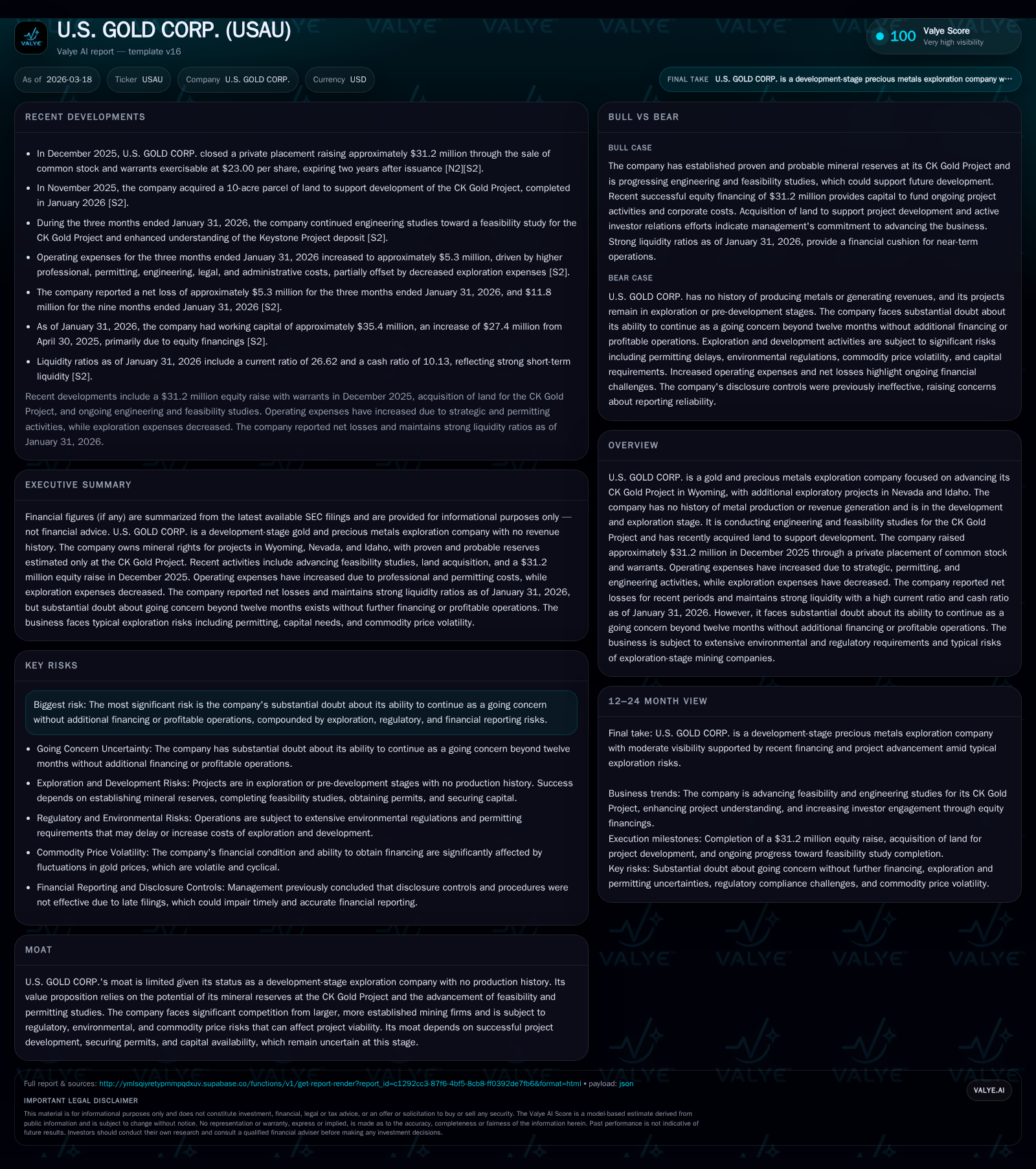
U.S. GOLD CORP., a development-stage precious metals explorer, continues progressing its flagship CK Gold Project in Wyoming with focused engineering and permitting studies, while managing fluctuating operating costs and exploration outlays. The company reported sustained net losses and negative cash flow but boosted liquidity through a significant $31.2 million private placement in December 2025, enhancing working capital substantially. Despite this infusion, the company faces material going concern risks given its lack of revenue and dependence on future financings to fund project advancement beyond feasibility studies.
Exploration Upturn and Historical Performance Trends
U.S. GOLD CORP. (USAU) maintains a strict development-stage profile with zero revenue reported since pivoting fully to gold exploration and project preparation. Financial records confirm continuous net losses stretching multiple years, culminating in approximately -$20.6 million net income for FY2025 [F1]. This marks a nearly threefold deepening relative to the previous year's loss of -$6.9 million.
Operating income reflects a similar worsening trend: a -$13 million operating loss in FY2025 compared with -$7.3 million the prior year, underscoring escalating expenditure pressures consistent with advancing feasibility activities [F1]. Meanwhile, exploration expense curtailments are evident quarter-on-quarter but have not offset rising general operating costs associated with engineering and permit-related functions documented in SEC filings [S2].
The shift in cost structure—from broad exploratory outlays to targeted engineering consulting—signals a transition phase that prioritizes definitive assessments of deposit economics over wide-scale resource drilling campaigns. This evolution is consistent with mining sector norms where projects approach the critical milestone of feasibility study completion.
Historical performance (annual)
| FY | Net ($mm) | CFO ($mm) | OpInc ($mm) | Capex ($) | Net YoY |
|---|---|---|---|---|---|
| 2025 | -21 | -10 | -13 | 6158 | -198.1% |
| 2024 | -7 | -7 | -7 | 177513 | +9.4% |
| 2023 | -8 | -9 | -9 | 177513 | +45.3% |
| 2022 | -14 | -13 | -15 | 178972 |
Source: SEC companyfacts cache [F1].
Capital returns and efficiency (annual)
| FY | FCF ($mm) | ROE% |
|---|---|---|
| 2025 | -10 | -177.4 |
| 2024 | -7 | -39.5 |
| 2023 | -9 | -40.4 |
| 2022 | -13 | -58.9 |
Source: SEC companyfacts cache [F1].
Table: Summary of U.S. GOLD CORP.'s Operating Metrics for FY2022-FY2025 ([F1])
Engineering Progress and Project Development Updates
Development efforts center on the CK Gold Project in Wyoming where USAU has defined proven and probable mineral reserves under S-K 1300 standards—a crucial compliance metric signifying quantifiable deposit confidence required for financing [S2]. Recent engineering studies focus on preparing a Definitive Feasibility Study (DFS), which will underpin project execution planning.
Key steps include engagement with technical consultants such as Micon International Limited and Halyard Inc., alongside infrastructure pre-construction efforts with Cheyenne Light Fuel & Power aimed at powerline construction—an essential utility for future mine operation [S16][S22]. November 2025 saw acquisition of an adjacent 10-acre parcel solidifying surface rights crucial for site expansion scenarios [S2].
Sector-wise this represents progressing from greenfield exploration to brownfield development stages where engineering rigor amplifies permitting complexity and capital budgeting urgency. Advancing beyond this phase hinges on permit approvals from regulatory agencies addressing environmental assessments specific to mining waste management and land use conformity.
Liquidity Infusion: Recent Capital Raising Milestone
In December 2025 USAU concluded a private placement yielding gross proceeds near $31.2 million through issuance of approximately 1.92 million common shares priced modestly below market ($16.25 vs $16.91 closing price) plus warrants exercisable within two years at $23/share strike price [S2][S9].
This injection significantly bolstered liquidity metrics as current assets rose to nearly $36.8 million by January 31, 2026 against minimal current liabilities (~$1.38 million), lifting working capital above $35 million—a marked jump from ~$8 million recorded six months prior [S4][F1]. While enhancing operational runway toward finalizing feasibility studies and permitting engagement costs, this equity raise also elevates share count dilution risk inherent in junior miner financing strategies.
Proceed allocations prioritize permitting processes and engineering consultancy commitments essential at this pre-construction juncture per corporate disclosures [S2][S3].
Financial Health Check: Operating Losses and Cash Flows
Reflective of active development progression rather than curtailed activities, operating losses have expanded recently—reporting $13.54 million for nine months ending January 31, 2026 versus $9.83 million same period prior year [S11]. Notably professional fees surged fueled by consulting contracts supporting feasibility analyses (+$3.25 million increase), whereas direct exploration expenses contracted (~$640k decrease), illustrating reallocation toward higher order project planning tasks instead of grassroots drilling programs [S18].
Cash burn measured via operating cash flow widened by roughly 40% YoY to around $12.13 million during nine months ended January 31, 2026 from $7.15 million prior year interval [S3][F1]. Capital expenditures remain minimal reflecting non-productive status—with purchases limited to land/building acquisitions totaling under $2 million during the same span [S3][F1]. This profile typifies junior miners sustaining cash outflows aligned with incremental technical diligence rather than heavy equipment deployment or construction spending.
Given accumulated deficit exceeding $105 million as of early calendar year and negative free cash flow approaching -$9.88 million last fiscal year ([F1]), the financial foundation’s sustainability is contingent on timely success in capital raises without which project continuity may be compromised.
Future Catalysts and Project Milestones to Monitor
Although explicit company guidance is absent regarding precise timing for feasibility study completion or permitting milestones ([S2]), investors should closely watch:
- Publication of Definitive Feasibility Study results assessing economic viability,
- Progression of environmental impact statements and receipt of key mining permits,
- Further infrastructure agreements facilitating power supply setup,
- Commodity price trends influencing gold project economics.
These milestones represent actionable triggers that could alter development trajectory or financing terms.
Risks From Going Concern Doubts and Financing Needs
U.S. GOLD CORP.’s filings repeatedly emphasize substantial doubt about its ability to continue as a going concern absent new financings or profitable operations—neither currently realized given zero revenues from production or sales [S1][S23]. Liquidity strength post-private placement suffices only for near-term study continuation but falls short for groundbreaking or sustained operations without further capital commitment.
This funding dependency is exacerbated by documented disclosure control weaknesses noted in late filings that could impact investor confidence or delay regulatory reporting precision [S1]. Additionally regulatory risks including delays or denials in permit issuance loom large given environmental scrutiny faced across U.S.-based precious metal projects [S25][S28].
Collectively these factors delineate the classic high leverage profile typical among junior development stage miners lacking operational cash inflow buffers.
Capital Allocation Strategy and Shareholder Returns Outlook
USAU has no history of dividend payouts or share repurchases reflective of its developmental status—as confirmed by absence of distributions in recent annual reports [F1][S26]. Equity issuances constitute the predominant financing vehicle to fund operations—a pathway underscored by persistent net losses producing negative ROE near -177%, implying erosion of shareholder value in present mode [F1].
Amid growth funding necessity dilution remains a critical consideration since shareholders face expansion-driven share count inflation potentially diluting intrinsic value absent corresponding project de-risking achievements.
Strategic Position versus Larger Mining Players
Operating within the competitive niche of junior gold explorers developing advanced-stage deposits domestically hinges heavily on delivery against key technical milestones underpinning resource monetization potential—the core aspect of USAU’s moat which currently rests solely on proven & probable reserves at CK Gold Project ().
Compared with major miners possessing multi-asset portfolios generating stable revenues from producing mines globally, USAU’s leverage is high with risks concentrated around the success/failure binary surrounding project commissioning. Junior miners like USAU often face intensified operational gearing combined with onerous financing requirements which magnify business cycle impacts relative to diversified incumbents. Successful navigation through permitting hurdles alongside disciplined execution of DFS outcomes will be pivotal determinants shaping strategic relevance going forward.
This analysis reflects information available from U.S. GOLD CORP.’s filings up to March 18, 2026 without extrapolation beyond disclosed data points or speculative forecasts. It does not constitute investment advice but aims to objectively synthesize company-specific developments within sector operative frameworks relating to exploration-to-development transition dynamics.
Disclaimer: This is research-only, informational analysis and not investment advice. It may include AI-generated interpretation and general industry context. Always verify important details using primary sources.

Comments