
ProCap Acquisition Corp's Growth Hinges on Successful Financial Services Business Combination
Newly listed SPAC with $256 million in liquidity targets financial services sector amid structural and timing risks.
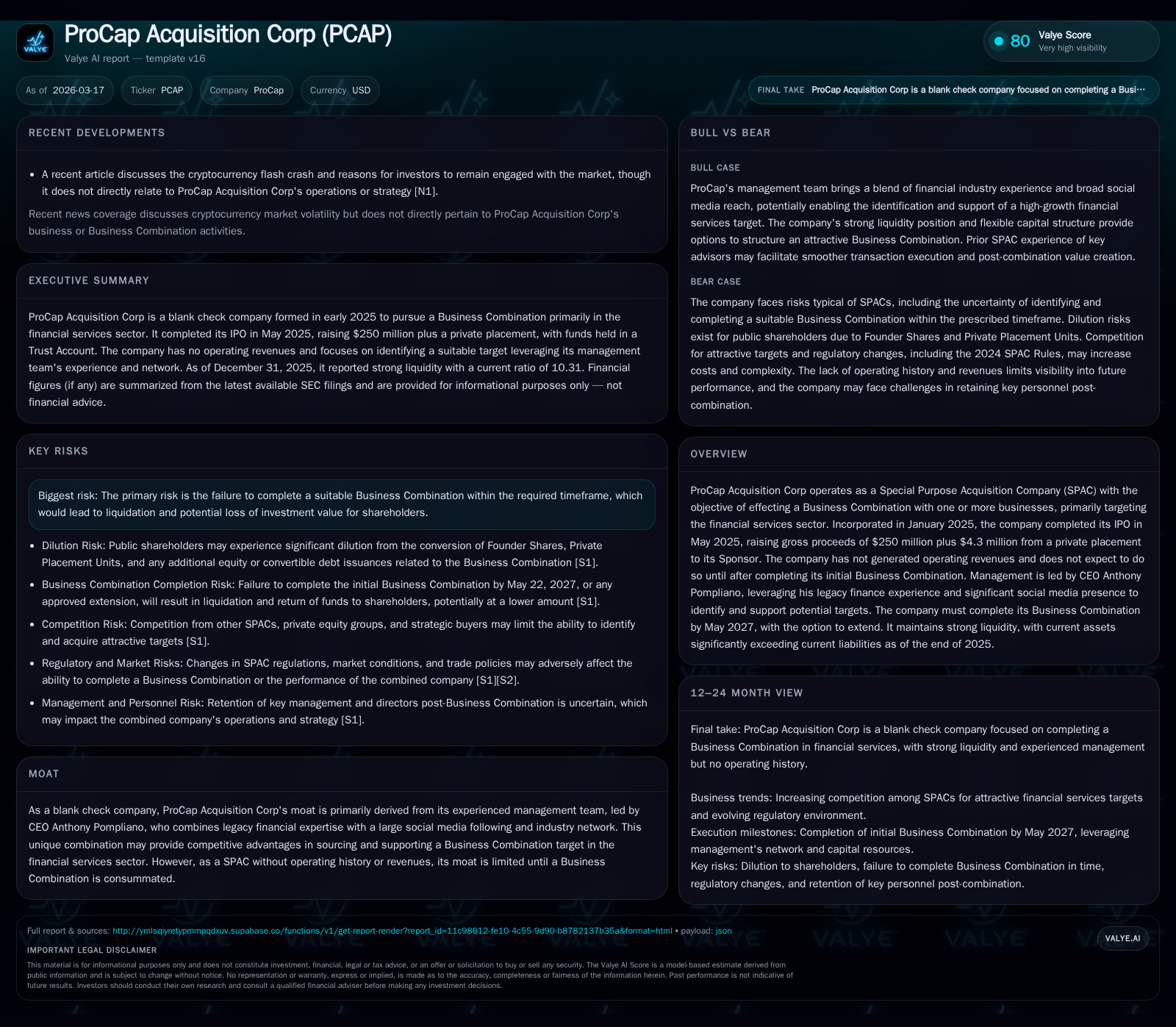
ProCap Acquisition Corp, a SPAC launched in early 2025, raised $250 million in its May 2025 IPO plus $4.3 million from a private placement, positioning itself to consummate a business combination within two years. Lacking operating revenues and with no completed target selection yet, growth and returns depend entirely on the initial business combination, focusing primarily on financial services. Capital structure is robust at present with funds predominantly held in trust, but dilution and financing risks loom depending on deal terms and shareholder redemptions. The company’s differentiated moat lies chiefly in CEO Anthony Pompliano’s blend of traditional finance experience and social media influence, though success hinges on navigating increasingly stringent SPAC regulations and execution timelines.
Company Overview
ProCap Acquisition Corp was established as a Cayman Islands exempted company on January 2, 2025, designed as a Special Purpose Acquisition Company (SPAC). Its stated mission is to identify and merge with one or more businesses, focused primarily on the financial services sector. This focus leverages the management team's collective track record, especially CEO Anthony Pompliano's extensive industry experience combined with his large social media following — positioning ProCap to attract compelling deal flow in a competitive SPAC environment [S1][S8].
The firm completed its Initial Public Offering (IPO) on May 22, 2025, issuing 25 million units at $10 each including partial over-allotment exercised by the underwriters. This generated gross proceeds of $250 million backed by an additional $4.3 million in private placement units subscribed by its Sponsor immediately post-IPO, totaling an aggregate capital base earmarked primarily for acquisition purposes [S9]. Simultaneously with the IPO closing, ProCap deposited the entire proceeds (save for working capital) into a Trust Account overseen by Odyssey Transfer and Trust Company as trustee [S9].
Historical Financial Performance
As is standard for SPACs without completed mergers, ProCap has no operating revenues or meaningful operational metrics prior to completing its business combination. Consequently, the company's income statement reflects operating losses attributable principally to general and administrative expenses related to organizational setup and regulatory compliance—totaling an operating loss of approximately $470k for the year ended December 31, 2025 [F1]. Despite this operational deficit, net income shows a positive figure of around $5.66 million attributed mainly to non-operating activities such as interest income earned on trust funds or other non-core sources [F1].
Liquidity remains solid: current assets tallied around $1.19 million against current liabilities near $116k yielding a strong current ratio above 10x — emphasizing minimal short-term obligations excluding ongoing administrative costs [F1]. Most critically, funds allocated inside the Trust Account approximate $256 million intended exclusively to finance the future business combination once identified [S3].
Historical performance (annual)
| FY |
|---|
| 2025 |
Source: SEC companyfacts cache [F1].
Operating metrics are consistent with typical pre-combination SPAC financial profiles where revenue absence coincides with setup costs.
Future Growth Prospects
Prospective growth is inherently dependent on successfully identifying and closing a Business Combination within the stipulated timeframe — currently set for May 22, 2027 (24 months from IPO), extendable subject to shareholder consent [S9][S25]. Management intends to target financial services companies valued sufficiently to deploy or augment ProCap's capital effectively.
Notably absent are disclosures regarding specific targets or sectors beyond broad financial services aspirations — these details will ultimately define trajectory but pose considerable uncertainty at this stage [S1][S8]. The ability of CEO Pompliano and his team to leverage their networks — both conventional finance contacts and social media channels — could be pivotal in sourcing attractive deals with strong growth characteristics in an increasingly crowded SPAC market.
However, several factors could cap growth potential:
- Competitive dynamics intensifying due to multiple SPACs chasing scarce quality targets.
- Regulatory impacts stemming from evolving SEC guidance around SPAC disclosures and shareholder rights may complicate merger mechanics [S1][S2].
- Potential need for additional funding beyond trust account balances if redemption levels spike or acquisition pricing demands extra liquidity [S13][S23].
Forecasts and Milestones
While explicit numerical guidance has not been disclosed by management, key milestones include:
- Completion of initial Business Combination before May 22, 2027 (with possible extension).
- Obtaining necessary shareholder approvals where applicable.
- Execution of transaction structure satisfying Nasdaq's minimum valuation test requiring at least 80% fair market value relative to trust assets [S16].
Market observers should watch for proxy filings or tender offer documents as signals that ProCap has selected a target; these filings will detail transaction specifics including price mix between cash, debt, or equity components as well as anticipated post-merger strategies [S11][S23].
Returns and Capital Allocation
With no operational earnings yet and no dividends declared or share repurchase programs initiated given its pre-combination status, returns analysis focuses mainly on cash flows associated with trust fund management.
Public shareholders have rights enabling redemption of shares at approximately $10 per unit plus accrued interest if they disapprove of any proposed business combination or if no deal transpires within the deadline [S11][S17]. Although Founder Shares held by Sponsor interests are subject to forfeiture if no deal closes timely — limiting downside risk exposure for insiders — potential dilution exists post-combination through anti-dilution adjustments tied to equity issuances needed to fund acquisitions exceeding trust account balance or support working capital needs [S21][S26].
Management disclosures indicate no current plans for dividend payments or share repurchases but allow for private transactions involving insiders buying Public Shares subject to SEC safe harbor rules governing purchase timing/pricing [S10][S14]. Such mechanisms also serve as tools for managing shareholder base composition ahead of redemptions.
Risk Factors
Despite management optimism regarding their ability to source deals characteristic of attractive valuations combined with operational upside potential, material risks remain:
- Failure to consummate timely initial Business Combination triggering automatic liquidation proceedings resulting in investor returns equal principally to cash held per share in Trust Account minus dissolution costs [S1][S25][S27].
- Market reception challenges relating to shareholder vote requirements potentially influencing deal approval outcomes; public investors can redeem independently regardless of vote stance impacting transaction liquidity needs.
- Regulatory shifts under newly imposed '2024 SPAC Rules' may considerably increase cost/time burdens tied to merger completion process including increased disclosure mandates [S1][S2].
- Competitive pressures complicated by possibility of having multiple simultaneous negotiations can dilute focus/resources leading to delays or failed transactions.
- Limitations emerging from trade tariff changes mentioned generally which could affect prospective targets’ valuations indirectly though primary focus remains domestic financial services firms [S2].
Management Profile as Moat
A key differentiator purportedly enhancing ProCap's competitive edge lies in CEO Anthony Pompliano's synthesis of deep traditional finance expertise coupled uniquely with vast engagement through social platforms. This blend facilitates broad strategic outreach potentially unlocking access to proprietary deal flow sources less penetrated by conventional SPAC operators purely reliant on institutional banking networks alone [S1]. While still nascent from an operational perspective until acquisition consummation occurs, this dual-channel sourcing capability constitutes a potentially meaningful moat bridging old-economy diligence discipline alongside new-age mobilization capacity via digital influence.
Conclusion
ProCap Acquisition Corp presents as a freshly minted SPAC vehicle firmly rooted in financial services targeting shaped by experienced leadership blending legacy skills with modern communication advantages. The company stands well-capitalized presently with rigorous controls ensuring investor funds dedicated toward eventual acquisition remain secured. Nonetheless, the principal vector driving future value ultimately hinges entirely on successful execution of the planned Business Combination within prescribed deadlines amid increasing regulatory scrutiny.
Investors should monitor forthcoming disclosures detailing target specifics along with evolving market conditions impacting deal feasibility while mindful that anticipated returns remain contingent upon transaction pricing dynamics and attendant dilution risks post-closing.
This report is intended solely for informational purposes based on publicly available SEC filings and does not constitute investment advice.
Disclaimer: This is research-only, informational analysis and not investment advice. It may include AI-generated interpretation and general industry context. Always verify important details using primary sources.

Comments