
Telesat Corp's Revenue Decline Contrasts With Strategic Military Expansion
Telesat's sharp revenue contraction in 2025 contrasts with its intensified military Ka-band satellite initiatives amid liquidity headwinds.
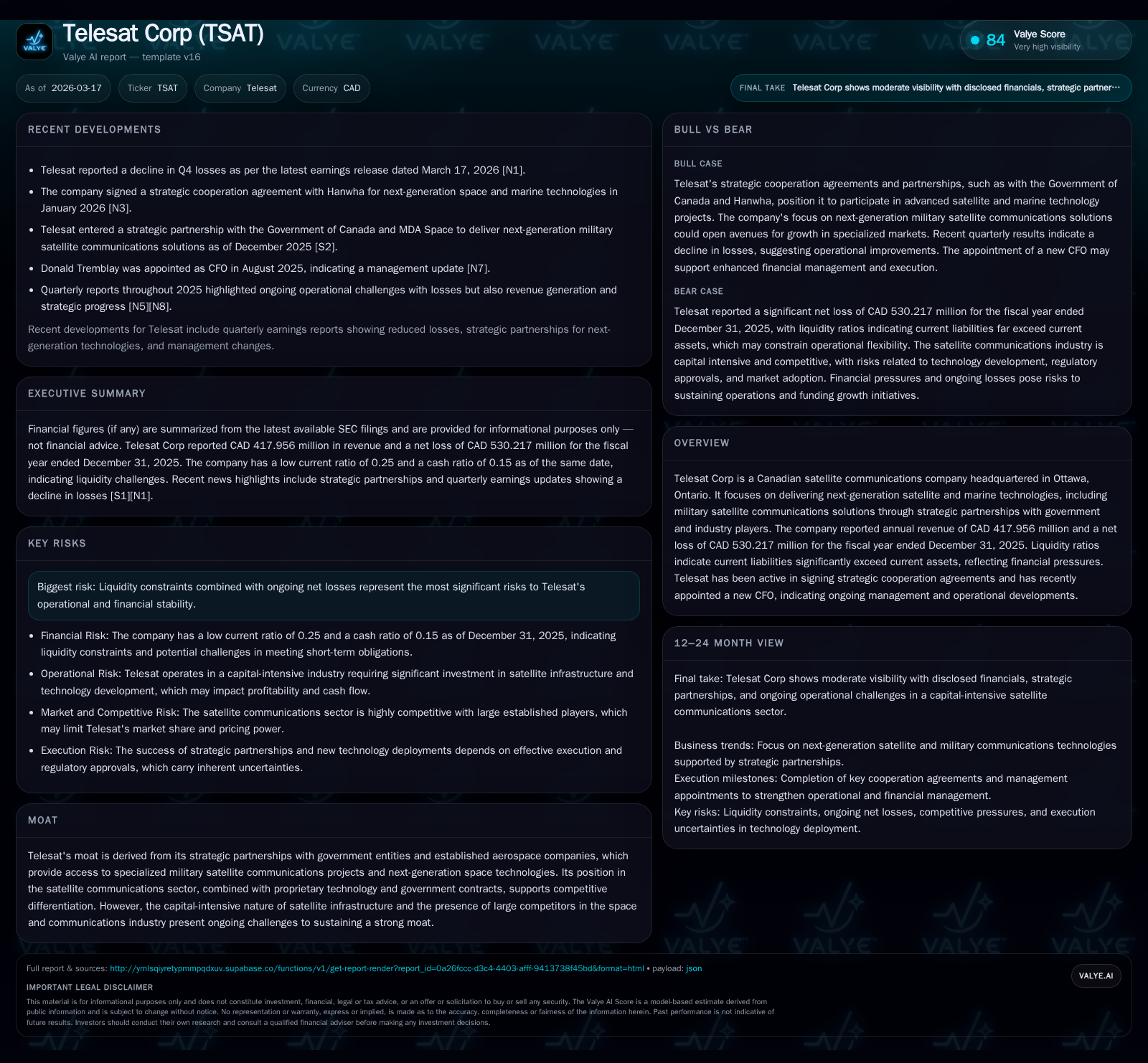
Telesat Corp reported a steep revenue decrease of nearly 27% in fiscal year 2025, alongside a widened net loss surpassing CAD 530 million. Despite this financial strain, the company has strategically pivoted towards military Ka-band satellite communications, securing critical partnerships with government and aerospace players to reinforce its competitive moat. Liquidity challenges are acute, reflected by a current ratio near 0.25 and ongoing creditor litigation, offset partially by management’s appointment of a new CFO to address internal controls. Future growth hinges on expansion within defense contracts and deploying next-generation satellite technology, though continued cash flow deficits and sector competition present material risks.
Surface-Level Snapshot: Telesat's Recent Revenue and Loss Trajectory
Fiscal year 2025 marked a significant downturn for Telesat Corp, with reported revenues dropping to CAD 417.956 million — down almost 27% from CAD 571.044 million in the prior year [F1]. This top-line contraction accompanied a steep increase in net losses, which ballooned to CAD 530.217 million from CAD 302.466 million in 2024 [F1]. Such a widening deficit reflects intensifying operational costs and potentially one-off charges associated with restructuring or technology development efforts.
Despite these pressures, quarterly results indicated narrowing losses as noted in recent news reports highlighting improved Q4 performance [N2][N3]. Nonetheless, the full-year metrics illustrate the challenging environment faced by Telesat amidst evolving market dynamics.
Drivers Behind the 2025 Revenue Collapse: Contract, Market, and Operational Factors
Historical revenue trends from FY2022 through FY2025 show consistent declines: CAD 759.169 million in 2022 tapering down cumulatively to the FY2025 figure [F1]. While explicit details around contract lapses or customer churn remain undisclosed, the timing aligns with shifting market demands and intensified competition within satellite communications.
Operationally, Telesat’s investment into advanced technologies likely strained margins as deployment costs preceded revenue realization. However, recently signed strategic cooperation agreements may signal an inflection point; these include collaborations focused on emerging marine and military communication solutions indicating potential stable contract inflows ahead [N2][N3].
Strategic Shift Toward Military Ka-Band and Defense Collaborations
In early December 2025 filings and March 2026 updates, Telesat outlined an expanded focus on military demand for Ka-band spectrum [S9][N2][S2]. Ka-band denotes high-frequency satellite signals offering increased bandwidth critical for modern defense applications requiring secure, low-latency communications.
Telesat’s Lightspeed constellation is being enhanced to incorporate this technology capability through partnerships including the Government of Canada and MDA Space Systems [S9], allowing access to sovereign military bandwidth markets—a niche with high entry barriers afforded by security clearances and technical sophistication.
This strategic realignment could bolster Telesat’s moat by embedding it deeper into government-funded defense projects where procurement cycles are long-term and margins potentially more resilient despite capital intensity.
Liquidity and Capital Structure Under Pressure: A Closer Look at Balance Sheet Classification and Creditor Litigation
On the liquidity front, Telesat faces notable challenges as of December 31, 2025: current assets totaled CAD 832.058 million against current liabilities over CAD 3.317 billion yielding an alarming current ratio of roughly 0.25 [F1]. This severely constrained liquidity position heightens short-term solvency risks.
Further complicating matters is ongoing creditor litigation reported at various points through late 2025 and early 2026 filings [S4][S5][S6][S7], underscoring strained relations with debt holders or suppliers possibly triggered by delayed payments or covenant breaches.
Additionally, the company disclosed a material weakness in internal control over financial reporting related particularly to balance sheet classification errors involving derivative liabilities linked to Lightspeed financing warrants [S1]. Although misclassification did not affect net income or compliance ratios materially, this reveals governance vulnerabilities affecting investor confidence.
Management Changes and Governance: The Arrival of a New CFO and Implications for Internal Controls
Amid these challenges, Telesat appointed a new Chief Financial Officer recently as per March 17, 2026 announcements [N2][S1], signaling active management response toward shoring up financial oversight.
The new leadership appears tasked explicitly with remediating identified material weaknesses by designing formal processes for technical accounting review and reinforcing disclosure controls. This governance enhancement aims to improve transparency and timely financial communication crucial for market credibility during restructuring phases.
Future Growth Catalysts Linked to Satellite Tech Innovation and Government Partnerships
Telesat’s near-term growth prospects pivot largely on executing its military contractual roadmap linked to Lightspeed constellation enhancements integrating Ka-band capabilities [N2][S2]. Key milestones include scheduled satellite launches and potential multi-year defense contracts expected to lift recurring revenue streams.
While explicit forward guidance remains sparse in public filings, watchers should monitor contract awards pipeline updates and launch timetable adherence as leading indicators of recovery momentum.
Government partnerships underpinning these efforts provide a competitive edge given restricted access to secure military spectrum bands—an area where competitors range from legacy aerospace firms to specialized new-space entrants.
Return Metrics and Capital Allocation Discipline Amid Losses
With FY2025 net losses exceeding half a billion Canadian dollars against equity of approximately CAD 1.77 billion , return on equity is deeply negative at near -30% reflecting heavy write-downs or operating deficits [F1].
Cash flow from operations data was not explicitly provided but liquidity strain suggests cash burn remains elevated relative to inflows. No dividends or share repurchases were declared amid the need to prioritize liquidity preservation according to SEC consistent statements [F1][S1].
Such capital discipline aligns with industry norms where satellite operators typically channel resources into costly capacity build-outs before achieving profitable scale.
Risks Inherent to Cash Flow Deficits and Competitive Industry Landscape
Telesat operates within a capital-intensive industry dominated by large aerospace incumbents wielding extensive government relationships—a formidable competitive backdrop—risk factors cited include liquidity constraints compounded by ongoing losses plus vulnerability stemming from weak internal reporting controls [S1].
Dependence on government contract cycles adds revenue predictability risk; delays or cancellations can materially impact cash flows given fixed cost bases associated with satellite constellation maintenance.
Additionally, regulatory complexities surrounding spectrum allocation coupled with technological obsolescence pressures require continuous R&D investment without guaranteed commercial payoff.
Metric Snapshot: Historical Performance Table & What Investors Should Watch
Historical performance (annual)
| FY | Rev ($mm) | Net ($mm) | Rev YoY | Net YoY |
|---|---|---|---|---|
| 2025 | 418 | -530 | -26.8% | -75.3% |
| 2024 | 571 | -302 | -18.9% | -151.9% |
| 2023 | 704 | 583 | -7.2% | +828.0% |
| 2022 | 759 | -80 |
Source: SEC companyfacts cache [F1].
Capital returns and efficiency (annual)
| FY | ROE% |
|---|---|
| 2025 | -30.0 |
| 2024 | -12.1 |
| 2023 | 24.3 |
| 2022 | -4.4 |
Source: SEC companyfacts cache [F1].
*Year-over-year percentages computed between sequential years.
Key performance watchers should track upcoming contract announcements related to Ka-band deployments alongside quarterly liquidity metrics for signs of stabilizing cash flow. Progress on internal control remediation may also influence investor sentiment positively.
This analysis synthesizes Telesat Corp’s recent filings and news releases up to March 17, 2026 without projecting future valuation or investment recommendations.
Disclaimer: This is research-only, informational analysis and not investment advice. It may include AI-generated interpretation and general industry context. Always verify important details using primary sources.

Comments