
QNB Corp’s Financial Trajectory Highlights Expansion and Capital Efficiency
QNB Corp has demonstrated consistent growth with a strong local banking model, supported by prudent capital management and an impending merger expected to enhance scale and capabilities.
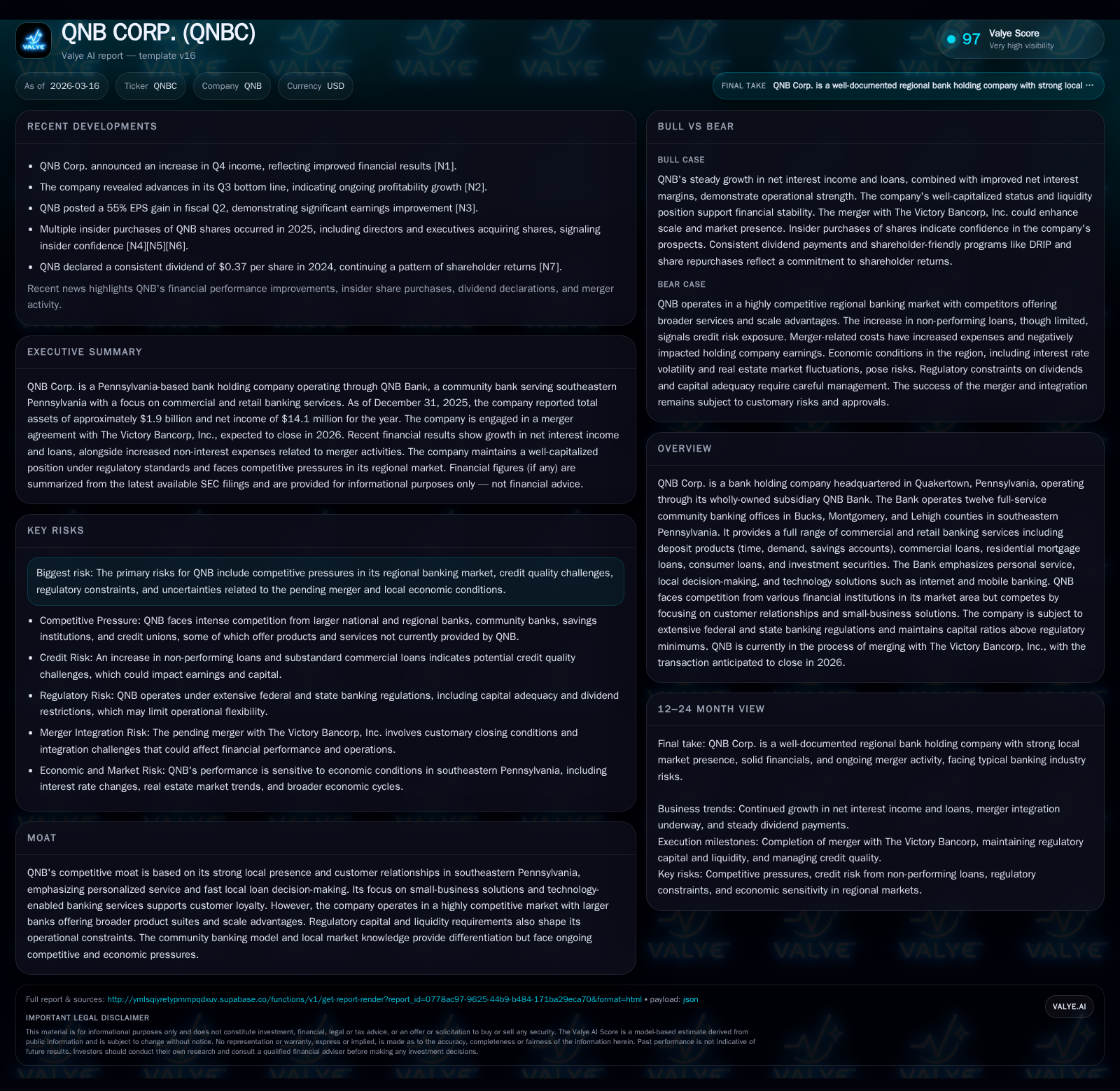
QNB Corp., a community-focused bank serving southeastern Pennsylvania, has steadily expanded its earnings driven by commercial and retail banking strengths. The company's financial profile shows expanding loan portfolios balanced by deposit growth and improved liquidity, with capital ratios comfortably above regulatory minima. A pending merger with Victory Bancorp aims to leverage regional consolidation benefits while maintaining local decision-making agility. Key risks include competitive intensity and regulatory oversight, but capital discipline and customer relationships underpin QNB’s resilience.
Historical Growth: Solid Profits Backed by Local Market Intimacy
QNB Corp.’s financial trajectory over recent years underscores resilient profitability emerging from its community banking roots in southeastern Pennsylvania. The company reported net income of $3.98 million for FY2025, representing a substantial increase of approximately 30.5% year-over-year from $3.05 million in FY2024 [F1]. This earnings growth correlates strongly with expanded lending activities targeting small businesses and local residents, reflecting the bank’s strategic focus on deepening existing customer relationships within Bucks, Montgomery, and Lehigh counties [S1][S2]. Operating cash flow remained robust at $16.6 million in FY2025, marking a slight increase over prior years and signaling stable cash generation capabilities supportive of ongoing operations [F1].
Such profitable expansion can be attributed to QNB’s emphasis on personalized service that fosters customer loyalty coupled with agile local credit decision-making processes allowing responsiveness to community needs. This approach has enabled asset base growth alongside improving returns despite challenges posed by intense competition among regional lenders.
Evolving Financial Profile: Loan and Deposit Dynamics Reflecting Strategic Focus
The evolution of QNB’s balance sheet reflects purposeful management of asset composition aligned with local market dynamics. Total loans receivable stood at approximately $1.26 billion as of year-end 2025 (per internal filings), driven predominantly by commercial real estate loans—covering office buildings, industrial facilities, retail spaces—and residential mortgages secured by first-lien properties [S1][S29]. Notably, commercial loans increased by over $23 million mid-2025 as part of strategic growth initiatives targeting small business segments [S7]. Retail lending also grew modestly with home equity lines expanding alongside mortgage originations retained on balance sheet due to attractive yields compared to secondary market alternatives.
On the funding side, QNB benefits from a diversified deposit structure emphasizing lower-cost core deposits including non-interest-bearing demand accounts as well as interest-bearing categories such as money market accounts and time deposits. Municipal deposits have emerged as an important incremental source of liquidity totaling about $187.5 million during the first nine months of 2025; these funds generally exhibit seasonal volatility tied to tax receipts but support loan funding needs while enhancing net interest margins by avoiding higher-cost borrowings from the Federal Home Loan Bank (FHLB) system [S4][S5][S7]. Short-term borrowings decreased over recent periods alongside repayment of longer-term debt obligations highlighting conservative liability management.
Strategic Merger with Victory Bancorp: Deal Details and Market Implications
A transformative element shaping QNB's near-term outlook is its agreed-upon merger with Victory Bancorp Inc., announced September 2025. Regulatory approvals were secured by February 25, 2026, positioning the transaction for completion in the second quarter of 2026 subject to standard closing conditions [S3][S10]. Under the terms, Victory will merge into QNB with QNB remaining as the surviving entity while their respective subsidiary banks will consolidate similarly.
This deal is strategically designed to create greater economies of scale across overlapping southeastern Pennsylvania markets where both banks operate community bank models emphasizing personal service but currently pose competitive pressures individually owing to scale disadvantages versus larger regional institutions. The combined entity is expected to leverage expanded market presence without compromising swift local lending decisions—a critical competitive advantage—and aims for cost synergies through consolidated back-office functions and enhanced technological platforms [S1][S3].
Competitive Advantages Rooted in Community Banking and Technology Integration
Despite operating within a crowded financial services environment comprising national banks, regional players, specialized savings institutions, and credit unions, QNB distinguishes itself through dedicated client relationship management (CRM) practices that prioritize personal attention across all points of contact [S10]. The bank maintains flexibility in tailoring products toward small business lending needs—a segment often underserved by larger banks seeking scale-centric deals—and couples that with technology-enabled features such as internet and mobile banking applications which enhance customer convenience without sacrificing service quality [S1][S2]. This blend helps maintain customer retention amid pricing pressures observed in competitive loan origination markets.
Regulatory Environment and Capital Adequacy: Navigating Constraints
A key pillar underpinning QNB’s operational stability is its disciplined approach toward regulatory capital compliance amidst evolving supervisory frameworks. At December 31, 2025, QNB reported strong capital ratios including a Tier 1 capital ratio of approximately 12.39%, total risk-based capital at nearly 15.86%, and leverage ratios exceeding 9%, each substantially surpassing thresholds defining “well-capitalized” status under Basel III guidelines enforced by federal regulators [S6][S12][S14].
Although eligible for Community Bank Leverage Ratio (CBLR) framework which simplifies regulatory metrics for smaller institutions under $10 billion in assets, QNB has opted not to adopt this alternative pathway presently preferring traditional capital adequacy measures that better align with its strategic risk profile [S6]. Maintaining this buffer enables continued dividend payments without restriction while providing resilience against credit or economic cycles impacting asset quality.
Capital Allocation Assessment: Dividends, Cash Flows, and Equity Returns
Return on equity for FY2025 approximated 3.1%, reflecting typical ranges for community banks balancing expansion investments against modest profitability relative to larger-scale peers [F1][S15]. This figure aligns with bank holding company norms emphasizing reliable earnings rather than aggressive risk-taking.
Dividend distribution practices demonstrate consistent shareholder returns amounting to about $5 million annually through FY2025 after steady increases in prior years; these payouts are funded comfortably by operating cash flows which totaled $16.6 million in the same year—highlighting ample liquidity coverage supporting both growth initiatives and distributions without excessive leverage build-up [F1][S15]. Share repurchase activity paused recently following buyback programs authorized but used sparingly since inception.
Key Financial Metrics Table: A Snapshot of Recent Years’ Performance
Historical performance (annual)
| FY | Net ($mm) | CFO ($mm) | Net YoY |
|---|---|---|---|
| 2025 | 4 | 17 | +30.5% |
| 2024 | 3 | 16 | +169.0% |
| 2023 | 1 | 14 | -79.2% |
| 2022 | 5 | 17 |
Source: SEC companyfacts cache [F1].
Capital returns and efficiency (annual)
| FY | Div ($mm) | ROE% |
|---|---|---|
| 2025 | 5 | 3.1 |
| 2024 | 5 | 3.0 |
| 2023 | 5 | 1.2 |
| 2022 | 4 | 7.7 |
Source: SEC companyfacts cache [F1].
Note: Net income YoY reflects percentage change from prior fiscal year as per company filings; financial figures aligned with SEC reported data [F1].
Future Outlook: Growth Opportunities Amid Market and Regulatory Challenges
Looking ahead through an analytical lens, QNB faces a nuanced balance of growth prospects constrained by competitive intensity among regional lenders who benefit from scale advantages and product breadth beyond community offerings currently missing at QNB such as full trust services or insurance products considered ancillary revenue streams elsewhere . Regulatory demands continue shaping capital deployment flexibility requiring cautious calibration between support for loan growth versus maintaining prudential buffers.
The forthcoming merger concretely offers avenues for scale efficiencies alongside expanded product capabilities afforded by Victory Bancorp’s complementary footprint; successful integration could enhance loan origination volumes especially within small business sectors familiar to both franchises while mitigating overlap costs through administrative rationalization.
Nevertheless, external factors such as interest rate dynamics influencing net interest margin variability plus economic developments impacting credit quality remain variables requiring active monitoring given historical upticks in non-performing assets tied primarily to localized commercial credit stress events within portfolio segments tracked by management protective provisions accordingly .
Monitoring Milestones: Critical Factors Ahead of Merger Close
Key near-term focus resides on fulfilling customary conditions precedent associated with merger closure anticipated mid-2026 post-regulatory clearances obtained early that year [S3]. Stakeholders should closely watch announcements related to any adjustments stemming from integration planning outcomes or evolving economic factors that could influence timing or terms.
Additionally, progress on harmonizing operating systems post-merger will serve as an early indicator regarding realization of synergy goals touted during deal announcement phases—a vital signal concerning sustained shareholder value creation absent dilution effects.
This analysis compiles information strictly anchored on available filings as processed without speculative assumptions or investment guidance disclosure.
Disclaimer: This is research-only, informational analysis and not investment advice. It may include AI-generated interpretation and general industry context. Always verify important details using primary sources.

Comments