
First Real Estate Investment Trust of New Jersey Balances Steady Rental Income Against Refinancing Risks
FREIT maintains stable income from its diversified portfolio while managing concentrated debt maturities and commercial tenant challenges.
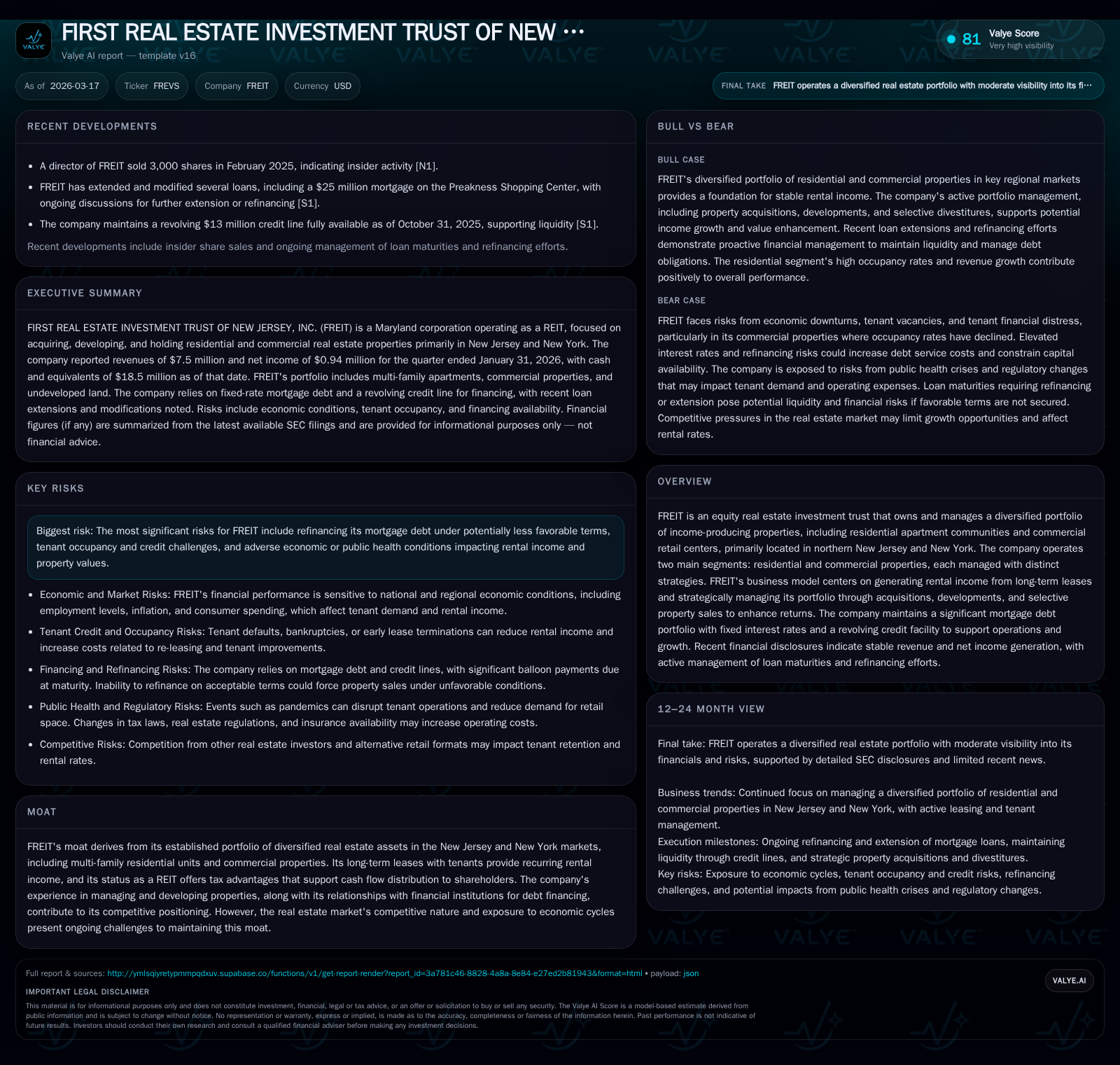
First Real Estate Investment Trust of New Jersey, Inc. (FREIT) operates a mixed residential and commercial property portfolio primarily in northern New Jersey and New York, generating steady rental income with modest growth throughout recent years. The company’s financial performance shows consistent operating income expansion but a significant drop in operating cash flows in Fiscal 2025, combined with lower capital expenditure levels. Its capital structure includes substantial fixed-rate mortgage debt with looming balloon payments that pose refinancing risks amid higher interest rates. Management’s strategic focus on selective acquisitions, redevelopment of challenged commercial assets, and disciplined dividend payout reflects an approach balancing income stability with cautious risk management.
Business Overview
First Real Estate Investment Trust of New Jersey, Inc. (FREIT) is an externally managed REIT focused on acquiring, developing, and managing a diversified portfolio of residential apartments and commercial retail centers primarily located in northern New Jersey and New York [S1][S16]. The company's business model hinges on generating reliable rental income under long-term lease contracts across two distinct segments: residential and commercial properties.
Since its founding in 1961 and subsequent corporate reincorporation to Maryland law in mid-2021 [S1], FREIT emphasizes long-term holding strategies while selectively divesting underperforming assets or those misaligned with its portfolio aims [S16]. Its real estate holdings benefit from tax advantages inherent in the REIT structure which requires distribution of at least 90% of taxable income to shareholders [S14].
Historical Performance
Over the past several fiscal years ending October 31, FREIT has exhibited slow but steady revenue growth driven by stable occupancy levels and relatively resilient rental rates across its residential units despite broader economic headwinds such as rising inflation and elevated mortgage rates [S1][F1].
Historical performance (annual)
| FY | Rev ($mm) | Net ($) | CFO ($mm) | OpInc ($mm) | Rev YoY | Net YoY |
|---|---|---|---|---|---|---|
| 2025 | 8 | 1122000 | 6 | 15 | +4.0% | +7.9% |
| 2024 | 7 | 1040000 | 20 | 15 | +1.5% | +58.5% |
| 2023 | 7 | 656000 | 3 | +1.5% | +218.4% | |
| 2022 | 7 | -554000 | 7 |
Source: SEC companyfacts cache [F1].
Capital returns and efficiency (annual)
| FY | Div ($mm) | FCF ($mm) | ROE% |
|---|---|---|---|
| 2025 | 7 | 6 | 3.3 |
| 2024 | 1 | 20 | 3.1 |
| 2023 | 14 | 2 | 2.7 |
| 2022 | 54 | 7 | -2.1 |
Source: SEC companyfacts cache [F1].
Revenue increased approximately four percent year-over-year into fiscal year 2025 [F1], reflecting mostly stable rents particularly within the residential segment where average rents have shown resilience despite broader market softening [S1]. Operating income grew marginally (+0.8%) indicating effective expense management alongside revenue gains.
Conversely, operating cash flow declined substantially (-69%) between fiscal years ending in October 2024 and October 2025 [F1], attributed mainly to timing differences in receivables and payables along with tenant payment cycles impacted by economic pressures [S1]. Capital spending contracted sharply (-89%) indicating deferment or completion of capital projects [F1]. The company continues focused on cost discipline amid slower market conditions.
Net income improved nearly eight percent YoY reaching just over $1 million USD though margins remain tight given exposure to financing costs and occupancy variability [F1]. Despite modest profitability levels relative to asset base reflected in a roughly estimated ROE of about three percent, the company sustains dividends consistent with its REIT obligations totaling over seven million USD in FY25 [F1][S14].
Portfolio Composition and Segment Performance
FREIT's portfolio encompasses multi-family residential communities alongside commercial retail centers with different operational characteristics: the former generally benefits from steady demand due to housing needs while the latter faces fluctuating occupancy tied to consumer retail trends [S1][S16].
Residential properties maintain positive cash flow overall with average rents showing nominal softening compared to prior periods, although elevated interest rates pose uncertainty for next year’s results [S1]. Commercial properties are unevenly performing; centers like Franklin Crossing and Glen Rock report healthy occupancy and net operating incomes whereas Westwood Plaza and Preakness face elevated vacancies prompting active leasing efforts and exploration of redevelopment opportunities [S1][S7].
Such contrasts underscore challenges stemming from competitive pressures on retail tenants exacerbated by e-commerce growth and tariff-related cost inflation impacting operators’ profitability [S26]. Lease agreements are mostly long-term favoring recurring revenue but tenant turnover risk exists especially amid shifting economic conditions.
Debt Profile and Refinancing Risks
A critical factor shaping FREIT's financial profile is its mortgage debt portfolio totaling approximately $121 million at October 31, 2025 carrying fixed interest rates averaging around 5.34%, with weighted-average maturity near just over one-and-a-half years [S4][S8]. Many loans have amortization schedules longer than their terms resulting in substantial balloon payments due within short horizons:
- Approximately $60.6 million due within one year,
- An additional $34.2 million due within two to three years,
- Remaining balances spread through years four to five [S8][S12].
Among these exposures is a notable $25 million loan on Preakness Shopping Center that matured August 1, 2025 but remains under negotiation for extension or refinancing; similar arrangements apply for other properties such as Westwood Plaza where management secured extensions or restructuring at higher interest costs [S9][S18][S21].
The company maintains a revolving credit facility totaling $13 million secured against select properties with no current borrowings outstanding and favorable renewal terms through October 31, 2026 offering liquidity flexibility for working capital needs or opportunistic transactions [S4][S23].
Interest rate swaps have been utilized by FREIT to hedge variable-rate loan exposure converting floating costs into fixed rates mitigating volatility risk; mark-to-market adjustments are reflected under comprehensive income without direct net income impact though early termination risks exist if market rates shift significantly [S19][S21].
Overall, FREIT’s refinancing prospects hinge on ability to negotiate extensions amid potentially higher prevailing rates that could elevate debt service burdens or compel asset disposals if unfavorable terms arise [S6]. Continuous monitoring of covenant compliance remains critical given tight margins.
Capital Allocation & Returns
FREIT adheres to REIT distribution mandates guaranteeing most taxable income passes through dividends; total dividend payments rose noticeably from roughly $1.49 million in fiscal ’24 to above $7 million in fiscal ’25 despite limited net income growth highlighting reliance on payout funded partially through financing activities or sale proceeds when necessary [F1][S14].
Capital expenditure spending remained restrained at just $27 thousand USD for fiscal ’25 compared to prior levels signifying a conservative reinvestment approach likely driven by cautious outlooks and cost control imperatives [F1][S12]. This dynamic supports near-to-medium term free cash flow generation estimated around $6.22 million for the latest reporting period excluding acquisition activity.
Equity rose marginally year-over-year reaching about $34 million reflecting retained earnings accumulation balanced against distributions; approximate return on equity calculated near three percent signals moderate profitability given asset scale but constrained room for expansion absent accretive investments or operational improvements [F1].
Management historically employs selective asset sales and joint ventures as tactical tools for enhancing portfolio returns and returning capital while preserving core holdings aligned with strategic priorities [S16].
Industry Context & Risks Analysis
The REIT operates within a competitive landscape marked by rival institutional owners targeting similar geographic markets often wielding greater capital capacity intensifying bidding pressure on acquisition targets or leading tenants toward more favorable leases elsewhere . Retail tenants confront increasing threats from digital commerce necessitating adaptive leasing strategies including redevelopment or repurposing options.
Moreover, macroeconomic conditions characterized by persistent inflationary pressures alongside recent Federal Reserve rate cuts yet still-elevated mortgage financing costs introduce uncertainty regarding valuation stability and tenant demand intensity particularly across cyclically sensitive commercial segments [S1]. Unexpected tenancy defaults attributable to economic downturns or health crises remain ongoing risks potentially affecting rental streams abruptly.
The large concentration of balloon maturities within a compressed timeframe amplifies refinancing risk heightening vulnerability should access be constrained or terms deteriorate forcing distress sales or increased leverage costs detrimental to earnings quality . Expense variability linked largely to professional advisory fees suggests cautious expense monitoring remains warranted.
Outlook Considerations
While explicit forward guidance is not provided beyond reaffirmations concerning lease renewals, refinancing negotiations, and dividend policy review frequency, key watch points include:
- Progress resolving loan maturity extensions specifically Preakness Shopping Center's $25M loan,
- Leasing velocity improvements at lower occupancy commercial centers,
- Trends in residential rent renewals amid evolving market affordability,
- Movement in operating cash flows relative to tenant collection performance,
- Any indications of capital deployment shifts from acquisitions or strategic dispositions,
- Potential changes in dividend declarations reflective of earnings cadence,
- Broader economic signals impacting financing availability including interest rate fluctuations.
These variables will critically influence FREIT’s capacity to sustain stable distributions alongside balanced reinvestment supporting medium-term portfolio appreciation prospects.
This analysis is based solely on publicly available information from SEC filings through March 2026 ([F1]–[S29]) supplemented by domain knowledge relevant as of this date; it does not represent investment advice nor an endorsement of securities mentioned herein.
Disclaimer: This is research-only, informational analysis and not investment advice. It may include AI-generated interpretation and general industry context. Always verify important details using primary sources.

Comments