
SECURITY NATIONAL FINANCIAL’s Tripartite Model and Steady Growth in 2025
Analyzing the interplay of Security National Financial's life insurance, cemetery and mortuary, and mortgage segments driving its financial trajectory.
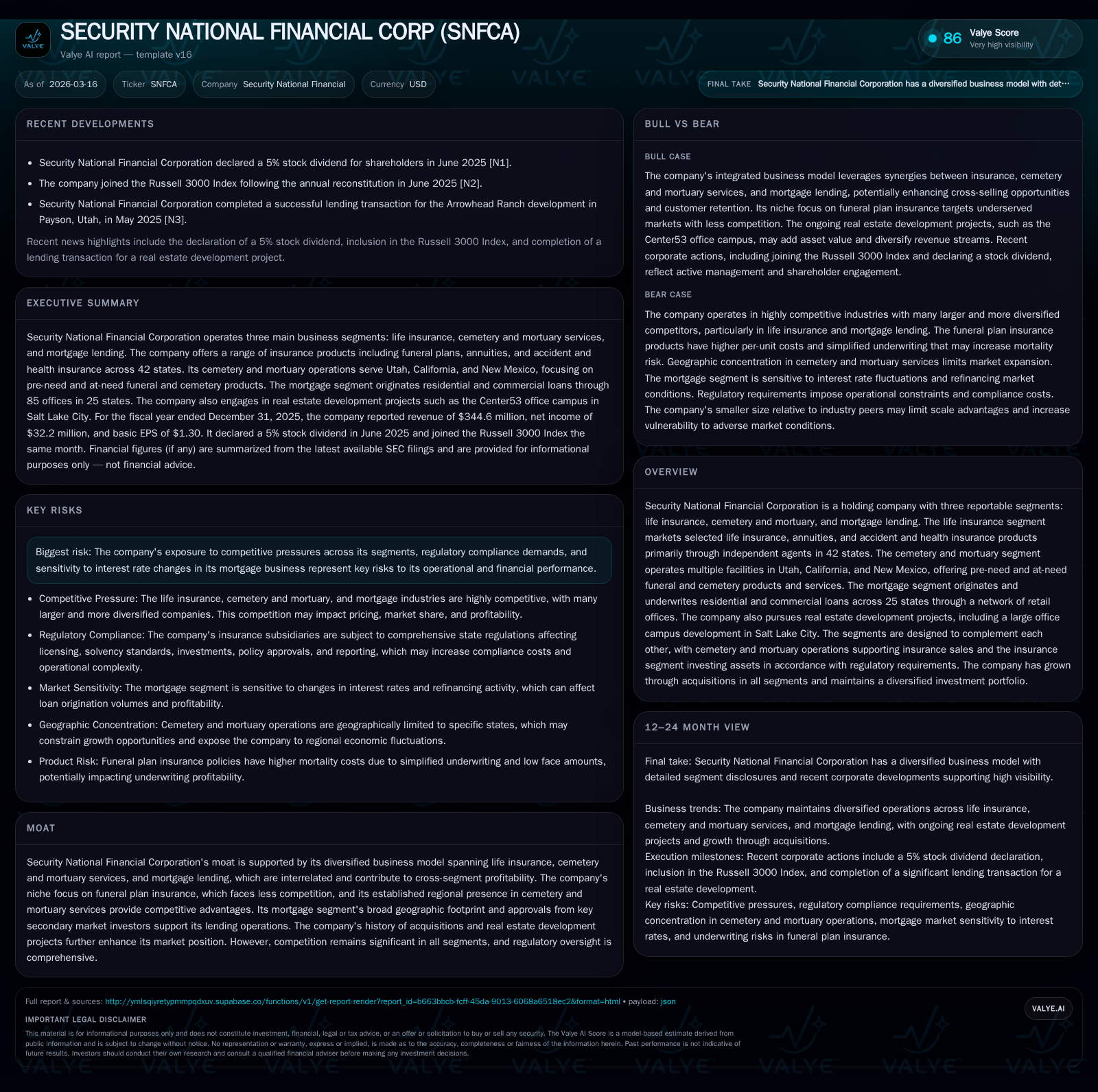
Security National Financial Corporation leverages its diversified business encompassing life insurance, cemetery and mortuary operations, and mortgage lending to deliver steady top-line growth and improved profitability in 2025. Its niche focus on funeral plan insurance and a broad mortgage footprint confer competitive advantages despite regulatory and interest rate challenges. The company sustains capital discipline with moderate buybacks and consistent stock dividends while pursuing real estate development projects poised to contribute to future growth.
Historic Growth Patterns Across Core Segments
Security National Financial Corporation experienced moderate revenue growth of approximately 3% in FY2025, reaching $344.6 million after recovering from a sharp decline seen in FY2022 where revenues dropped substantially (see Table below). Net income rose robustly by 21.2% year-over-year to $32.2 million, signaling gains in operational efficiency or cost management despite only mild top-line expansion. Operating cash flow (CFO) declined by roughly 20.6%, settling at about $45.5 million in FY2025 but still providing healthy cash generation given controlled capital expenditures (capex) that fell about 31.5% compared with the prior year. The company's return on equity (ROE), calculated from net income relative to equity of $410.4 million at year-end, stood near 7.8%, indicating steady though not aggressive profitability.
Historical performance (annual)
| FY | Rev ($mm) | Net ($mm) | CFO ($mm) | Capex ($mm) | Rev YoY | Net YoY |
|---|---|---|---|---|---|---|
| 2025 | 345 | 32 | 46 | 2 | +3.0% | +21.2% |
| 2024 | 335 | 27 | 57 | 2 | +5.0% | +83.1% |
| 2023 | 318 | 14 | 54 | 1 | -18.3% | -43.6% |
| 2022 | 390 | 26 | 130 | 2 |
Source: SEC companyfacts cache [F1].
Capital returns and efficiency (annual)
| FY | Buybacks ($mm) | FCF ($mm) | ROE% |
|---|---|---|---|
| 2025 | 2 | 44 | 7.8 |
| 2024 | 3 | 55 | 7.8 |
| 2023 | 3 | 53 | 4.6 |
| 2022 | 8 | 129 | 8.8 |
Source: SEC companyfacts cache [F1].
Table: Summary of SNFCA Annual Financials FY2022-FY2025 sourced from [F1]
Synergistic Business Model Fuels Cross-Segment Profitability
At the heart of SNFCA’s competitive positioning lies its integrated tripartite business model comprising life insurance, cemetery and mortuary services, and mortgage lending, each designed to mutually reinforce profitability across divisions [S1][S3][S7]. The cemetery and mortuary segment enhances brand visibility through local footprint penetration that indirectly supports marketing efforts for funeral plan insurance policies sold by the life insurance segment’s commissioned sales force—often dual-licensed agents who leverage funeral home relationships to cross-sell insurance products.
The life insurance segment reinvests assets generated by pre-need funeral contracts into investment portfolios compliant with state insurance department mandates, creating a circular value stream benefiting both operational expenses and underwriting reserves [S1]. Meanwhile, the mortgage segment contributes complementary revenue streams by providing residential and commercial loan origination through its broad retail platform spanning roughly twenty-five states; these loans also yield real estate-related investment opportunities for the holding via asset acquisitions or developments.
This synergy specifically exploits niches less contested elsewhere—especially in funeral plan insurance where fewer insurers compete due to underwriting complexity and small policy face amounts—while expanding reach into mortgage markets backed by approvals from significant secondary market investors like HUD and Fannie Mae.
Mortgage Lending: Market Footprint and Competitive Dynamics
SecurityNational Mortgage operates an extensive network of around eighty-five retail offices across twenty-five states with particularly strong origination footprints in Utah, Florida, Texas, Nevada, and Arizona [S4][S6]. Its status as an approved FHA lender under HUD programs and seller/servicer approvals from Fannie Mae facilitates access to broader secondary market capital essential for competitive pricing structures.
Despite these advantages, the mortgage segment contends with intense competition from national banks, regional lenders, and specialized mortgage companies operating within overlapping geographic locales. Interest rate fluctuations significantly impact refinancing volumes—a highly rate sensitive sub-market—thereby introducing revenue volatility risk that necessitates prudent balance sheet management [S6].
Cemetery and Mortuary Operations: Regional Strengths and Challenges
SNFCA's cemetery and mortuary operations principally serve Utah (eleven mortuaries, five cemeteries), California (one cemetery), and New Mexico (one cemetery plus four mortuaries), focusing geographically within approximately a twenty-mile radius around facilities—a common industry practice limiting market scope but allowing concentrated brand presence [S3][S6]. These services encompass both pre-need (purchased before death via contracts) and at-need sales occurring at time of service demand.
Pre-need sales support cash flow stability through advance payments often accompanied by corresponding funeral plan insurance policies funded via life insurance products sold by commissioned agents operating within the same service regions [S3]. However, pricing pressures mount as municipal-owned cemeteries engage in localized competition offering lower-cost alternatives which private operators cannot match without sacrificing margins.
The company incurs higher costs operating an active pre-need sales force compared with municipal peers who typically do not sell through commissioned representatives; nevertheless SNFCA asserts competitiveness of its pricing relative to other private entities within its markets [S6]. Efficient management of pre-need commissions remains critical given its sizable compensation burden but also constitutes an essential driver of cross-segment profitability.
Life Insurance Segment: Product Lines and Distribution Channels
The life insurance business centers on selected lines including funeral plans—a principal focus—and interest-sensitive life policies alongside limited accident and health coverage [S1][S10]. Funeral plans involve small-face-value policies designed primarily to cover immediate final expenses post-death with face amounts generally capped near $30,000 representing a distinct market niche characterized by lower competition but higher mortality risk due to simplified underwriting methods.
Distribution relies heavily on a commissioned sales force comprised mainly of independent licensed agents authorized across forty-two states who market these products alongside third-party competitors’ offerings [S10]. Commissions range broadly from approximately fifty percent up to one hundred fifty percent of first-year premiums reflecting incentive alignment strategies customary within life insurance brokerage models.
Challenges arise given that larger insurers boast greater capital resources paired with more extensive product suites supporting broader client coverage needs; however SNFCA mitigates this disadvantage via targeted marketing emphasizing niche funeral plans sold primarily to middle-aged or older customers concentrated notably in Arkansas, California, Florida, Georgia, Louisiana, Mississippi, Tennessee, Texas, and Utah [S19].
Real Estate Development Initiatives Impacting Future Growth
Beyond core operating segments, SNFCA invests strategically in real estate development projects leveraging existing property holdings including an ambitious multi-phase office campus named Center53 located near central Salt Lake City composed initially of two completed six-story buildings totaling over four hundred thousand square feet plus parking infrastructure supporting nearly sixteen hundred vehicles—the complex is currently leased above ninety percent occupancy levels for initial phases completed since mid-2017 through late 2021 [S4][S9].
This phased development initiative represents diversification outside traditional financial services offering potential upside as leasing activity matures though it carries longer investment horizons reflective of commercial real estate cycles unaligned directly with near-term revenue forecasts discussed herein.
Financial Metrics: Revenue, Income, Cash Flow & Capital Returns
As highlighted earlier based on audited SEC filings [F1], SNFCA’s fiscal year results for FY2025 exhibit:
- Revenue: $344.6 million (+3% YoY)
- Net Income: $32.2 million (+21% YoY)
- Operating Cash Flow: $45.5 million (-20% YoY)
- Capital Expenditures: $1.69 million (-31% YoY)
- Approximated ROE: ~7.8%
Free cash flow calculates roughly $43.8 million equating CFO minus capex—a robust figure reflecting solid operational efficiency despite pressure on cash flows relative to previous years when elevated CFO was recorded likely related to timing differences or extraordinary items in FY2022.
Buybacks have tapered notably from peak repurchase levels exceeding $7 million annually down to near $1.6 million last fiscal year suggesting more conservative capital allocation alongside stable dividend issuance practices detailed next.
Capital Deployment: Dividends, Share Repurchases, and Investment Priorities
SNFCA maintains a consistent track record of rewarding shareholders principally via regular stock dividends issued annually at approximately five percent rates continuing uninterrupted since early nineties except heightened distributions in pandemic-era adjustments during FY2020 [S22][S28]. This demonstrates commitment toward shareholder value preservation through equity returns complementing measured share repurchase programs which declined progressively reflecting cautious balance sheet stewardship amid macroeconomic uncertainties.
Investment priorities include ongoing support for the Center53 project alongside smaller residential developments aligned with assessing external demand factors before committing substantial incremental capital outlays per disclosed strategy remarks [S4][S9]. Modest leverage levels indicated by robust equity base allow room for opportunistic acquisitions or expansions subject to board discretion.
Regulatory and Competitive Risk Landscape
Given its diverse operational reach Security National Financial faces intensive regulatory scrutiny across all three core verticals:
- Insurance subsidiaries comply with numerous state-level solvency standards enforced by state insurance commissioners supplemented by requirements regarding licensing agents/distributors; policy form approval; reserve establishment; regularly scheduled financial exams every three-to-five years; prior notifications needed for intercompany transactions deemed extraordinary; quarterly/annual reporting duties imposed under varied jurisdictional statutes among others [S5][S9][S14][S16].
- Cemetery/mortuary operations fall under Federal Trade Commission rules governing funerary businesses plus relevant state licensure regimes coupled with municipal ordinances managing facility operations including endowment care funds oversight ensuring long-term maintenance commitments are met per legal mandates [S14].
- Mortgage units must adhere strictly to U.S Department of Housing & Urban Development regulations along with Consumer Financial Protection Bureau oversight covering loan origination practices including broker licensing; underwriting standards; audits verifying fee structures plus disclosures designed to protect consumer interests affecting compliance costs materially though supporting reputational integrity crucial for accessing key secondary markets [S14].
Competitive threats remain salient due to entrenched market participants possessing larger scale or municipal status especially pronounced within cemetery/mortuary vertical where price wars occasionally ensue given some municipally owned providers enjoy ability to subsidize via tax revenues limiting feasible private operator margins [S6]. Interest rate volatility particularly impacts mortgage volume streams presenting an inherent sensitivity risk requiring disciplined portfolio risk management measure refinement as macroeconomic conditions evolve beyond company control factors.
Conclusion
Security National Financial Corporation exploits its interconnected tripartite business design combining life insurance focused on niche funeral plans, regionally concentrated cemetery/mortuary services generating essential public engagement channels driving cross-sales along with a geographically diversified mortgage origination platform leveraging key secondary market investor approvals for loan sales funding support—all while supplementing growth prospects via commercial real estate developments.
Robust revenue recovery following prior cyclical dips paired with profitability improvement evidenced through doubled-digit net income gains underscore operational strengths even as cash flow softness moderates free cash generation somewhat. Capital deployment balances stockholder return through longstanding dividend schemes complemented by selective buybacks amid prioritized reinvestment into developmental real estate ventures reflecting prudent but opportunistic stewardship geared toward medium-term expansion potential. Comprehensive regulatory frameworks impose ongoing compliance costs offset partly by specialized niche market positioning mitigating direct price-based rivalry pressure though competitive vigilance remains imperative. This confluence renders Security National Financial well-positioned within its target markets while facing typical risks associated with interest rate regimes alongside sector-specific competitive dynamics characteristic of multi-industry financial service enterprises.
This analysis is intended solely for informational purposes based on publicly available data without providing investment advice or recommendations.
Disclaimer: This is research-only, informational analysis and not investment advice. It may include AI-generated interpretation and general industry context. Always verify important details using primary sources.

Comments