
Kalaris Therapeutics Advances Retinal Drug Development with TH103 Amid Clinical and Financial Tests
Kalaris progresses its novel VEGF trap candidate TH103 through early clinical trials while managing operational and financial challenges in a competitive retina therapy space.
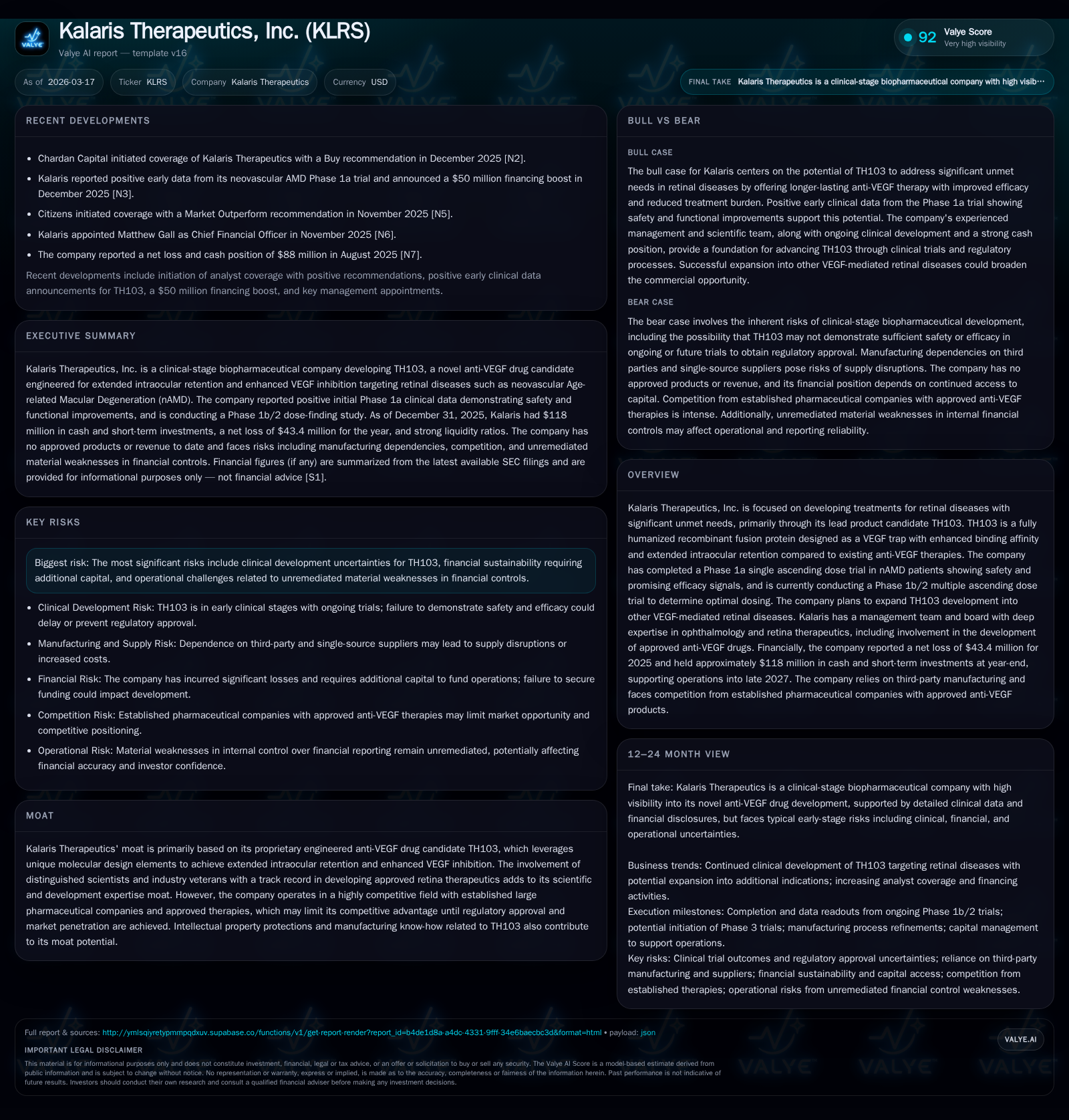
Kalaris Therapeutics is advancing its lead product candidate, TH103, a fully humanized recombinant fusion protein designed as a next-generation VEGF trap for neovascular age-related macular degeneration (nAMD). Following promising safety and initial efficacy signals from a Phase 1a single ascending dose trial, the company is now engaged in a Phase 1b/2 multiple ascending dose study aimed at optimizing dosing for potential pivotal trials. Despite the clinical progress, Kalaris faces significant financial headwinds with ongoing operating losses and the need for further capital amid complex regulatory and market dynamics. The evolving FDA pathway, intellectual property considerations, and competitive pressures characterize the critical phase of transition confronting the company.
From Concept to Clinical: The Evolution of TH103 and Early Performance Milestones
Kalaris Therapeutics has positioned TH103 as a next-generation anti-VEGF agent specifically engineered to address significant unmet needs in retinal diseases dominated by neovascular pathology. At its core, TH103 is a fully humanized recombinant fusion protein functioning as a VEGF trap — a decoy receptor molecule that mimics the highest affinity vascular endothelial growth factor receptor 1 (VEGFR-1) binding properties found naturally in humans. This molecular design aims to enhance binding affinity beyond existing treatments such as aflibercept (Eylea), which itself is a VEGF trap but differs in key molecular features.
Preclinical data disclosed by the company show that TH103 exhibits increased anti-VEGF activity and extended duration relative to aflibercept [S1]. These improvements theoretically translate into longer intraocular retention after intravitreal injection — a critical factor in reducing treatment burden, as current anti-VEGF injections require frequent monthly or bimonthly administration.
The initial human clinical validation occurred through an open-label Phase 1a single ascending dose (SAD) trial involving treatment-naïve patients with neovascular age-related macular degeneration (nAMD). Results announced in December 2025 indicate that TH103 was generally well tolerated across doses tested [S1]. More importantly, functional measures such as best-corrected visual acuity (BCVA) demonstrated improvement at one month post-dose. Additionally, pharmacokinetic profiling from this trial suggests sustained presence of active drug levels potentially enabling less frequent injections compared to current standards. Taken together, these early clinical insights support the underlying science and provide foundational confidence for further development.
Current Trials Spotlight: Phase 1a and Ongoing Phase 1b/2 Dose-Finding Study Insights
Building upon the encouraging Phase 1a results, Kalaris is conducting an ongoing Phase 1b/2 multiple ascending dose (MAD) study designed to evaluate safety, tolerability, and efficacy across multiple doses administered as four monthly loading injections in nAMD patients [S1]. This dose-finding study targets enrollment between approximately 60 and 80 patients — a sample size sufficient to inform optimal dose selection ahead of larger Phase 3 investigations.
This trial’s design reflects typical biopharma development pathways aiming to refine therapeutic windows before confirmatory studies. Identifying an appropriate balance between maximal VEGF inhibition and acceptable tolerability will be key. Preliminary data from this Phase 1b/2 study are anticipated in the first half of calendar year 2027 [S1]. These readouts represent critical inflection points where successful outcomes could de-risk subsequent program stages including pivotal trials and eventual regulatory submissions.
Navigating Competitive Headwinds: Market Context and Unmet Medical Needs in Retinal Therapeutics
The anti-VEGF retinal therapeutics market stands out as one of ophthalmology’s largest segments globally, with estimated global branded revenues exceeding $15 billion in recent years based on public filings for leading products such as Eylea, Vabysmo, Lucentis, and their variants [S1]. Despite these substantial sales figures indicating commercial success for existing agents, real-world challenges persist.
Key among these is the treatment burden linked with frequent intraocular injections — typically every four to eight weeks — which many older or comorbid patients find onerous. Compliance difficulties bear direct consequences on sustained visual outcomes because lapses or delays lead to decline even after initial gains seen in controlled trials. The therapeutic landscape includes newer agents targeting incremental efficacy or dosing convenience but registrational trials often do not conclusively demonstrate reduced injection frequency or improved adherence.
TH103’s promise lies in addressing this treatment durability gap through molecular optimization delivering prolonged intraocular retention while maintaining or enhancing VEGF blockade potency. Such innovations could materially differentiate it from currently marketed drugs if clinical data corroborate these hypothesized benefits [S1].
Financial Trajectory: Analyzing Loss Reduction, Cash Position, and Capital Landscape
Since inception, Kalaris has operated at a loss consistent with early clinical-stage biotech profiles [F1]. Notably in FY2025 operating losses narrowed by roughly 29.5% year-over-year from approximately $65.4 million in FY2024 to $46.15 million [F1]. This marks several consecutive years of improving income statement metrics reflecting measured cost discipline alongside advancing clinical programs.
Net losses similarly improved from $58.7 million in FY2024 to $43.4 million in FY2025 [F1], evidencing parallel outcomes on bottom-line profitability though remaining distant from break-even performance.
Operating cash flow tracked net income patterns closely due primarily to minimal non-cash charges typical for pre-revenue R&D-focused companies. CFO improved from -$67.7 million to -$38.4 million over FY2024–25 [F1], suggesting slower liquidity depletion.
Cash and equivalents at year-end FY2025 were robust at nearly $98.05 million relative to current liabilities of $9.7 million resulting in a strong current ratio exceeding 12x [F1]. This liquidity position supports near-term operational continuity but will require replenishment ahead of later-stage costly trials.
Historical performance (annual)
| FY | Net ($mm) | CFO ($mm) | OpInc ($mm) | Capex ($) | Net YoY |
|---|---|---|---|---|---|
| 2025 | -43 | -38 | -46 | 200000 | +26.1% |
| 2024 | -59 | -68 | -65 | +69.1% | |
| 2023 | -190 | -124 | -200 | -12.9% | |
| 2022 | -169 | -142 | -171 | 26000 |
Source: SEC companyfacts cache [F1].
Capital returns and efficiency (annual)
| FY | FCF ($mm) | ROE% |
|---|---|---|
| 2025 | -39 | -55.1 |
| 2024 | -51.9 | |
| 2023 | -130.6 | |
| 2022 | -142 | -75.1 |
Source: SEC companyfacts cache [F1].
Table Note: Figures sourced from most recent SEC filings show progressive narrowing of losses reflecting financial discipline during early-stage pipeline progression [F1].
Capital Allocation Focus: Operating Losses Drive Cash Burn; Minimal Fixed Asset Investment
Kalaris allocates capital predominantly toward clinical development activities related to TH103 alongside building necessary organizational infrastructure characteristic of emerging biopharmaceutical companies [F1]. Capital expenditures remain nominal (~$200K for FY2025), indicating low investment in fixed assets consistent with outsourced manufacturing or service models typical of biotech startups.
Operating cash flow burn drives liquidity reduction since there are no product revenues yet. Negative free cash flow approximates $38.57 million when subtracting capex from CFO for FY2025 [F1].
The company has not paid dividends nor repurchased shares—a normal posture given pre-commercial stage status with heavy reinvestment required upstream of regulatory approval or revenue generation [F1]. Return on equity stands negative at about -55%, driven by cumulative net losses against shrinking shareholder equity base due to prior operating deficits [F1]. This profile aligns with expectations for clinical stage companies investing heavily before hitting inflection points.
Regulatory and Development Risks: Clinical Uncertainties and Compliance Challenges
Regulatory uncertainties constitute material risks for Kalaris related primarily to future clinical trial outcomes and approval trajectories for TH103 [S4][S5][S10]. Despite positive early-phase data on safety and pharmacokinetics observed so far [S1], succeeding phases must confirm consistent efficacy signals without unmanageable adverse events for marketing authorization prospects.
Operationally flagged material weaknesses in internal controls create an additional layer of risk regarding accurate data reporting and compliance adherence which may affect regulatory interactions or investor confidence if not remediated promptly [S4][S5].
Furthermore, the company faces typical biopharma challenges navigating complex U.S. FDA regulations alongside international bodies should eventual global approvals be pursued.
Pricing pressures coupled with evolving reimbursement landscapes add another dimension where achieving adequate third-party payer coverage remains uncertain even post-approval [S4][S10]. Intellectual property protections underpinning TH103’s unique molecular composition offer some defensive moat but patent litigations or competition from biosimilars continue as possible threats [S12][S20].
Legal proceedings related to merger transactions alleging misrepresentations have been initiated by former AlloVir shareholders but are denied by management without apparent impediment currently; these add uncertainty but have yet constrained corporate activities materially [S19].
Strategic Outlook: Potential Milestones and Expansion Beyond nAMD
Looking forward,the company's primary near-term catalyst centers around releasing preliminary Phase 1b/2 dose-finding data expected within H1 2027[S1], which will shape dose selection confidence ahead of potential late-stage pivotal development.
Success there may trigger scale-up fundraising efforts given trailing cash consumption trends despite current reserves.
Strategically,Kalaris aims to expand TH103’s application beyond nAMD into broader VEGF-mediated retinal disorders which include diabetic macular edema (DME) and retinal vein occlusion subtypes; this pipeline diversification hinges first on validating lead indication results [S1].
Continued mitigation of regulatory risks through enhanced compliance programs along with robust intellectual property enforcement will also be critical pillars supporting long-term value creation.
Practitioners should watch carefully both clinical datasets detailing durability benefits vis-à-vis existing therapiesand management disclosures concerning capital strategy updates that frame runway longevity amid expensive translational research efforts.
This analysis is based solely on available public filings dated as of March 17th, 2026 including SEC disclosures ([S#]) and companyfacts numeric data ([F1]). It does not represent investment advice but aims to provide an informed overview of Kalaris Therapeutics’ operational status within the context of late early-stage biopharmaceutical development dynamics.
Disclaimer: This is research-only, informational analysis and not investment advice. It may include AI-generated interpretation and general industry context. Always verify important details using primary sources.

Comments