
Usio, Inc. Builds Integrated Payment Ecosystem with Cross-Selling as Growth Engine
Usio leverages a unified fintech platform and diverse payments suite to fuel revenue gains while managing profitability and market pressures.
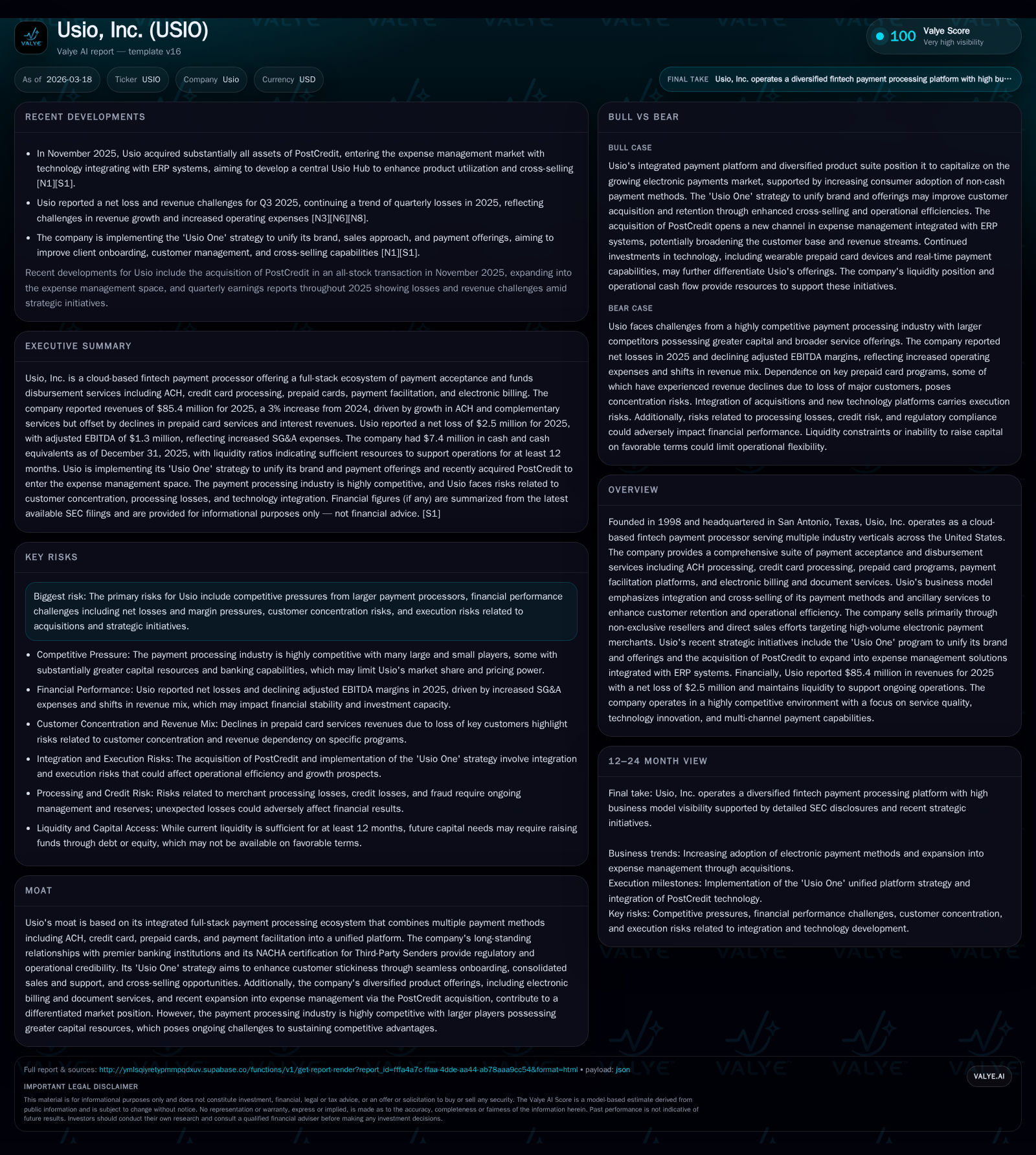
Founded in 1998, Usio, Inc. has evolved from a niche electronic bill presentment provider into a full-stack fintech payment processor covering ACH, credit cards, prepaid cards, and PayFac services across numerous US industries. The company’s 'Usio One' strategy seeks to integrate its offerings tightly, improving onboarding, cross-selling, and customer retention. Over recent years, Usio has demonstrated consistent revenue growth (approximately 12.7% YoY), driven by expanding ACH and complementary services. However, this top-line progress contrasts with recurring operating losses and net losses reflecting margin pressures and elevated SG&A costs. Liquidity remains sufficient for near-term needs, with positive operating cash flows exceeding capital expenditures in 2025. Key risks include competitive forces from larger processors, reseller concentration dependency, acquisition integration challenges, and regulatory/security complexities. Milestones to watch involve successful technological integration of offerings, expansion of real-time payments adoption, and progress toward sustained profitability.
Growth Evolution: From Electronic Bill Presentment to Full-Stack Payment Platform
Usio’s origins rest on electronic bill presentment (EBPP), first introduced in the late 1990s. Since then, the firm expanded its fintech footprint by incorporating Automated Clearing House (ACH) processing and complementary products such as PINless debit (introduced in 2016), Remotely Created Checks (RCC), account validation/inquiry tools (2019), and credit card processing via PayFac technology launched post-2017 acquisition of Singular Payments [S4][S7]. These advances enabled Usio to transform from a narrow ebill service provider into a multi-channel payment processor serving diverse verticals like legal, healthcare, and property management.
The strategic rollout of the PayFac-in-a-Box platform serves app developers and software integrators seeking seamless payment monetization for their downstream merchant bases via API integration covering credit/debit card acceptance, ACH transfers, and prepaid card issuance [S9]. The recent push into Real Time Payments (RTP) starting around 2023 positions Usio to tap higher-value real-time settlement flows alongside traditional slower ACH rails reflecting evolving payments trends [S7]. These incremental product additions collectively support steady year-over-year revenue expansion; for instance, historical figures illustrate growth from about $12 million in revenue during FY2016 to nearly $28 million by FY2019 [F1], yet margins have not kept pace.
Diverse Product Portfolio Driving Customer Retention and Cross-Selling
Central to Usio’s forward strategy is its "Usio One" program aimed at consolidating its scattered payments capabilities under one brand umbrella with unified client onboarding channels. By integrating sales teams and customer support spanning ACH products, credit card processing via PayFac models, prepaid cards including wearable device-linked programs launched in late 2025 [S13], and electronic billing/document services through Output Solutions subsidiary [S14], Usio hopes to increase wallet share per merchant client through effective cross-selling backed by a consolidated customer management platform [S4].
This payfac-centric "integration layer" combined with API-based modular payment facilitation is a sector-native architectural approach that lowers friction for technology partners embedding payments while allowing Usio to monetize multiple touchpoints within the same customer ecosystem. Non-exclusive reseller channels remain instrumental for acquiring high-volume merchants capable of generating sufficient transaction volumes needed for profitable scaling [S6]. These resellers often bundle Usio’s portfolio with their own solutions targeting use cases such as homeowner associations or clinics where recurring payments are common [S10].
Financial Performance Trends: Revenue Growth Versus Operating Losses
Usio's financial trajectory reflects a tension between top-line momentum and persistent profitability headwinds. The company increased total revenues from roughly $25 million in FY2018 to approximately $28 million by FY2019 ([F1]), representing a compounded annual growth rate close to 12.7% most recently observed.
However, against these revenue advances operating income continues to be negative: -$2.36 million reported for FY2025 versus -$1.47 million the prior year indicating a 60.5% year-over-year decline in operating profits ([F1]). This suggests growing expenses outpacing revenue gains likely due to investments in sales/marketing infrastructure, integration costs from acquisitions like PostCredit, technology development including fraud tools enhancements under "Usio One," and increased general & administrative expenses noted in SEC filings ([S17][S18]). Net income similarly worsened from a positive $3.30 million gain in FY2024 to -$2.51 million loss in FY2025 ([F1]) signaling volatility partly attributed to one-time settlement reversals.
Despite losses at the profitability line, operating cash flow remains positive at $1.5 million (FY2025), though down nearly half year over year ([F1]), helping cover capex needs which have halved from $0.99 million in FY2024 to $0.43 million ([F1]). The company maintains liquidity sufficiency evidenced by a current ratio near 1.08 ([F1]) reflecting marginally more current assets than liabilities at year-end.
Historical performance (annual)
| FY | Net ($mm) | CFO ($mm) | OpInc ($mm) | Capex ($) | Net YoY |
|---|---|---|---|---|---|
| 2025 | -3 | 2 | -2 | 435014 | -176.0% |
| 2024 | 3 | 3 | -1 | 991881 | +795.7% |
| 2023 | 0 | 15 | -2 | 834964 | +91.3% |
| 2022 | -5 | -17 | -5 | 812242 |
Source: SEC companyfacts cache [F1].
Capital returns and efficiency (annual)
| FY | Buybacks ($) | FCF ($mm) | ROE% |
|---|---|---|---|
| 2025 | 1066589 | 1 | -14.0 |
| 2024 | 1408442 | 2 | 17.3 |
| 2023 | 456961 | 14 | -3.2 |
| 2022 | 1344569 | -18 | -39.4 |
Source: SEC companyfacts cache [F1].
*Data for years after FY2019 are based on latest available metrics from SEC filings; exact revenues not disclosed.
Strategic Expansion and Integration: ‘Usio One’ and PostCredit Acquisition
Launched formally during 2025 after iterative development phases [S14], 'Usio One' serves as the backbone initiative converging disparate product lines under unified onboarding protocols enabling every new client access across ACH processing, credit card/pass-through authorization via PayFac networks, and prepaid card management all through one integrated account interface. Sales teams were reorganized functionally allowing broader cross-selling capacity supported by refined reporting technologies exposing clearer client product usage insights. Fraud detection mechanisms also consolidated creating a singular risk/compliance group enhancing operational resilience against increasingly sophisticated cyber threats prevalent across financial services sectors [S4][S28].
The acquisition of PostCredit expands Usio's footprint into expense management—a nod toward addressing corporate disbursement automation trends—and leveraging its prepaid card infrastructure further beyond consumer/game incentive realms into B2B reimbursement ecosystems [S17]. Integrating these new capabilities without disrupting legacy operations remains an ongoing challenge but also an opportunity for differentiation amid commoditized payments processing environments.
Market Dynamics and Competitive Pressures in Payment Processing
The payments industry comprises diverse players ranging from global incumbents like Fiserv and Global Payments to agile fintech startups including Stripe or Block/Square attempting rapid scale leveraging deep pockets or network effects [S28]. These incumbents leverage consolidated banking affiliations enabling regulatory arbitrage or bundled service advantages often inaccessible to smaller operators like Usio.
Notwithstanding their relative scale disadvantage, Usio’s NACHA certification as a Third-Party Sender represents a critical regulatory moat allowing direct ACH network access conferring credibility among merchant customers concerned with reliability/compliance issues typical in electronic payments domains [S28][S15]. Furthermore, the comprehensive multi-channel product suite supports omnichannel commerce experiences valued for SMB-market segments where single-solution providers frequently fail on breadth or adaptability grounds. However,reseller channel dependency introduces concentration risk; loss of key resellers could impair client onboarding volume weighted heavily toward particular vertical specialists limiting diversification benefits[S15][S16].
Liquidity Position and Capital Allocation Overview
As of December 31st,FY2025 cash & equivalents total approximately $7.43 million alongside current assets exceeding liabilities resulting in a current ratio of about 1.08 indicating moderate short-term liquidity cushion[F1][S5].Operating cash flows turned positive at roughly $1.51 million offsetting capital expenditures which declined by over half compared with prior year reflecting tightened discretionary investment[S5][F1].Net income remains negative yielding an approximate return on equity near -14%, underscoring ongoing operational inefficiencies preventing shareholder value realization internally[F1].
Share repurchases occurred totaling approximately $1 million during FY2025[F1], reflecting measured capital returns amid constrained free cash flow generation.Specific debt arrangements include equipment loans supporting Output Solutions automation expansions evidencing conservative leverage stance unlikely imposing material financial strain[S5][S19].
Risks of Execution and Industry Challenges Ahead: Regulatory and Cybersecurity Dimensions
Key risks highlighted include competitive pressures from better-capitalized peers,Supplier channel dependence exposing merchant portfolio volatility if resellers switch providers or collapse,and acquisition assimilation exerting strain on integration resources potentially diluting focus[S15].Cybersecurity threats constitute continual hazard given handling sensitive PII/payment data across heterogeneous technological stacks requiring vigilant monitoring lest breaches cause reputational damage or compliance penalties[S22].Macro factors such as inflationary environment skewing merchant solvency,supply chain disruptions impacting document production logistics alongside geopolitical uncertainties impose additional external risks[S2].[S15] calls attention also to evolving regulatory landscape including legislations affecting prepaid cards through Consumer Financial Protection Bureau oversight potentially increasing compliance costs or restricting service offerings.
Milestones to Monitor: Technology Adoption, Client Base Expansion,and Profitability Progress
Absent explicit future guidance,key indicators will revolve around successful rollout maturation of the 'Usio One' unified platform particularly improved fraud controls reducing losses; increase in net new merchant onboardings notably through reseller partnerships compensating for industry churn; broader RTP adoption tracking since real-time settlement can command premium pricing models affording margin uplift; effective expansion into adjacent verticals such as expense management via PostCredit delivering accretive revenue streams without undue cost drag; and finally movement towards operating income breakeven status signifying fundamental business model viability improvements.
This report synthesizes publicly filed SEC disclosures up to March 18th ,2026,and does not constitute investment advice but aims solely at providing an informed company operational snapshot contextualized within payments industry dynamics.
Disclaimer: This is research-only, informational analysis and not investment advice. It may include AI-generated interpretation and general industry context. Always verify important details using primary sources.

Comments