
Oculus Inc.'s Pursuit of Profitability and Product Innovation in Data Privacy Compliance
Oculus Inc. balances its proprietary watermarking legacy with SaaS innovations amid financial headwinds in a competitive cybersecurity market.
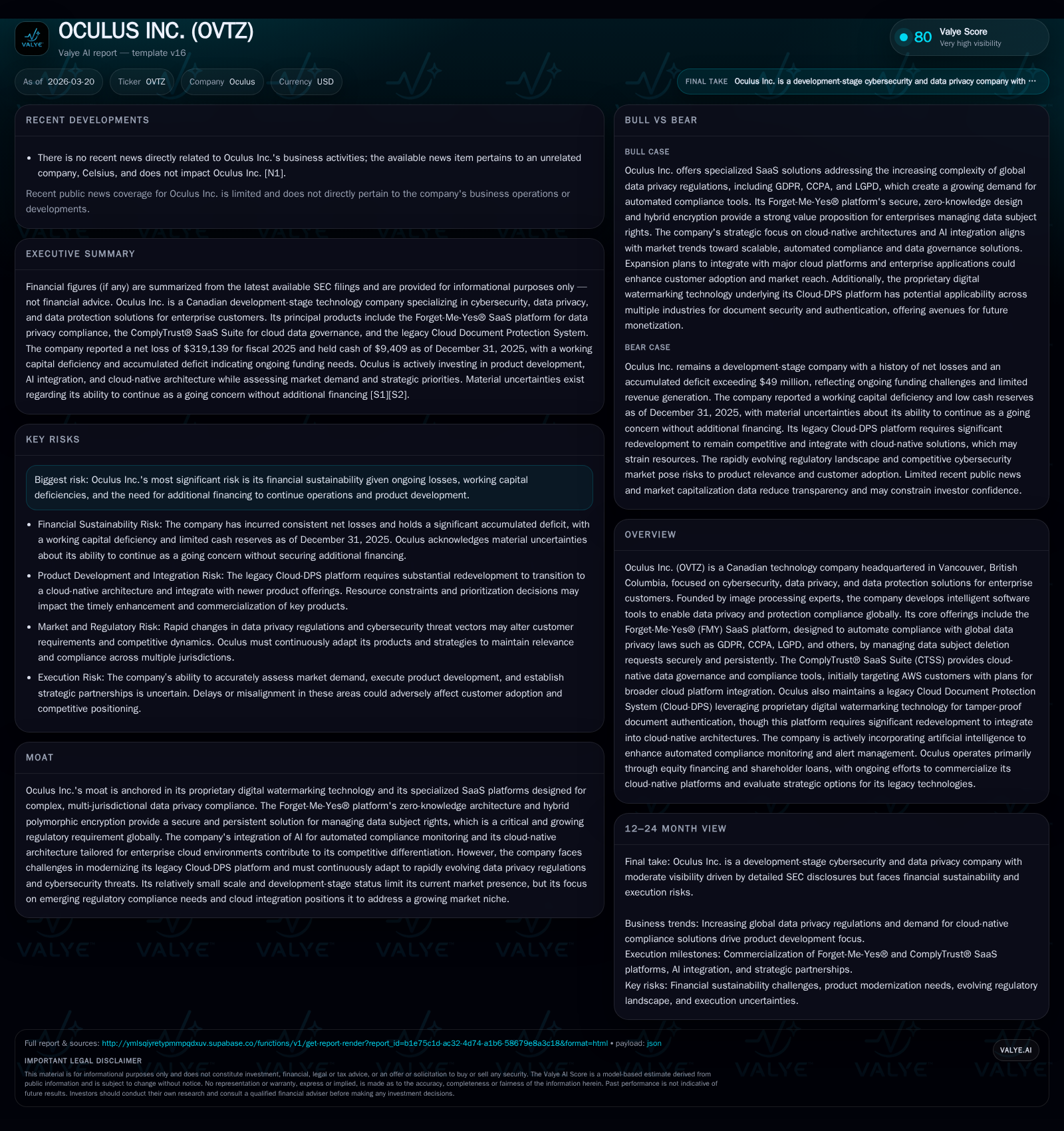
Oculus Inc. (OVTZ) has evolved from its roots in digital watermarking technology toward cloud-native SaaS platforms targeting global data privacy regulatory compliance. Despite no revenue to date and persistent operating losses, the company invests in advanced encryption, AI-driven automation, and multi-jurisdictional compliance tools like Forget-Me-Yes® and ComplyTrust®. Financially, Oculus faces liquidity challenges and a working capital deficit, requiring new financing to sustain product development and market penetration. Key milestones to watch include multi-cloud platform expansions and successful capital raises to underpin growth in an increasingly complex data privacy landscape.
Historical Performance and Growth Drivers: From Watermarking to SaaS Evolution
Oculus Inc., founded initially for digital media watermarking applications such as streaming video content authentication, has pivoted toward enterprise-focused cybersecurity solutions centered on data privacy compliance [S1][S6]. The company operates without recorded revenue since at least 2016 through 2025 [F1]. Operating income reflects consistent losses peaking around negative $2 million in 2022 before showing signs of moderation [F1]. The transition away from legacy Cloud-DPS watermarking services toward cloud-native Software-as-a-Service platforms underscores Oculus' strategic evolution amidst demanding data protection regulations worldwide.
Research & Development expenditures have diminished significantly by 2025 compared to earlier years — from approximately $6.9k in 2024 to roughly $1k in 2025 — coinciding with a slowdown reflecting completion or reprioritization of core SaaS product development [S3]. Meanwhile, ongoing increases in selling, general & administrative expenses are driven partly by marketing efforts to engage potential enterprise customers [S3].
Innovative Product Suite: Forget-Me-Yes® and ComplyTrust® in the Compliance Ecosystem
At the heart of Oculus’ offerings lies Forget-Me-Yes® (FMY), a cloud-native SaaS platform purpose-built to automate compliance with global privacy mandates such as the EU's GDPR, California's CCPA, Brazil's LGPD, China's PIPL, and multiple U.S. state laws [S1][S6][S25]. The platform uniquely implements zero-knowledge architecture and hybrid polymorphic encryption methods that secure data subject deletion requests persistently while preventing inadvertent data retention — critical features given stringent regulatory requirements around the 'Right-to-be-Forgotten' / 'Right-of-Erase'.
Additionally, the ComplyTrust® SaaS Suite (CTSS) targets enterprise clients using Amazon Web Services initially but intends broader cloud integration with platforms like Azure and Google Cloud, enhancing automated data governance and compliance monitoring capabilities [S1][S6][S25]. The legacy Cloud Document Protection System—originally leveraging real-time digital watermarking algorithms—continues as a standalone solution but requires significant redevelopment to fully migrate to modern cloud-native frameworks [S9][S10].
Competitive Differentiation: Cloud-Native Architecture Meets AI Integration
Within highly competitive ecosystems that include platforms such as OneTrust, TrustArc, BigID for data privacy management and OpenText or Varonis for governance monitoring, Oculus emphasizes its hybrid intelligence advantages [S4][S11][S17]. AI-assisted data processing facilitates automated compliance workflows and alert management reducing operational friction for clients. Its cloud-native architecture supports scalable deployment across distributed enterprise environments.
However, Oculus contends with competitors boasting greater resource allocations and market recognition. Its moat rests in specialized encryption technologies (zero-knowledge proofs) combined with tailored AI enhancements seen as distinctive but unproven at scale [S4][S17].
Financial Performance Snapshot: Persistent Losses Amid Development Stage Initiatives
Historical performance (annual)
| FY | Net ($) | CFO ($) | Net YoY |
|---|---|---|---|
| 2025 | -319139 | 6866 | +2.5% |
| 2024 | -327360 | -146542 | +44.6% |
| 2023 | -591212 | -533021 | +64.2% |
| 2022 | -1649589 | -1484369 |
Source: SEC companyfacts cache [F1].
Capital returns and efficiency (annual)
| FY | ROE% |
|---|---|
| 2025 | 43.3 |
| 2024 | 79.9 |
| 2023 | 658.6 |
| 2022 | -397.1 |
Source: SEC companyfacts cache [F1].
Operating income declines shown through FY2022; net income shows loss narrowing over recent years; operating cash flow improved markedly by FY2025. [F1]
Despite continuous product development investments, Oculus has yet to generate meaningful revenue. However, net losses have decreased substantially from peak levels observed mid-decade. Operating cash flow turned positive though marginally in 2025 after years of negative cash burn indicating early signs of operational stabilization potentially linked to reduced R&D outlays and controlled expenditures [F1][S3].
Liquidity Position and Capital Allocation
As of December 31, 2025 Oculus reported a working capital deficiency of approximately $738k alongside an accumulated deficit nearing $49 million reflecting cumulative losses over years without revenue generation [F1][S24]. Cash reserves stood at about $9.4k at year-end [F1]. Historically the company has financed operations primarily through shareholder loans and equity issuances from officers and small investor groups [S24]. No dividends or share repurchases have been declared due to the developmental stage status aligned with zero revenues and sustained losses [S8].
Management forecasts requiring an additional $3 million to $5 million in capital during fiscal year 2026 to continue operations uninterrupted; however no binding commitments are disclosed currently [S2][S24]. This ongoing capital dependency presents material risk regarding operational continuity absent successful financing.
Strategic Outlook: Growth Amid Regulatory Complexity
Oculus aims to expand Forget-Me-Yes® connectivity beyond AWS deployments toward Salesforce CRM ecosystems plus database-as-a-service providers covering both SQL and NoSQL systems [S22]. Licensing models envision API microservices enabling third-party integrations or OEM partnerships.
ComplyTrust® development targets enhanced tooling for multi-cloud environments extending beyond AWS. Meanwhile the legacy Cloud-DPS product requires significant modernization to remain viable within evolving cloud architectures [S9][S10][S15].
Global regulatory frameworks continue evolving rapidly with new statutes such as Virginia’s CDPA or Washington’s WPA adding complexity [S1][S25]. These dynamics create growth opportunities but also demand frequent technical updates.
Competitive pressures remain intense from well-resourced incumbents; Oculus’ differentiation hinges on hybrid encryption combined with AI-enabled compliance workflows under tight capital constraints.
Key Milestones To Monitor
- Completion of equity financings aligning with management's $3M–$5M funding target projected for fiscal year 2026 [S2][S24]
- Expansion of Forget-Me-Yes® integrations into additional CRM platforms and DBaaS categories beyond initial deployments [S22]
- Rollout of expanded ComplyTrust® functionality supporting multi-cloud environments beyond AWS
- Early customer acquisition announcements validating market traction beyond pilot stages
- Progress on Cloud-DPS architectural modernization or strategic partnership developments leveraging watermarking IP
Tracking these will provide insight into Oculus’ ability to convert developmental progress into commercial viability amid market challenges.
Conclusion: Balancing Innovation With Financial Realities
Oculus Inc.’s evolution from niche digital watermarking technology toward a suite of cloud-native SaaS products addressing critical global data privacy mandates illustrates technological ambition within a challenging financial context. Combining zero-knowledge cryptography with AI-driven automation offers distinct technical advantages.
However prolonged absence of revenue coupled with persistent losses underscores precarious liquidity necessitating urgent capital infusion simply to maintain development momentum. Success depends heavily on securing financing alongside demonstrable customer adoption driving sustainable growth beyond current developmental phase.
This report is prepared solely for informational purposes based on publicly available SEC filings; it does not constitute investment advice.
Disclaimer: This is research-only, informational analysis and not investment advice. It may include AI-generated interpretation and general industry context. Always verify important details using primary sources.

Comments