
Ashford Hospitality Trust Faces Refinancing Challenges Amid Ongoing Operational Pressures
Ashford Hospitality Trust, Inc. manages a portfolio of upscale hotels and confronts significant liquidity constraints and refinancing risks amid persistent net losses and negative equity.
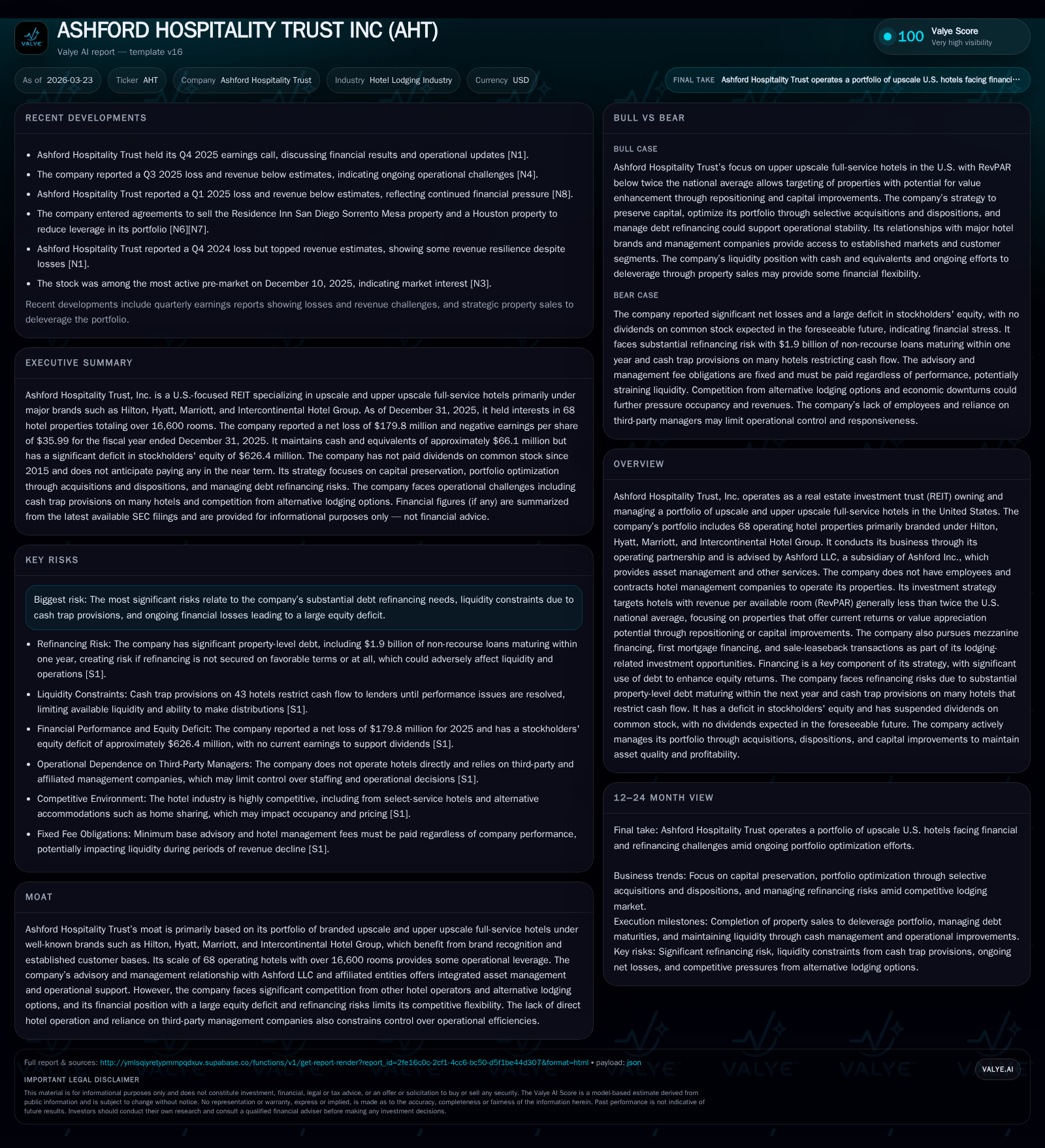
Ashford Hospitality Trust owns 68 upscale and upper upscale full-service hotels branded under Hilton, Hyatt, Marriott, and Intercontinental Hotel Group, with approximately 16,445 rooms. While operating income reached $116 million in 2025, the company reported a net loss of $180 million that year, reflecting ongoing financial challenges. With $2.6 billion in property-level debt—of which $2.4 billion is variable-rate—and substantial refinancing risk due within a year, Ashford faces liquidity pressures intensified by cash trap provisions on many properties. The company suspended preferred dividends starting January 2026 to preserve cash and does not expect common stock dividends in the near term. Its strategy emphasizes asset disposition, selective acquisitions in targeted market segments, and operational improvements through third-party management under an advisory agreement with Ashford LLC.
Company Overview
Ashford Hospitality Trust, Inc. (AHT) operates as a real estate investment trust focusing on upper upscale full-service hotels across the United States. Its portfolio comprises 68 consolidated operating hotel properties totaling approximately 16,445 rooms, primarily branded under Hilton, Hyatt, Marriott, and Intercontinental Hotel Group [S1][F1]. These assets are owned through its operating partnership and are managed by third-party hotel management companies rather than operated directly by Ashford. Remington Hospitality manages about 50 of these properties [S18].
The company's investment approach targets hotels with revenue per available room (RevPAR) generally less than twice the U.S. national average, aiming to generate returns through repositioning and capital improvements while also exploring lodging-related investments such as mezzanine financing [S1][S20].
Historical Financial Performance
Revenue data has not been updated publicly since FY2019 when it was approximately $355 million [F1]. Operating income has fluctuated markedly over recent years: from $76 million in FY2022 up to $259 million in FY2024 before declining to $116 million in FY2025 [F1]. Despite positive operating income results in recent years, net income remains negative with a loss of about $180 million in FY2025 [F1]. This reflects significant non-operating costs including interest expense.
Operating cash flow turned negative in FY2024 and FY2025 (-$24 million and -$15.7 million respectively), while capital expenditures increased notably to over $31 million in FY2025 [F1]. Consequently, free cash flow was significantly negative at approximately -$46.8 million most recently [F1]. Stockholders' equity was deeply negative at roughly -$626 million as of December 31, 2025 [F1].
Historical performance (annual)
| FY | Net ($mm) | CFO ($mm) | OpInc ($mm) | Capex ($mm) | Net YoY |
|---|---|---|---|---|---|
| 2025 | -180 | -16 | 116 | 31 | -198.2% |
| 2024 | -60 | -24 | 259 | 15 | +66.2% |
| 2023 | -178 | 14 | 130 | 22 | -27.7% |
| 2022 | -140 | 39 | 76 | 13 |
Source: SEC companyfacts cache [F1].
Capital returns and efficiency (annual)
| FY | Div ($mm) | Buybacks ($) | FCF ($mm) |
|---|---|---|---|
| 2025 | 24 | 44000 | -47 |
| 2024 | 20 | 49000 | -39 |
| 2023 | 15 | 90000 | -8 |
| 2022 | 12 | 316000 | 26 |
Source: SEC companyfacts cache [F1].
Note: Revenue figures after FY2019 are not publicly available.
Capital Structure & Liquidity
As of December 31, 2025, Ashford carried approximately $2.6 billion in property-level indebtedness with around $2.4 billion being variable-rate debt [S4][S5][S6][F1]. Refinancing risk is significant with about $1.9 billion of loans maturing within one year from the reporting date [S10]. Failure to refinance could lead to foreclosure risks and trigger change-of-control provisions incurring termination fees under the advisory agreement [S10].
Liquidity is further constrained by "cash trap" provisions affecting revenues from about two-thirds of its hotels (43 out of total properties), where profits are directed into lender-controlled accounts restricting distributions until performance improves [S11]. Total cash and restricted cash stood at roughly $216 million at year-end but much is reserved by lenders rather than freely available for use [S7][F1].
Preferred dividends were suspended effective January 2026 as part of efforts to preserve liquidity; no common stock dividends are anticipated due to accumulated deficits and REIT distribution requirements [S8][S13][F1].
Business Model & Operations
Ashford operates through an advisory agreement with Ashford LLC which provides asset management services; it does not directly manage hotel operations but contracts third-party managers [S18]. Remington Hospitality manages the majority of properties (50 hotels), while others are overseen by independent firms [S18]. This structure limits direct operational control but leverages established brand affiliations for competitive positioning.
The company's strategy focuses on owning upper upscale full-service hotels with RevPAR below twice the national average to exploit repositioning opportunities or capital improvements for enhanced returns [S1][S20]. It also pursues selective dispositions of non-core assets and opportunistic acquisitions aligned with its investment criteria [S20].
Industry & Competitive Environment
The upscale full-service hotel sector is sensitive to economic cycles impacting business travel budgets and leisure spending. Hotels catering mainly to business travelers face volatility during recessions or health crises affecting occupancy and average daily rates [S14][S19]. Competition comes from both traditional hotels and alternative lodging platforms.
With roughly sixteen thousand rooms across its portfolio, Ashford's scale offers some advantages but remains modest compared to larger hotel REIT peers.
Legal & Regulatory Matters
The company has accrued liabilities for legal settlements related to wage-and-hour class actions affecting some managed hotels totaling approximately $2.65 million allocated between cases settled by late-2025 [S17][S14]. These settlements are not expected to materially impact the overall financial condition.
Other regulatory issues include ongoing investigations related to COVID-era workforce recalls but no material losses have been recognized as outcomes remain uncertain [S14].
Outlook & Key Considerations
While explicit forward guidance is limited [N1][S7], critical factors influencing Ashford's trajectory include:
- Successful refinancing or extension of mortgage maturities due predominantly in late-2026.
- Progress on disposition of non-core assets to reduce leverage and improve liquidity.
- Operational performance trends such as RevPAR across portfolio brands reflecting broader economic conditions.
- Potential access to capital markets given suspension of Form S-3 eligibility which may hamper equity raises [S27].
- Board decisions regarding preferred dividend resumption amid ongoing losses.
- Resolution or developments concerning pending litigation or regulatory matters.
Conclusion
Ashford Hospitality Trust navigates a challenging environment balancing leverage reduction against cyclical pressures inherent in upscale hotel ownership. Its well-branded portfolio benefits from scale but substantial refinancing risks coupled with liquidity constraints pose near-term uncertainty.
Strategic emphasis on asset rotation and prudent capital deployment aims to stabilize finances; however, success depends heavily on external credit conditions and market receptivity alongside operational recovery.
This analysis highlights the importance of monitoring refinancing outcomes and asset disposition progress as key indicators for Ashford's financial health moving forward.
This report is provided solely for informational purposes and does not constitute investment advice or recommendations related to Ashford Hospitality Trust's securities.
Disclaimer: This is research-only, informational analysis and not investment advice. It may include AI-generated interpretation and general industry context. Always verify important details using primary sources.

Comments