
SolarEdge Technologies’ Growth Rebound and Strategic Refocus Following Manufacturing Overhaul
SolarEdge restructured its manufacturing footprint and product offering in 2025, achieving strong revenue growth yet continued net losses.
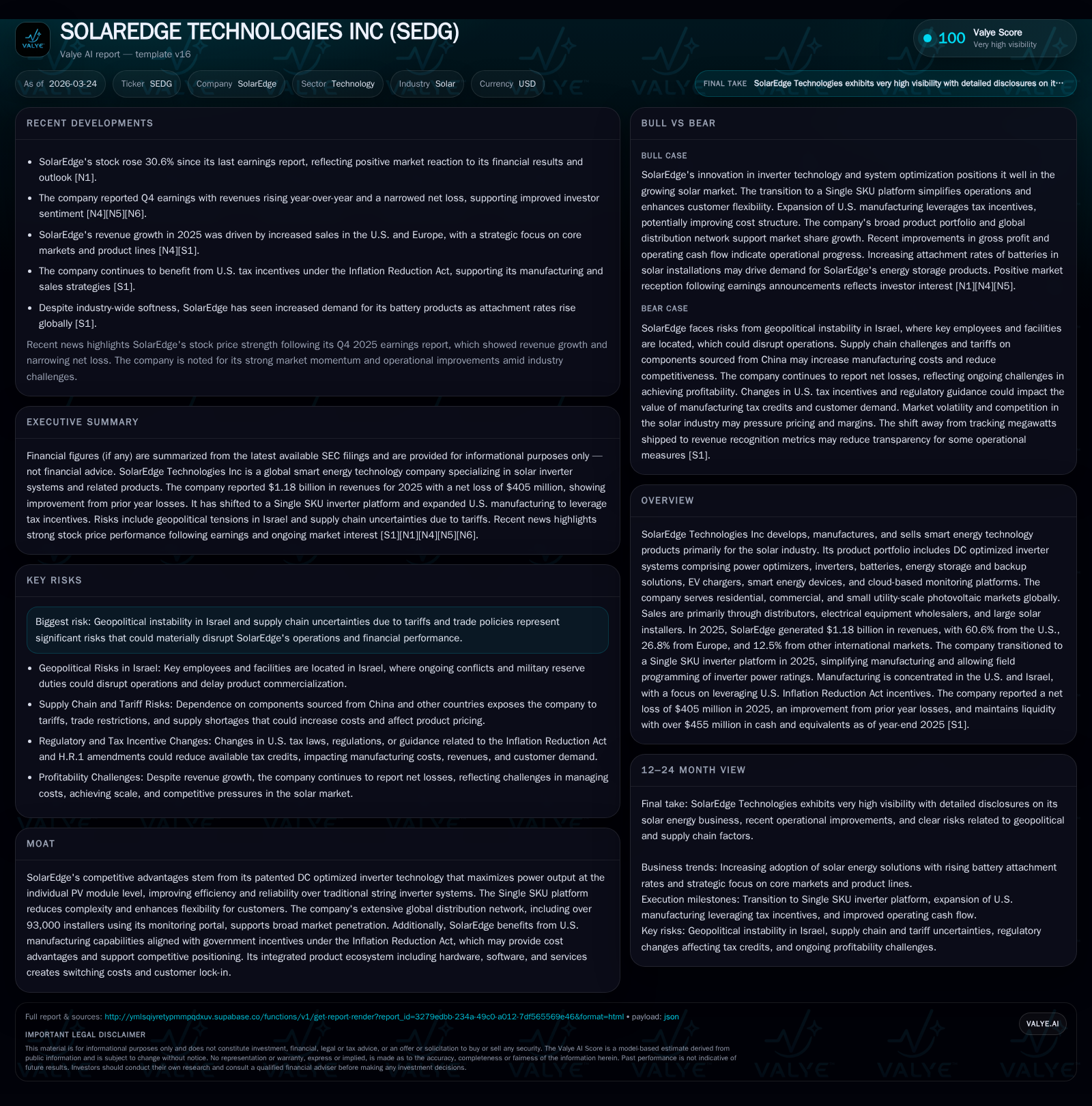
SolarEdge Technologies reported a 31% revenue increase in 2025 driven by a transition to a Single SKU inverter platform and U.S.-focused manufacturing aligned with Inflation Reduction Act incentives. While gross margins turned positive after a prior year's steep loss, the company remains unprofitable with a substantial net loss improving but still at -$405 million. Strategic portfolio rationalization targets core markets and products amid geopolitical risks centered on Israeli operations. Cash flow strengthened significantly, supporting a positive free cash flow position despite ongoing operating losses.
Company Overview and Historical Context
SolarEdge Technologies Inc is a global smart energy company specializing in DC-optimized inverter systems designed to maximize photovoltaic (PV) system power output through module-level optimization technology. The company’s comprehensive product lineup includes power optimizers, inverters, batteries, storage solutions, EV chargers, smart energy devices, and cloud-based monitoring platforms broadly serving residential, commercial, and small utility-scale solar markets worldwide [S1].
Historically, SolarEdge operated multiple manufacturing sites across Asia and Europe but began consolidating its production footprint by focusing heavily on U.S. manufacturing facilities during 2025 to capitalize on incentives introduced by the Inflation Reduction Act (IRA) [S1][S14]. This strategic move included closing factories in China, Mexico, Hungary while maintaining minor operations in Israel and third-party manufacturers in Vietnam.
Financially, the company suffered severe setbacks in 2024 with an extensive gross loss of approximately -97% largely due to elevated inventory write-downs and restructuring impairments [F1][S11]. However, following the operational overhaul and product simplification strategy culminating in the Single SKU inverter product rollout at year-end 2025 [S1], SolarEdge achieved remarkable top-line recovery.
Historical performance (annual)
| FY | Rev ($bn) | Net ($mm) | CFO ($mm) | OpInc ($mm) | Rev YoY | Net YoY |
|---|---|---|---|---|---|---|
| 2025 | 1.2 | -405 | 104 | -302 | +31.4% | +67.7% |
| 2024 | 0.9 | -1255 | -313 | -1708 | -69.7% | -3754.5% |
| 2023 | 3.0 | 34 | -180 | 40 | -4.3% | -63.4% |
| 2022 | 3.1 | 94 | 31 | 166 |
Source: SEC companyfacts cache [F1].
Capital returns and efficiency (annual)
| FY | Buybacks ($mm) | FCF ($mm) | ROE% |
|---|---|---|---|
| 2025 | 0 | 81 | -94.8 |
| 2024 | 50 | -421 | -190.6 |
| 2023 | -351 | 1.4 | |
| 2022 | -138 | 4.3 |
Source: SEC companyfacts cache [F1].
Table notes: Gross margin swung materially from loss to profit between years; net losses remain high though improved; operating cash flows shifted positive.
Drivers of Past Growth and Performance
The rebound in revenue for fiscal year 2025 reflects several critical developments:
Single SKU Platform: Transitioning all inverter products to a software-definable Single SKU platform meant one physical inverter could be programmed post-installation for specific kilowatt ratings [S1]. This innovation reduced manufacturing complexity, improved customer flexibility for future system upgrades, and streamlined supply chain logistics.
Manufacturing Relocation: By relocating nearly all manufacturing to U.S.-based facilities—specifically Texas (inverters), Florida (optimizers and inverters), and Utah (batteries)—SolarEdge positioned itself favorably to benefit from IRA incentives which encourage domestic content in renewable energy products [S1][S14]. This helped reduce tariff risks tied to imports from China or other locales.
Focus on Core Markets: The company rationalized its portfolio by concentrating on regions demonstrating strongest growth potential while discontinuing activities in select countries [S1][S5]. This focused approach allowed sharper resource allocation toward top distributors and key installers.
Product Portfolio Evolution: Launch of the next-generation residential product "SolarEdge Nexis" late in 2025 alongside expanded commercial energy storage offerings underpinned technology leadership efforts [S1].
Improved Cost Controls: Reduction of workforce by over 500 employees trimmed R&D personnel expenses by approximately $41 million year-over-year contributing to lower operating costs [S11][S12]. Furthermore, large inventory write-downs incurred in prior year dropped significantly.
Despite these positives on revenues and gross margin gains (16.6% gross profit vs negative prior year), accumulated restructuring charges and prior goodwill impairments continued weighing heavily on net profitability resulting in a $405 million net loss for the full year—though notably smaller compared with losses exceeding $1.25 billion during 2024 [F1][S11].
Future Growth Prospects and Risks
Growth Catalysts:
- Continued adoption of SolarEdge’s innovative DC optimized inverter systems that provide higher efficiency over traditional string inverters thanks to module-level maximum power point tracking.
- Expansion opportunities include broader penetration into smart energy device markets such as EV charging infrastructure and enhanced grid services like virtual power plants leveraging their cloud-based software platforms.
- Increasingly favorable regulatory environment under U.S. IRA promoting domestic manufacturing serves as both cost advantage and barrier against less compliant competitors.
- Ability to scale commercial energy storage solutions especially through advanced CSS-OD units could open larger project opportunities requiring scalable megawatt-hour level battery deployments [S1].
Potential Constraints:
- Geopolitical uncertainty related to ongoing conflicts impacting Israeli facilities or workforce remains an unsettling factor given majority of senior technical staff reside there; disruptions could delay product development or hamper key manufacturing capabilities at Sella plant [S8][S20].
- Supply chain fragility caused by dependence on select components primarily sourced internationally—especially where tariffs or trade tensions with China exist—could raise costs or cause shortages impacting delivery timelines [S14].
- Concentration risk exists with one major customer responsible for nearly one-fifth of revenues; loss or diminished demand from this client could disproportionately affect business volumes [S10][S18].
- Competitive pressures intensify as more players invest aggressively into smart inverter technologies requiring sustained R&D investments even amidst cost rationalizations [S12].
Financial Milestones To Watch
While explicit forward guidance was not provided [N#], key indicators investors should monitor include:
- Adoption rates for SolarEdge Nexis residential platform following initial deliveries at end of 2025.
- Commercial deployment scale-up trends for advanced energy storage systems like CSS-OD.
- Margins recovery trajectory excluding impacts from Advanced Manufacturing Production Tax Credits (AMPTCs), which temporarily supported gross profits last year.
- Progress expanding installer base beyond current ~93,000 accounts globally using SolarEdge monitoring software portal.
- Effects of geopolitical developments or supply constraints relating to Israeli operations or Sino-U.S. trade relations.
- Capital spending trends post automation investments as indicated by reduced capex spend from $108 million (2024) down to $23 million (2025) signaling maturation of factory technology base [F1][S15].
Capital Allocation and Returns Profile
SolarEdge currently operates with negative returns on equity given ongoing net losses—approximate ROE stands near -94.8% due to recent impairments overshadowing earnings improvements [F1]. Despite this backdrop:
- The firm generated positive operating cash flow of $104 million during fiscal 2025 marking a significant turnaround from negative cash flows exceeding $300 million previous year—reflecting improved working capital management and operational leverage benefits post restructuring efforts.
- Capital expenditure dipped sharply representing nearly a fifth of prior year spend indicating near completion of major capacity build-outs or automation projects—a move that supports free cash flow generation evidenced by roughly $81 million positive free cash flow after capex deduction [F1].
- No share repurchases were recorded following buybacks totaling nearly $50 million in fiscal 2024 suggesting preservation of liquidity amid uncertain market conditions [F1][S27].
- Liquidity metrics are sound with current ratio above 2x supported by over $450 million cash equivalents providing runway for continued investment cycles or absorption of short-term shocks [F1][S15].
Management’s emphasis appears oriented toward operational stabilization over aggressive capital return strategies until consistent profitability resumes.
Industry Positioning & Competitive Considerations
SolarEdge remains distinctive within the solar technology sector due predominantly to its patented DC optimized inverter architecture allowing module-level power harvesting—a technical advantage that enhances overall system ROI relative to conventional string inverter configurations widely used by competitors. The Single SKU platform further differentiates their solution by offering unique backend programmability simplifying inventory logistics across diverse geographies.
However, competitive intensity continues escalating as incumbent inverter manufacturers integrate smarter control capabilities while new entrants seek traction with hybrid hardware-software packages targeting residential-to-commercial PV segments increasingly merging with grid-edge technologies such as VPPs and IoT-enabled home energy management systems.
The firm's embedded distribution network comprising leading wholesalers, EPC contractors, and installers globally backed by robust training programs including Edge Academy promotes high switching costs among its downstream partners bolstering defensibility against commoditization pressures.
In markets outside North America—particularly Europe where regulatory frameworks differ—the challenge lies in sustaining growth momentum amid fluctuating government incentives and adapting solutions compatible with variant grid codes.
Risks Summary From SEC Filings & Recent News
Material operational disruptions remain plausible due primarily to geopolitical instability surrounding Israel where core R&D personnel reside along with some manufacturing capabilities. Although no direct impact was reported through end-2025, any escalation could delay product development pipelines or create bottlenecks jeopardizing fulfilling commitments during critical growth phases [S20][S21].
Supply chain dependencies expose vulnerabilities linked to trade policy changes particularly tariff escalation on components imported mainly from China creating cost inflation risks requiring continuous adjustment efforts including supplier diversification initiatives which are not guaranteed successful nor cost-neutral [S14].
Customer concentration risk persists accentuated by dependency on few major solar distributors whose contracts lack long-term purchase commitments potentially amplifying revenue volatility if demand weakens or competitor offerings prevail within chosen channels [S10][S24].
Technological obsolescence is an ever-present threat given rapid innovation cycles demanding sustained R&D focus balancing against cost containment measures implemented recently [S12]. Furthermore intellectual property protection challenges through litigation risk add uncertainty although SolarEdge maintains an extensive portfolio globally allowing firm leverage should enforcement be required [S21].
Conclusion
SolarEdge Technologies made meaningful progress reversing prior years’ severe financial deterioration primarily via strategic refocus emphasizing U.S.-centric manufacturing leveraging IRA benefits alongside innovative product simplification embodied by the Single SKU platform driving top-line resurgence plus gross margin recovery. Operational improvements resulted in positive operating cash generation supporting ongoing business stabilization despite underlying net losses remaining significant at present. Future outlook hinges critically upon sustaining momentum expanding core product adoption within target geographies balanced against persistent geopolitical risks associated mainly with Israeli facilities whilst navigating tightening component sourcing environments influenced by evolving trade regimes. Continued investments into next-gen product development coupled with scaling commercial storage offerings will be essential levers affecting medium-term performance dynamics within increasingly competitive global solar technology markets.
This analysis is based solely on disclosed financial data, SEC filings through March 23, 2026, and publicly available news as cited; it does not constitute investment advice.
Disclaimer: This is research-only, informational analysis and not investment advice. It may include AI-generated interpretation and general industry context. Always verify important details using primary sources.

Comments